> In 2015, Nobel laureate Prof Tim Hunt resigned from his position at University College London after telling an audience of young female scientists at a conference in South Korea that the "trouble with girls" in labs was that "when you criticise them they cry".
Why was this mentioned, right at the end of the article? Also, the author conventiently ommitted that Tim was joking, the audience laughed (i.e. got the joke) and the joke was about his wife, whom he met in his lab.
In addition, the article doesn't even try to substantiate or explain why CERN considers the presentation as "highly offensive" - facts can clearly be wrong, but can they be offensive?
A fact is not offensive, but can be used offensively in an offensive argument. By some school of logic - so I learned recently but forgot what school that was - an argument consists at least of premises and conclusion. If the premises is underspecified, the conclusion can be wrong even if the premises is factual. That is, the correlation suggested by the data might not lead to the conclusion when more data is considered. The fallacy here might be post hoc ergo propter hoc (a term I also learned only recently).
He was basically arguing outside of his field of expertise. I'm not inclined toward gender studies either, but if addressing their conclusions, that women are confronted with unintentional bias, then that argument needs to be taken up. The career argument is the premises, not the conclusion.
Edit: If there is a bias, that would necessarily show up in statistics. Even if the initial data point doesn't show that bias. If there are two data points, one showing bias, one not, that's simply not enough to draw a conclusion either way. A physicist should know that. Anecdotal evidence of course does not count as additional data point.
- The guy presenting this might be wrong.
- He may be an asshole and/or have resentful intentions with making this presentations.
However, none of the people who disagree with him in this article engage with any of these things. They're just angry that he's saying this at all! Their upset emotions seems to be the only case against what he's saying.
- Private corporate memos written after feedback was explicitly requested
Probably others.
The same thing was said in every case: "it's not the right forum, it's insensitive and without empathy".
How incredibly surprising that there doesn't seem to be any right forum or right time for expressing opinions about anti-male bias. Somehow it's always offensive and it's always terrible that women were upset.
It looks almost as if some people want to shut that conversation down wherever it happens.
It seems as if that conversation was part of the bias in the first place, so there's two sides of the same medal.
One right place would have been the room where the anti-male/pro-female responsibility was decided. Now that the decision is through, it's just bickering and not constructive to oppose it, ignoring it denigrating it in public as if that was outside the assumed responsibility for the forum (the institution).
I can't speak for the libertarians and how they respond. I think a libertarian blog is the perfect place for it, and I'd have happily engaged in a debate, just like I am here.
I was very outspoken in the wake of James Damore being fired from Google, because I think there was a reasonable narrative in there somewhere, even though some of the science was flawed. I still don't think firing the guy was the right response. To my mind his ideas were respectfully presented and weren't phrased in absolutes. There could have been a great conversation around gender in Google as a result.
But this is different to that. This is somebody writing off a large group's experience, supported by poor science, in an area he knows nothing about, at a conference for the express purpose of supporting women. I don't want to shut down conversation, but I sure want to condemn people who can't be respectful of others.
Upsetting anyone? Probably not possible, and probably not desirable. There's always going to be people getting offended when you state a controversial opinion. But of course you can minimize the offense, and it doesn't take much imagination to think up a better option than a conference designed to support women. Blogs/journals/conferences not specifically for supporting women/editorials/radio shows/record a podcast. Write a manifesto for crying out loud.
His findings? A request for comment to the "Frauenbeauftragte" (gender equality officer, women's affairs representative, whathaveyou) or a prof of gender studies would have given a chance to compare his results to others. It's not exactly a master thesis or anything.
I think the selection of studies was somewhat myopic, and I thought his reasoning was flawed, so I'd change that.
But honestly I wouldn't have so much of a problem if he presented the same thing anywhere other than a conference for encouraging women into science. If I were any one of those women, I would have walked away discouraged and hurt.
Galileo maybe isn't the best example, since his reputation seems to (as I understand it) be massively overblown in an enduring myth.
But I think the question you're asking is: am I critical of him because it's fashionable today to push feminism with blinkers on? And would I still do so in 50 years, if today he sparked a mens' rights revolution?
Let's not assign this guy mythical status preemptively. There have always been loud points of view; some of them haven't held up with time, others have. We usually forget the ones that haven't, unless they managed to really hurt people along the way. To put it another way, just because you take a loud contrary position on a political or social issue, doesn't mean you're right.
I actually do applaud him for standing up for something, but my admiration only goes that far. You can present your point of view while trying to minimize the collateral damage. You can also be aware of your own fallibility.
If Galileo burst into Catholic prayer to proclaim the church was wrong and he was right, yeah, I'd call him a bit of a dick. What does he hope to achieve, by choosing the forum that is most disrespectful of others?
Considering the prevalence of the church and its properties at the time, there really was no “correct” forum for Galileo to promote his findings - everywhere is disrespectful! He was pushed out of every forum he went to.
This guy has the same problem - you will always just tell him he’s in the wrong place.
Well no. You're assuming a lot about me. I've expressed an opinion on exactly one place which I think is wrong.
You're probably right Galileo didn't have a platform, but you're the one drawing that comparison, not me. Do you really think he has the same problem, in the age of the Internet? In another comment below I've suggested other, more respectful, platforms: "Blogs/journals/conferences not specifically for supporting women/editorials/radio shows/record a podcast. Write a manifesto for crying out loud."
None of these “facts” refute the hypothesis that “physics is built by men” because that’s who has been allowed into the field to date. For example, the points about citations can be explained by the fact that male authors are much more likely to cite themselves, and the fact that social networks play a role in how often works are cited: https://www.sciencemag.org/careers/2017/05/female-authors-ge.... It also ignores that the citation gap has narrowed dramatically over the past decades, which is the opposite of what you’d expect if measures to admit more women into the field led to underqualified women entering the field.
This ia just lazy reasoning from people who should know better.
You either have to believe that there is a meritocracy and that it's under attack by an unnamed mob of truth-haters or you have to believe there is a pattern of shitty behavior (against women in this case) that people are--sometimes clumsily--trying to rectify so that anyone with a contribution to make to physics (or computer science, etc.) gets a decent chance at it.
Right. The thing is that there's gender disparity going in the other direction as well, fields that pay well and are well respected but that are dominated by women. Nursing being an obvious example.
Any theory that explains why physics is gendered should also explain why education is also gendered. It's unlikely that those two fields ended up with skewed gender ratios for completely different reasons.
So, why do you think psychology, education, and nursing are all female dominated fields?
If it was simply a pattern of shitty behavior, what I would expect is some fields that women obviously don't have access to, and a more or less even gender ratio in all the other fields.
What I'm seeing instead looks a lot like gender ratios are a gaussian distribution, which I don't think fits your hypothesis that the gender ratios are caused by "a pattern of shitty behavior". That probably is a co-factor, but it doesn't explain the female-dominated fields very well.
Interesting, but I think this flirts a little too close to the fallacy that this goes both ways equally. In your examples of nursing, education, and psychology I would suggest that a man in each of those fields is actually advantaged compared to his female peers, even if he is outnumbered significantly. The same is not true for women in many of the well-paying fields in which they are underrpresented.
So, just from a very high level consideration of what is the most important thing to focus on, I still think shitty behavior is it. There is no better use of time than reading and reflecting on what shitty behavior is and then building up the bravery to call it out daily. That is hard, critical, adult work.
So why do you think the female dominated fields are female dominated?
I'm not trying to do the false equivalence thing here, or saying "what about the men". I'm certainly not saying "well men have it bad too".
What I am saying is that male-dominated fields and female-dominated fields both likely have the same root cause, and any hypothesis that explains one needs to explain the other. Well, plus or minus some co-factors.
So, how do we explain this data? If you're looking for the answer that makes this men's fault, you could pretty easily say that men don't enter those fields because it doesn't live up to their self-image. That definitely avoid the "fallacy that this goes both ways equally" while still having one root cause for all the data.
But that's a pretty lazy answer in my opinion, and doesn't fit with the data I've observed. Can you come up with a few more hypothesis that explain both male and female dominated gender ratios?
I'm just guessing, and I get the sense that you're open to that, so bear with me. I think the fields have sorted out by gender because of intrinsic interests/tendencies, cultural expectations (to your point about self-image), pay (women often can afford to make less while their spouses make more), and finally the systems that naturally come about which enforce those things.
I do think men bear most of the responsibility, and that's largely historical (men controlled the money) and partly because of the sex dynamic.
For my part, I think men, including myself, just have a long way to go to treat women fairly in the workplace. After that, my #2 focus is why "women's work" pays less. Elevating the economic worth of care jobs and such is another great societal discussion that needs a lot of attention.
I'm by no means an expert, so I'll definitely bear with you. But your hypothesis more or less matches mine. I do think you underestimate the amount of sexism men experience in nursing and child-education.
Now my problem is that gender ratio is the key metric we seem to be using to measure sexism in STEM fields, and I don't think any policy is going to fix that. We can try and mitigate cultural expectations, but if those cultural expectations are grounded on intrinsic interests, we're going to have a very hard time getting rid of them.
I think you really need to examine your idea that "men bear most of the responsibility". Men always bear most of the responsibility, and that's one of the oldest stereotypes. Men are generally considered to be more responsible for their own actions then women are. I think it's why they get longer prison sentences for the same crime. If you're not an object, you're a subject.
So why do you think men bear most of the responsibility, aside from historical precedent? Are men best situated to fix these problems?
I will note that a lot of new programmers are indian or asian men, which implies to me that tech is pretty good as far as racial discrimination goes. It certainly seems like a welcoming environment for those visable minorities. Or at least more welcoming then most of the alternatives.
Besides the history and baggage of patriarchy, men bear the responsibility because women still run into double standards of behavior (not allowed to be angry, critical, etc.), inequity of where they can comfortably hang out, and men are more likely to objectify women because of sex interests. Now those are just tendencies and many men do a great job working against them, but they are a massive part of a woman's experience in the workplace and I think men checking other men is the highest priority.
This story is illustrative, I think, and helps me think about women out in the world. My wife went into a bar in DC recently which at that moment was entirely men (imagine 20-30 middle aged male, DC professionals socializing, and they might have been colleagues), so when she ordered a drink, she took it outside. Outside there were two more woman and a tatted up male. What do you think would have happened if she had sat at an empty booth inside? What if she were me, and I'd sat at an empty booth inside? I think she would either been ignored OR one of those men would have seen her presence as an invitation. They would not view my presence as any sort of invitation. Small, fun example, I think, of the work men need to do.
What do you think is wrong with approaching a woman in a bar? After all, it's not a professional space, and she can always leave (as she did) or say "no thank you". Personally, I don't think there's anything men should change in this situation (as long as they're being respectful and non-annoying). If you went to a gay bar, I imagine the effect would be the same (nothing wrong with that either).
Also, thanks (both of you) for an interesting thread!
if you have a smaller set, and an equivalent distribution, smaller width of the bell curve is proportional to its hight.
> I do think men bear most of the responsibility, and [...] partly because of the sex dynamic.
Indeed, but group dynamics within the sexes are a factor, too, so the hypothesis would be incomplete without other closely and tangentially related aspects. Otherwise, if sexual attraction was the strongest drive, you'd have to expect male lab heads preferring female companions. Whereas, ironically, the opposite would have to be called sexual distraction. What do you make of that?
Male nurses are stronger and sometimes perceived as lower drama. Male teachers bring balance to classrooms; lots of kids respond better to one gender or another, so it helps a school to have some male teachers on staff, and yet they're harder to find.
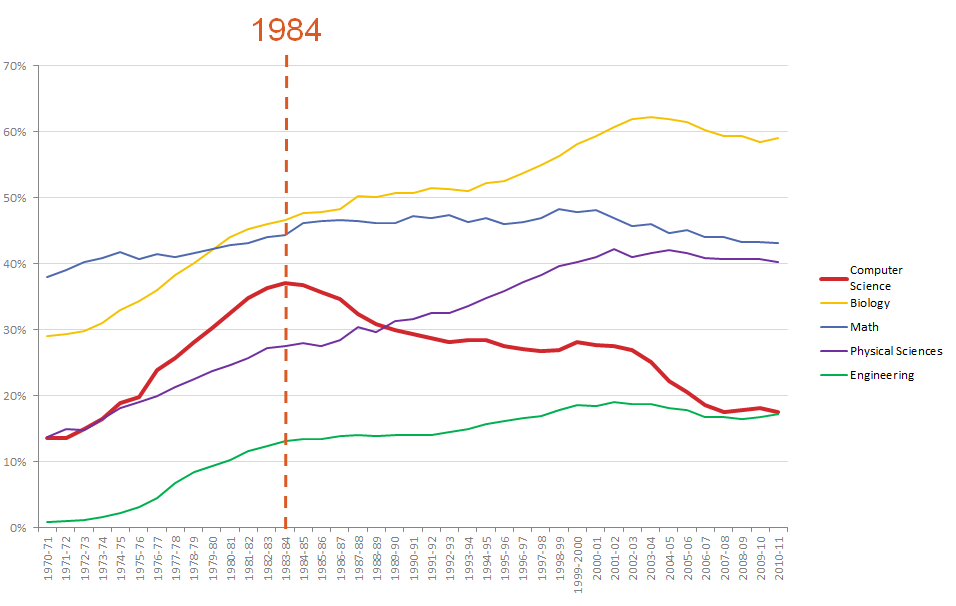
I'd love to agree with you, but the science provides us[1] with a clear trend: the freer the women and the more equal they are culturally and legally, the lower their participation in STEM. That doesn't agree too well with the "shitty behavior" scenario, putting me in a "we need a better explanation with more predictive power" camp for now.
Not exactly, because I'm not saying we must have more women in STEM at all costs. I'm saying we need them if they want it and will contribute. If the women are truly empowered and being treated fairly and then choosing against STEM, fine.
Way too early in the process to be faulting that measure, because the ratio is so far out of whack. When its not way out on the bell curve somewhere, then its reasonable to fault the metric.
Only if enforcing quotas is the only solution put forward. But realistically what's happening is that girls are being offered lots of STEM enrichment down into elementary school now so we'll know soon enough if they decide to pursue those fields.
Again, that's arguably unlikely. The stats are so far out of whack. In fact, the argument sounds like an attempt to paper over an uncomfortable problem. I'd think hard about motivation before going down that path.
That stats aren't more out of whack then the stats of psychology or education. STEM and education have very similar gender ratios, and it gets less gendered if you just focus on the T in STEM.
There are plenty of female-dominated fields with similar gender ratios as what you see in STEM. Do you think sexism is a good explanation for those female dominated fields?
Of course. Folks go where they're welcome and can make a difference. Its all part of the culture. It can all be changed. The mistake is in thinking its somehow hardwired, or dwelling on who's fault it is.
We can all help make our area more welcoming, by removing pointless obstacles and by refraining from casual bias.
There are female influencer making lot of money on Instagram by posting photos of their bodies, makeup kits, outfits etc.... who are making way more than median pay in STEM career.
I don't understand why would any woman choose STEM when batter paying gigs are available to them.
> Maybe because Instagram millionaires are about as common as sports millionaires?
If you enjoy it, that's good. But not everyone enjoys it and that's why STEM has lower praticipation from females and that's what we are discussing here.
I didn't say millionaire anywhere. Many modeling gigs pay more than entry level median salaries in STEM.
It's about efforts vs reward.
People in STEM require years of education compared to posting a product review on Instgram which doesn't even require a high school certificate.
Don't compare it to Pro football players either which is very risky and requires years of training and money.
Too many of the people trying to solve the gender imbalance in STEM are ignoring the fact that girls and women just don't pick STEM (biology/maths excluded) at A-level or degree level and want to fix it by tipping the scales when it comes to hiring in the hope that will encourage more girls to follow STEM career and "fix" the problem instantly.
The problem isn't that women are overall disadvantaged when it comes to getting hired in STEM, it's that women are not choosing STEM careers.
You could argue that too many men in the workplace will put women off following that career, but I really doubt that is the only significant factor at play here.
Because of intrinsic interests/tendencies, cultural expectations, pay (women often can afford to make less while their spouses make more), and finally the systems that naturally come about which enforce those things.
What problem exactly? I'm definitely not going to try to solve the "intrinsic differences in interests" problem.
That "women's work" tends to get paid less then "men's work"? Well I'm not sure how true that actually is, but I'd recommend using unions. I'm presuming that part of the reason why "women's work" tends to pay less is because women, on average, are less comfortable negotiating. Using collective bargaining is the obvious way to fix that.
If you're running a convenience store and your customers purchase 65/35 apples/oranges, how would you solve a "problem" of getting them to buy 50/50?
Nowhere in real life do we see an equal representation unless it's enforced artificially.
If I told you that hispanics outnumber asians majoring in History 8:1, but asians outnumber hispanics majoring in Chemistry 10:1, then how would one solve that? Does that need to be solved?
Two reasons: 1) Women make less than men often because of career choices. If they make that choice because of shitty behavior in well-paying industries, then we have an injustice on our hands. 2) Underrepresentation of any group puts them at real risk of policies being made against their interests. Imagine a men’s family rights law office staffed only by women. I wouldn’t trust that for best representation. Also see the CA board rules about female representation just announced.
I didn't down-vote you, but a few refutations: (1) shitty well-paying jobs are a fact of life, men often have to (and do) deal with that (e.g. oil rigs, finance, doctors, soldiers). STEM isn't even that well paid (compared to medicine or law) (being a soldier is shitty pay also AFAIK). If you're bent on solving this problem for women only, that's pretty sexist; or is this just the specific instance of this problem where you see most potential upside (unlikely IMO). (2) We're talking about jobs, not policy here. Also, the market adapts - you would just use a different product, a different law office! Are you worried about our tech being "too Asian" because of their over-representation?
Because there are way easier opportunities than STEM. How many men go into STEM because they were interested in the field vs for a well paying job?
It’s socially acceptable for females to marry a rich guy and be a stay at home mom. I would say some women prefer the traditional route of raising kids full time so that should reduce the number of working women.
I lean towards the former, although a more charitable interpretation would be, it's under attack by people who have different values (i.e. they value diversity/proportional representation/equality of outcome more than they value meritocracy).
Or one might believe the world is not black and white, nor even shades of grey, but is, instead, in living glorious technicolor and the truth is a hair more complicated than such discussions would like it to be for the purposes of conveniently lining people up on two sides and trying to decide which one is right and which one is the villain.
We live in a post truth world. Instead of accepting men and women as complementary we're forced into "competition", yet another way of dividing society.
He also said that he himself was overlooked for a job that he was more qualified for, which was given to a woman.
So, basically, he got burned -- or feels he did -- and he wants justice of some sort. Which is not unreasonable per se, but this is not really the way to go about trying to get that.
Good on this guy for speaking some truth, even if he faced flak for it all around. He had the statistics to prove it, and he was discredited. He had the anecdotal experience to back his story, and he was discredited. By daring to say that people should be admitted based on merit and not given free passes into the field based on gender, he was lambasted. There was no rebuttal, the only responses were basically 'I don't like what he said'.
Let's just ignore whether this guy's arguments are valid or not for a second, why, why would you present them in a room full of young, presumably aspirational, predominately female scientists at a conference focussed on getting more women to science? You can question whether such a conference should exist, but this isn't the way to make your point. Particularly when bringing up studies suggesting women like working with people and men like working with things - all those women in the room seemingly don't fit into that reductionist rule, so it's irrelevant in the context at best, and flat out wrong at worst. He's not a crusader, he just seems like a bit of jerk.
> given free passes into the field based on gender
Free passes aren't given based on gender, though preferential treatment might be given as part of an affirmative action program. Personally I think that is absolutely necessary, in all of STEM, because I believe there is a structural imbalance in our society against women. I'm open to the idea there isn't, and there are immutable biological differences at play, but unless we do something meaningful to correct the societal factor we'll never know. But it's super easy to say there's no chance of that and we should treat everybody totally equal, when you're not the one with the disadvantage.
As to his arguments, so much of the evidence he points to can be shaped by the same societal forces he is trying to dismiss. "I made some simple checks and discovered that it wasn't, that it was becoming sexist against men and said so." Anybody who thinks they can unravel this in a evening on google is arrogant, and totally wrong.
> speaking some truth
Real scientists don't talk in terms of absolute truth, they deal in scientific consensus given the available evidence. Please consider being less dismissive, when almost 50% (and in some ways, 100%) of the world's population is affected by how we view and respond to gender.
What if they are the same. Is that really an issue? Poor children get a "Free Pass" or (preferential treatment) by going to school for free. Seems like the right thing to do to me because their experience should not be decided by factors they can't control (in this case the financial situation they were born in). Same with gender "Free Passes" if one accepts the premise that it is a disadvantage to be born a woman and want to make it in STEM. If one does not believe that (meaning they were not convinced by the evidence), then that's another discussion and the debate is open.
I take free pass to imply you don't have to do anything. Preferential treatment is more like - this person is good enough to do the job and do it well, and they have a background we want to support so that's an extra positive.
I was once passed over for a job, and I somewhat knew the female candidate who got it. We were equally qualified, and I may have been slightly more experienced. I think it's likely that was preferential treatment (I could be wrong, maybe they just liked her more, maybe it was arbitrary). I think that's awesome. I most definitely wouldn't call it a free pass.
Thank you, OED. Would you call a concession ticket a free ticket? Pretty sure one means a discount to account for other personal factors, and the other means... free.
The rebuttal is “these facts were cherry-picked to support the author’s interpretation of observable events.”
From the article:
“He also said that he himself was overlooked for a job that he was more qualified for, which was given to a woman.” If we start with a hypothesis of equal capability, his graph shows that women are being passed over for career opportunities in favor of less qualified men more often than the reverse is true. Facts don’t lie, but with subjective context they can be used to tell stories.
It would be nice to see other scientists contrasting his data points and trying to reconcile why male scientists are able to see this yet everyone does not. If its a fallacy, then help these male scientists see the facts. Why isnt the media presenting the data that refutes his facts! A lost opportunity.
We are burning someone at the stake for their ideas in the science community. If he is wrong, so be it. But to burn and punish him because of his research and ideas is taking us back to the dark ages.
Due to the media reaction of this, I guarantee we're missing out on significant amounts of research that could cause offense in many areas of society. Today anything to do with the lottery of life (your race, your sex, inherited genes) is nuclear and career ending if it doesnt fit a popular narrative.
This constant "Men vs. Women" narrative really doesn't make any sense to me. I've always seen people as just that, as individuals, with strengths and preferences that will most likely decide what they will work as. Making everything about gender just annoys me, no matter who does it.
Was physics built by men? Sure, probably because women weren't allowed to, or maybe they really didn't want to, who knows. But this outrage isn't about those women in the past who could have made it big, is it? It's about the present day situation where gender is not a deciding factor (or a factor at all) in who is allowed by society to do what.
I've always seen people as just that, as individuals
The problem is that there is lots of research indicating that while many people will swear up and down that this is what they do, in many cases it subconsciously isn't the case.
Had you asked me two years ago or so I would have absolutely sworn that I was no way biased with regards to gender, but about a year and a half ago I started to seriously introspect on these issues, specifically trying to focus on my subconscious actions and running through past interactions, and now I honestly don't feel confident claiming that anymore. I obviously never actively discriminate and try to be aware of my action, but the subconscious is a hard thing to control.
Sure, everybody is biased in many ways. I am not claiming I don't have any bias, but those become irrelevant if you make an effort to decide things rationally. And in my opinion, when judging other people, we should always make sure we're basing our decision on rationality, not what feels better to us.
This obviously requires some work to train yourself to notice when you're lying to yourself or making up reasons to go with the decision that feels better when you should really know it's not the correct one.
Definitely not as overtly prohibitive as in the past, but still we have workplaces/systems/hierarchies which aren't as inclusive for men as they are for women. e.g.: you won't find many women on the trading floor, but I'm pretty sure there are a lot of women out there who would enjoy making a shit ton of money in a high-risk environment. However the treatment of women there is notoriously bad. It's not the job women don't want, it's the toxic environment which goes along with it.
I'm inclined to believe that those jobs are equally as toxic towards men as to women. This is purely based on my personal experience, but to me it seems as though men just grow more used to the typical male-to-male bullshit (pardon the expression) while growing up, so they can more easily just deal with it. Also, consider that it isn't enough that women want those jobs, there needs to be lots of women who want those jobs. If the set of people who 1. want those jobs and 2. believe they are capable of achieving them contains less women, then the subset of those people who are good enough to get those jobs will also contain less women.
Now, combining the factors that 1. girls are often confronted with an image of men being good at the sciencey stuff and women being better at caring for a family and 2. to women it's much more viable to instead attempt to get married to a man with one such high-paying job\, it makes sense that less women would attempt to get into those positions.
\ And I am not trying to say that's something only women do, but something men would probably do just as much if it was available to them.
Noone is opposing the argument "reduce bullshit" (we're just pointing out it's unrealistic). But the argument "reduce bullshit because women" is simply sexist.
Would you say that women greatly outnumber men in university because the environment is toxic to men, there are systematic hierarchies holding men back, or men's preferences lead them not to attend?
I don't think it deserves to be flagged - even if the opinion the person holds is unconventional.
OT: He does say his conclusions might not be fully right. But that the assumption of identical brains is ideology. Now, I agree with this but it does not mean one is better than the other.
The fact that women might produce _less_ output (as shown in the stats?) does not mean they produce less valuable work. They might just get their priorities different later in life, as opposed to men.
But again, those are generalisations and you probably should not try to generalize these kinds of things to apply to _all women_.
It was also not the right place to make those comments I think.
Yeah the second thing is the problem... You also often see like 100 upvotes and 300 comments and many comments downvoted... HN algorithms recognize such articles/threads as "flame wars" so they demote (but not flag) them.
If you're going to lob grenades, own it instead of hiding behind "but I might be wrong."
The math/science magnet high school I attended is now predominantly Asian, in an area that's predominantly white. My hypothesis is that Asians are better at math/science than whites. But I could be wrong! At the very least, the "assumption of identical brains is ideology." /sarcasm
^^^ Do you think that's a useful analysis of the situation, or is it unnecessarily inflammatory given the shaky reasoning underlying the point?
> My hypothesis is that Asians are better at math/science than whites.
If that's sarcasm, presumably you think that Asians aren't better at math/science than whites. Assuming that's true, you should conclude that there are cultural factors contributing to the imbalance. So do you support measures that would discriminate against Asians (i.e. pro-white affirmative action) to correct for this "structural" imbalance?
If whites were the subject of longstanding past discrimination, then sure, and I'd support such measures. I think it's irrational to assume that you can remedy past discrimination without affirmative action. It's like bending a paperclip and assuming that it'll return to its original shape so long as you leave it alone.
I've also wondered if the more formalized path of career progression in medicine and law has made it easier to reform the fields for better inclusiveness.
That's not irrational at all. Why would the decisions of people 50 years ago have any impact on my hiring decisions today? You will rapidly end up arguing about subconscious bias and other things you can't prove.
The idea that innocent people today should suffer for supposed crimes of their ancestors is called 'corruption of blood' and it's explicitly forbidden by the US Constitution as well as most notions of human rights.
That's an almost Wesley Snipesian con-law argument, militating as it does against taxation, which, after all, is in large part a visitation of the debts of parents and even grandparents on their children and grandparents.
What a straw man. "Men should not be punished for the perceived crimes of their ancestors" is not in any way an argument against the general concept of taxation.
But if it helps you ignore the argument, feel free to write it off as "we must discriminate against men because if we didn't, we'd find ourselves getting rid of tax".
What is the difference between market interventions that correct imbalances due to past prejudices and forcible appropriation of resources from later generations to repay the debts of former generations?
You seem to be starting from the assumption that the former is obvious and proven, and the latter is OK. Both assumptions seem wrong to me.
1) I don't believe gender imbalances today are due to past prejudices in past eras. Many other people don't either. There's overwhelming evidence that gender disparities have other explanations.
2) Well run governments don't rack up huge debts. The ones that are doing, like the USA, need more fiscally conservative governments to get it under control, although nobody in America seems to care much about the deficit or getting it under control. This is not true of every country however.
You haven't so much answered my question as talked around it. Plenty of people disagree just as strongly or more strongly with the decisions their forebears made with the national debt as you do about the "overwhelmingly evidence" you claim to have about the cause of gender disparities. Are taxes that repay those debts a form of "blood corruption"?
No. Corruption of blood is a constitutional term that specifically means penalising children for the crimes of their parents. It's related to crimes. Racking up the national debt is a bad thing to do but it's not a crime, and it's something that affects everyone equally, not specific individuals or subgroups.
Arguing, as so many people on HN unfortunately do, that white men deserve to be dumped on because in times gone by some other white men did something the speaker did not like, is a lot closer to the original concept of corruption of blood, even though it's not exactly the same thing as what the constitution is talking about.
But I don't understand why you dragged us down this irrelevant tangent. My point was that explicitly penalising people for things their ancestors did or supposedly did is bad and wrong. Yes, I am also a supporter of balanced budgets because making children pay for the mistakes of their parents is also bad. This has nothing to do with the general principle of tax - it's just a logical fallacy wrapped inside a straw man. Governments can easily tax and spend whilst also not borrowing.
A fragment of email that was sent to CERN emploees:
We have therefore decided to remove the slides from Indico, in line with our Code of Conduct that does not tolerate personal attacks and insults.
Diversity is a strong reality at CERN, and is also one of the core values underpinning our Code of Conduct. The Organization is fully committed to promoting diversity and equality at all levels.
I do wonder whether humanity will suffer through us aiming for equality of outcome rather than equality of opportunity. Won't we inevitably end up with less talented/innovative/productive/etc people at the top since some will have come through purely to meet a quota?
I'm just speculating, but network effects are extremely important in science and I see it as very possible that women might have a harder time networking (presenting their papers, talking to peers, given benefit of the doubt by peers, etc.) in a field that is dominated by men. My SO did her bachelors on AA in big corps and found a lot of studies that supported the hypothesis that males bosses statistically tend to promote and acknowledge the work of other males more than of their peers. (Though I have to concede that it was just a bachelors degree and could also have been badly/unbalanced researched and that I am too lazy to find citations, as I have no clue of where she got them.)
>American universities train roughly twice as many Ph.D.s as there are jobs for them. When something, or someone, is a glut on the market, the price drops. In the case of Ph.D. scientists, the reduction in price takes the form of many years spent in ``holding pattern'' postdoctoral jobs. Permanent jobs don't pay much less than they used to, but instead of obtaining a real job two years after the Ph.D. (as was typical 25 years ago) most young scientists spend five, ten, or more years as postdocs. They have no prospect of permanent employment and often must obtain a new postdoctoral position and move every two years. For many more details consult the Young Scientists' Network or read the account in the May, 2001 issue of the Washington Monthly.
Measurements of metric are objective only from the people who establish them, who are biased. Even if the professor is right, challenging meritocracies is always valuable and necessary.
This doesn't mean you should throw away all systems for selecting people to do a job; it means examining we must examine the consequences of using those systems and examining whether they are a net positive not only for the work you're doing but for society as a whole.
Can you clarify on that a bit? Obviously no one would expect his detractors to spend a bunch of time discrediting him, but at least a cursory explanation of the flaws in his methodology/data is kind of necessary.
Validaton of hypotheses by data should consider the explanatory power of variables and possible presence of confounders. Does the distribution of inSPIRE citations reflect the lack of women in HEP, or does the lack of women in HEP result in the distribution of inSPIRE citations due to other confounders? What is the R^2 of the gender-equality-paradox line? Given that citations accumulate over 20-30 years, and the prevalence of men in HEP in the past, is it statistically significant to use gender citation ratios? Experimental research is often authored by the entire lab team, and a gender imbalance in the lab could account for greater gender disparity w.r.t. individuals with significant citation counts. Just saying, proper (data) science should validate a hypothesis and include a discussion of potential confounders and limitations in the data.
I come from Poland where girls either choose a) medicine b) pyscology c) fashion related gig like hair dressers, tailor d) modeling (often most pretty girls choose this)
Here in Poland, entry level gigs in technology companies pay way less than modeling gigs these days.
I asked many of those girls who went into modeling and fashion related jobs, they always said, they found it easier and more rewarding than jobs where someome else might steal their credit.


> In 2015, Nobel laureate Prof Tim Hunt resigned from his position at University College London after telling an audience of young female scientists at a conference in South Korea that the "trouble with girls" in labs was that "when you criticise them they cry".
Why was this mentioned, right at the end of the article? Also, the author conventiently ommitted that Tim was joking, the audience laughed (i.e. got the joke) and the joke was about his wife, whom he met in his lab.
In addition, the article doesn't even try to substantiate or explain why CERN considers the presentation as "highly offensive" - facts can clearly be wrong, but can they be offensive?