Why do those rockets have a fuel filter at all? I get why we have them in cars; we refuel quite often, in dirty environments and with possibly low quality fuel. For space rockets, it seems that it would be (comparatively) easy to ensure that the tanks are clean and the fuel is of high quality.
On the other hand, if there wasn't any dirt, the filters would not have clogged, so I guess it does make sense after all.
Most rockets don't have fuel filters, but this requires their tanks to be kept in a much more strict state of cleanliness, and any failure to do so would result in mission failures.
SpaceX has long had a very different idea about FOD than most other rocket companies, famously Merlin engine qualification testing contains ingesting stainless steel nuts.
What size nuts do they pass through their engine? Every engine before it goes to space has to have a nut passed through the system? Like a 12mm "go into space" grade nut or a little itty bitty nut like I might find holding down a heat sink assembly in a 1998 vintage motherboard?
Actually I'd rather have such "bonkers" tests than the other extreme, like NASA not thinking about what could happen if pieces of foam from the external fuel tank impacted the Space Shuttle on launch until it was too late (https://en.wikipedia.org/wiki/Space_Shuttle_Columbia_disaste...).
The really shitty thing is they knew early on the O-rings were slipping and partially extruding themselves, which wasn't part of the original design. They shrugged and ignored this, which then opened the door for disaster when the O-rings behaved differently (and still wrong) when cold. If they had pumped the brakes when the initial deviation from the design was discovered, it wouldn't have ended in disaster.
"Boisjoly wrote a memo in July 1985 to his superiors concerning the faulty design of the solid rocket boosters that, if left unaddressed, could lead to a catastrophic event during launch of a Space Shuttle. Such a catastrophic event occurred six months later resulting in the Space Shuttle Challenger disaster."
Engineers objected and were ignored for the foam strike as well. What I don't know is how many engineers object, are ignored, and everything goes fine anyway. Maybe these are the only 2 times engineers objected. Maybe they get 100 objections for every launch.
That one is a classic example of normalization of deviance. They knew there were temperature limits, but they'd pushed the boundary a bit in the past with no ill results, and so began to feel complacent about the risks of pushing them even further.
Probably more "qualification of the design", like those bird ingestion tests they do on airliner engines. And the test probably doesn't look too interesting, the nut might not even come out the other end.
Let us know what you find. I find it not 'bonkers' but a great idea, and hope they are qualifying with the largest nuts found upstream, in 'go to space' grades.
Robustness and anti-fragility may not be so critical for an expendable vehicle that operates once for something like 12 minutes, but seems a key attribute for a refuel-able and reusable spacecraft?
Oh I agree it's not bonkers from the perspective of "wait you want to put people on that bomb and then explode it?"
You can make all sorts of rules about what's not allowed to happen, but often those things happen.
I'm just ... astonished if they've got a little practice room somewhere in their factory where they give each of their new rockets a nut to process... "Okay kid here's your graduation test!". A "we need screens to cope with big things and filters to deal with small things" is probably smart for any anything that's going to be reused.
A nut's probably in some ways easier to deal with than a blob of wd40 (in your lox tank).
> I'm just ... astonished if they've got a little practice room somewhere in their factory where they give each of their new rockets a nut to process... "Okay kid here's your graduation test!". A "we need screens to cope with big things and filters to deal with small things" is probably smart for any anything that's going to be reused.
That's what their McGreggor test site in Texas is for. It's a long, boring, two hour drive from anywhere or anything.
"anti-fragility" is probably not a design goal for Merlins and Falcon.
Anti-fragility means more than robustness, it means that the system is getting stronger with each adverse event, and it is not a realistic goal that ingestion of a nut should make the engine better/stronger etc.
Of course, not for individual rockets on individual flights (but self-repairing would be way cool!).
But Anti-Fragility as you define it definitely should be a goal for their overall organization and system of building and operating the fleet.
Each issue or incident should feedback into the engineering of new units and updating of existing units so that they are improved, stronger, less likely to create issues, more able to handle issues, etc. on each iteration. This actually seems to be the case at SpaceX, including this incident.
Oh yes, that is an excellent observation. The components themselves cannot be antifragile, but the development process certainly can.
Thinking about that, an important feature of that antifragility is not to risk human lives during the process if that risk can be avoided. Even though space exploration is inherently risky, any actual fatality is a huge setback.
The tradition of passing nuts comes at least from the history of developing engines for Soviet Moon launcher, N-1. The engines used on all four launches, NK-15, were notoriously unreliable, and the suspicion was that their turbopumps, having quite tight clearances, sometimes had rotors touching walls during work. In oxygen-rich environment that led to engine fire. The engine which fixed those problems, NK-33, was working much better, and to demonstrate that it's robust for the problems like turbine misalignment, some metal parts, like nuts, were intentionally dropped into the propellant flow.
I can guarantee you that “ingesting a nut” through the engine is not part of the official engine qual program. Maybe it happened once and somehow the engine survived and they were able to ascertain what had happened. But this is not a common thing.
Edit: I will say that what actually is a test commonly done (also in industry in general) is doing a “roll test”. They put the stages on these massive rollers and slowly turn them… listening for any “clinks”. Pretty funny seeing it done.
> Part of the Merlin’s qualification testing involves feeding a stainless steel nut into the fuel and oxidizer lines while the engine is running—a test that would destroy most engines but leaves the Merlin running basically unhindered.
They're not running it through the engine, they're verifying that the filter is installed and functional so it doesn't get to the engine.
yeah and even if starship tanks are perfectly clean you would also have to assume the tanks on the trucks delivering the fuel/oxi are also perfectly clean. As well as storage tanks, plumbing, and everything else.
Also meaningful to consider that as a vehicle meant to be reusable, it's going to be pretty much impossible to keep the tanks pristine over time unless they add a cleaning process that would be expensive and time consuming to every refurbishment (which runs counter to Starship's goal of rapid reusability). Relative to all other rockets, SpaceX's are refueled pretty often.
I wonder how frequently the filters need to be clean/changed? After every flight? After X flight hours?
And what is involved in changing them?
I imagine, initially at least, they'll remove all the engines after every flight, and that will give them easy access to inspect/clean/replace the filters, when necessary. However, I expect the longer term goal is they don't want to have to remove the engines after every flight, just like how a commercial aircraft doesn't have its engines removed after every flight.
1. Launch vibration is real. There's a reason why the Merlin 1 engine has to survive a nut being fed into the fuel and oxidizer lines while running.[1]
2. My understanding with this particular issue is that SpaceX uses autogenous pressurization. It pressurizes the LOx tank with the output from the oxygen-rich preburner. Well, that output is mostly oxygen, but it contains various hydrocarbons. Which, when combined with pure oxygen can form ice and dry ice.
It's generally not good to feed solid CO2 and H2O into a high performance turbopump that's designed to accept liquid oxygen.
Rockets and cars have fuel filters for different reasons.
You car has a fuel filter because dirt causes wear and tear on the engine over time.
In a rocket, a stray particulate is a potentially explosive event. the Fuel pumps are approximately 100,000 horsepower and particles in flow can have enough kinetic energy to trigger combustion with the walls of the system the fuel is flowing through. Most metals will burn as fuel in a high oxygen environment, even at standard pressures, let alone pressures 100x higher.
Don’t forget about all the equipment needed to fill the tanks and transport the fuel to the tanks. Probably easier to assume contamination gets introduced somewhere and just slap an in-line filter.
Imagine if the engine failed from FOD. The reaction would be "Why don't they use filters on their fuel pumps?" Whenever you make an engineering decision there are trade offs like this.
In my mind a rocket engine would be much more tolerant of debris since you just pipe the fuel into a giant fireball (yes I can practically see the eyes rolling, sorry! :-). For ICEs I can understand clogging tiny injectors or carbs would be a problem, do rocket engines also have injectors or other narrow parts susceptible to clogs?
Yes[1]. You want the fuel and oxidizer mixed as well as possible to achieve efficient combustion.
There are also other small channels fuel has to flow through, like the ones used for regenerative cooling[2].
And not sure how well most turbopumps[3] would tolerate debris either, though that probably depends on the exact design.
There are some really simple rocket designs out there that I could imagine tolerating debris (like solid motors[4] or pressure fed hyperbolic engines[5]) but Raptor definitely doesn't fall into those categories.
I posted upthread, but another concern is that stray particulate is an ignition source. Rocket fuel pumps are ~100,000 hp, and that energy is put into kinetic energy of the fluid flow. A stray particulate can cause the metal pump and fuel lines to burn in the presence of O2 at 300 atmospheres.
Fuel pumps are one of the most important design considerations of a rocket. When people talk about a rocket's specs, it's often going to be in the approximate order of thrust, efficiency (called ISP), fuel, and then what kind of fuel pump it has, aka its cycle
yeah copper burns green and is commonly used in liners and other components. If it starts to burn, which it's not suppose to, you see green. You'll see a green flash when the merlin engines startup but that's because of the hypergolic fluids used to get the pumps running and ignition started, not copper burning. During Falcon night launches you can really see the green glow of the starter fluid on ignition.
Yes, they do. All of the fuel and oxidizer goes through injectors to atomize it as it is sprayed into the combustion chamber. For a Merlin 1D, that’s about 340 pounds of propellant going through the injector plate every second.
The problem is that that fuel gets routed through a thin tube around the engine bell and then goes through a turbo pump before going into the engine. Both of those would have tight tolerances.
The thing is the energy density, flow rate/volume, and heat flux in a raptor is just so extreme. For example, there's two turbopumps operating at around 100k HP each in a volume not much bigger than the propane tank on your grill.. and those are basically just fuel pumps, not even where the real party is (pre-burners and combustion). Anything not going according to plan like a very small piece of debris in a filter causing turbulence or a change in flow rate is almost always catastrophic.


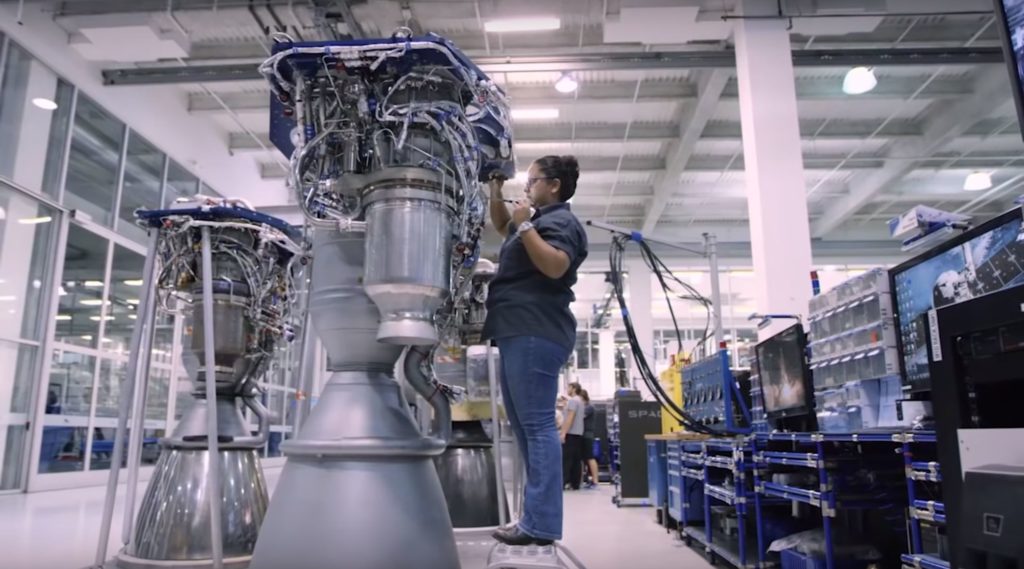
On the other hand, if there wasn't any dirt, the filters would not have clogged, so I guess it does make sense after all.