Fixing Social Security - it's always up for discussion and nothing ever gets done about it. The frustrating part is that the solution is somewhat simple, but politically it's untouchable. Here's my quick & simple solution for the problem:
1) Phase out Social Security benefits if your income level hits $50k that year.
- This aspect of Social Security is perhaps most baffling - why does someone who is making $250k a year on their pension and 401k distributions getting the same amount of Social Security as someone who's destitute and barely getting by? "But I paid into it, I should get something out of it!" goes the argument by rich people. Really? I pay into my car insurance every 6 months, never been in an accident, and I don't get a refund check when I'm done driving! Social Security is insurance, it's not a deferred savings plan. Social Security is really called FICA, and the "I" stands for insurance. It's insurance in case you don't have enough money to survive in old age, and the benefit payouts should reflect that. Someone making over 100k a year doesn't need another 25k a year in Social Security benefits to survive.
2) Take away the cap on contributions. Last year any dollar you made above $106k wasn't taxed at the 6.2% FICA rate. Why?
3) Make the Social Security Administration an independent entity free from Congress's whims, and more importantly, free from Congress's hands dipping into its pockets every time they need cash. Social Security should have a huge surplus right now in cash, as over the years they've always had more pay-in than pay-outs. Too bad Congress took all that money and spent it. Social Security is full of government bonds right now, essentially IOU's from Congress that "we promise to pay you back".
Combine #1 and #2 and you have a simple solution to both decrease payouts and increase pay-ins. Add #3 and you're assured that this institution (which isn't some evil socialist creation but really should be thought of as "poverty insurance") can be a self-sustaining, solvent part of our country forever.
1.) FYI - Your car insurance analogy falls apart in aggregate because some people do use it, but the element of luck is what you can't account for, so we use risk tables. There's no refund for you because other people got unlucky - you're paying for them to absorb your risk. Social Security isn't insurance - it's a progressive tax for the purpose of generating a small pention for everyone.
Quite right - if SS were insurance, you would pay into it directly in proportion to your probability of receiving it. Good drivers pay less for car insurance, and people who can provide for their own retirement would pay less for retirement insurance.
For example, consider a very rich person, with P(income < $50k/year) = 0.01. If SS were really insurance, he should only pay $50k x 0.01 = $500 + administrative costs. If bluedevil truly believes SS is insurance, and if we implemented his 1), then 2) would be utterly unnecessary.
Insurance is still insurance even if everyone pays equally into the system. The underlying principle of insurance is spreading risk to lower average cost. You can bill everyone the same amount and still have such a model. What you must mean is that social insurance isn't priced like commercial insurance, and that is true, but it makes sense to do it that way.
Commercial insurance tries to give least protection to those most at risk, to produce a higher profit margin. Social insurance tries to give maximum protection to those most at risk, to achieve some sort of ethical goal. Or in other words, commercial insurance is a form of business, social insurance is a form of charity. That's why social insurance costs least for those with the highest risk, and why commercial insurance is priced the other way around. They're still both insurance, just priced based on a different theory.
This difference is also why a commercial model of insurance can never be used efficiently for a social system (such as pensions or healthcare). Competition forces insurers to lower their prices, but the only way to do that and maintain profit is to lower pay-outs. How do you lower pay-outs? (1) provide less service to those that need it more, or (2) raise prices on those that need it more (risk-based billing, as you propose). The logical conclusion of that is that many of those that need protection are unable to afford it. That's not a "social" system. Social insurance is a charity, not a business.
Insurance is about pooling risk to allow people to reduce the variance/value at risk/etc of their costs, while holding the expected value of their costs constant.
You are describing a forced redistribution scheme, which perhaps devotes a slim minority of it's revenues to insurance. It's deceptive to describe such a scheme as insurance - you might as well describe the mafia as a pizza business, since a small amount of their revenues are laundered through a pizza shop.
You are also utterly mistaken about what charity is. Charity is the practice of benevolent giving. You are describing taking money from people by force and giving it to other people.
Social Security is insurance. The fundamental underlying problem with the entire thing is that people view it like you state, as an entitlement, rather than what it truly is, insurance. Read my arguments over again, but instead use the term "poverty insurance" instead of social security to reinforce what it really is.
Good point in that it is capped, and hence regressive, on the income side, but it's still net redistributive to the lower brackets on the pay-out side. My mistake.
There are a lot of other options you left out as well:
  * Raise the retirement age
  * Privatize a portion of the program
  * Reduce benefits to a more sustainable level
  * Decrease the rate at which benefits increase each year
I don't particularly like the options you laid out as it asks an already strained middle class to pay for benefits to the poor without the recipients making any concessions. But that's why the solution is not so simple.
You're conflating upper class with middle class. People who are making $50k a year after retirement, or making more than $106k a year before retirement, are not middle class. They are upper-middle to upper class, and they have substantially more savings than the people who receive less Social Security benefits.
You can make anything sound politically bad by calling something an attack on the middle class. The thing is, you can define middle class however you want. Are people who make more than $106k a year middle class? They're in the top quintile of incomes. How about people who make more than $250k? They're in the top 2%.
Raising the retirement age will disproportionately hurt anyone who works physical jobs, who are already strained by the decline in construction and manufacturing. Privatizing the program will be a giant subsidy to Wall Street. Decreasing everyone's benefits will hurt the middle class and the lower class, and might take away a little disposable income from the upper class.
Raising the retirement age will disproportionately hurt anyone who works physical jobs, who are already strained by the decline in construction and manufacturing.
Keep the low retirement age only for the declining number of people who work physical jobs. Problem solved.
The reason why wealthy retirees get Social Security and why the tax is capped at $106K/year is the same: it's to prevent Social Security from being a welfare program for poor people
Since everyone gets Social Security, this makes it much harder to get rid of. This was an intentional feature, and it has worked -- look at the fate of welfare programs devoted to poor people. The poor have very little political power and are easy to "other", making programs for them easy targets.
The tax cap is in place because Social Security payments are based on the amount you paid in. By capping the tax, this limits the payments necessary to wealthy retires which would make Social Security very expensive.
Anyway, nothing you're suggesting is totally unreasonable, but I think it's important to recognize that there is significant amount of political and policy savvy that went into to designing Social Security. It is both a very popular AND successful program.
I absolutely hate #2, however I would go along with it happily if #1 and #3 were implemented.
These are 3 really solid suggestions, that would in fact save social security. However, I think #2 is the only one thats going to happen, and its the worst one.
Why is that? The payroll tax is regressive, and it makes the total tax rate of someone who makes $200k a year lower than someone who makes $100k if you factor in employer contributions.
Please note: Romer writes about "dealing with the LONG-RUN budget deficit". The short-run deficit MUST be high right now.
In the current policy debate, debt is often invoked as a reason to dismiss calls for expansionary fiscal policy as a response to unemployment; you can’t solve a problem created by debt by running up even more debt.
It assumes, implicitly, that debt is debt -- that it doesn't matter who owes the money. Yet that can't be right; if it were, debt wouldn't be a problem in the first place. After all, to a first approximation debt is money we owe to ourselves. The overall level of debt makes no difference to aggregate net worth -- one person's liability is another person's asset.
The level of debt matters only because the distribution of that debt matters. Borrowing by some actors now can help cure problems created by excess borrowing by other actors in the past. Deficit-financed government spending can allow the economy to avoid unemployment and deflation while highly indebted private-sector agents repair their balance sheets, and the government can pay down its debts once the deleveraging crisis is past.
To a large extent, the focus on Social Security budget shortfalls in these pieces is like the punchline in the joke about why the drunk guy is looking under the lamp post for his keys when he lost them in the alley: "Because the light is better here." Rising Medicare/Medicaid costs are a much bigger long-term budget issue than Social Security, but coming up with realistic-sounding proposals to improve Social Security's fiscal status is relatively easy (and less politically radioactive) compared to controlling medical costs.
Still, I think that blog post really drops the ball by not even mentioning Medicare/Medicaid as budget problems.
Some numbers in this analysis are a bit misleading - if you view the budget as "social security, defense, and everything else", the huge portion of the budget taken up by Medicare and Medicaid is papered over. Medicare+Medicaid is $788b, more than Social Security, and is similarly "untouchable". (source: http://useconomy.about.com/od/fiscalpolicy/p/Mandatory.htm)
Not to say that I think Social Security shouldn't be touched. I do think that as a matter of purpose, Social Security needs to be a defined benefit plan, even if we have to cut those benefits to some degree or another to make ends meet.
On the whole, this is a ridiculous article. No one except rich elites cares about the deficit (including the bond market: 30 year treasury notes are yielding 4.5% right now). Republicans may have made noises about it in the last election, but one of their major planks was that the Affordable Care Act cut Medicare benefits!
We are in the middle of a global economic contraction, it is not the time to be reducing spending (redirecting spending to useful infrastructure, sure).
The calls to cut Social Security are especially irritating. Thirty years ago, Reagan increased Social Security taxes to save the system. It worked, and the Social Security benefits are fully funded until 2037.
For 30 years, workers have paid extra into Social Security to keep it solvent long-term. Now a bunch of rich elites demands that benefits -- that they don't need, but millions depend upon -- be cut. That is a bait-and-switch of the highest order.
He doesn't even talk about Medicare, which is the real budget problem. You can tell if someone is serious about reducing the budget deficit if they have a real plan for Medicare.
Despite my disagreement on entitlement spending, I appreciate that he thinks military spending could be cut and tax rates on the wealthy need to be raised. Since he's wealthy, I appreciate that he is willing to make a personal sacrifice.
"We are in the middle of a global economic contraction, it is not the time to be reducing spending"
I disagree. It's time to put Keynesianism to bed again. The only reason it came back to life was because it told politicians what they wanted to hear a couple of years ago. What it's time to stop doing is pretending that the solution to the problem is for the government to suck a dollar out of the economy to generate 75 cents of wealth and 50 cents of debt. In the real world, the Keynesian government multiplier is less than 1, and that cracks the entire theory wide open. And once you plug that number into the theory, it'll tell you the same thing.[1]
We absolutely need to cut government spending. Government can move dollars but it has proved incapable of generating wealth. It boggles my mind that after the past couple of years we're even talking about this. The final test of a theory is that it makes correct predictions, and the predictions based on Keynesianism have been repeatedly and continuously wrong. It's time to stop pretending it's because we're still not doing it hard enough.
[1] (Also, the multiplier is not a static universal constant. Like pretty much everything else economic, it reacts to conditions; if government were actually too small it might indeed be over 1 to grow it some more. So it's not that the optimal answer is to cut spending to 0, that's typical first-order thinking. It's just that today, the multiplier is way less than 1, and we've got a lot of shrinking to do before that's even close to changing.)
This is a terrible article. The heart of the projected deficit is increased medical spending -- if you don't deal with that, nothing else matters much, and vice-versa. Social Security is projected to be in balance for decades, then modestly out of balance for some time -- there is no rush to adjust it, and when we do the adjustment will not have to be dramatic, because although the expenditures are huge, so is the dedicated revenue stream. Finally, the "bipartisan" commission was bipartisan between rich centrist Democrats and conservative Republicans, and it foisted a deficit-increasing preference for reducing taxes on rich people into its report.
Fred Wilson, Paul Graham, Bill Gates, Larry Page, etc. ... these people are extraordinarily rich, in important ways the richest people the world has ever seen. Their perspective and interests do not and should not stand for the tech community, let alone the country or the world. The HN community could stand to be a little more skeptical of their pronouncements, and a little less slavish about enforcing the existing status hierarchy which upvotes every blog post they see fit to publish.
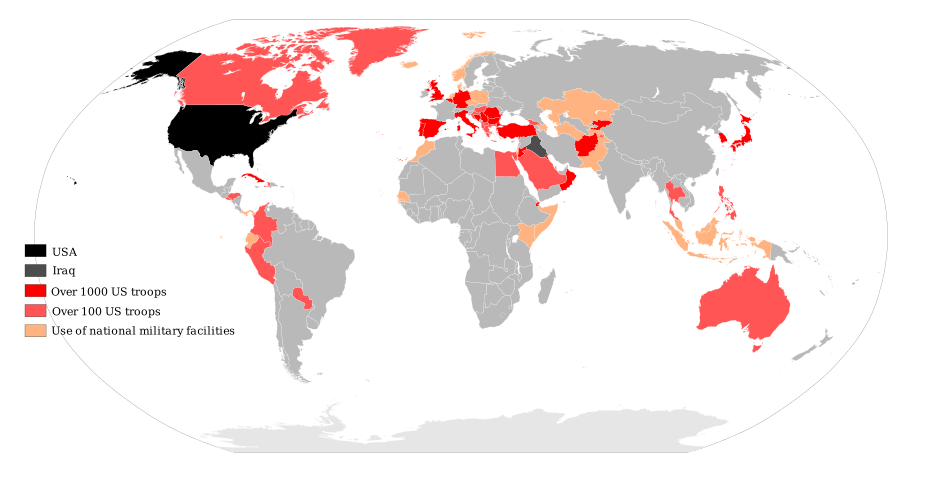
I can't read the comments for this article. It makes my brain hurt. Everything from 9/11 being an inside job to increase the national security net to the concept that the USA exists as a totalitarian empire.
I wouldn't go so far as to say that we still have many colonies, but a huge amount of spheres of influence across the planet? Yes.
When we are studied 500 years in the future, I suspect the US' historical role during this past century or so will be likened to the role of Britain at the peak of the British empire.
Military and "defense" costs far more than "just" $1 trillion every year.
There are many many hidden costs and the massive expenses for the thousands of severely wounded soldiers from Iraq and Afghanistan that survived instead of dying because of modern medical technology.
http://en.wikipedia.org/wiki/Military_budget_of_the_United_S...This does not include many military-related items that are outside of the Defense Department budget, such as nuclear weapons research, maintenance, cleanup, and production, which is in the Department of Energy budget, Veterans Affairs, the Treasury Department's payments in pensions to military retirees and widows and their families, interest on debt incurred in past wars, or State Department financing of foreign arms sales and militarily-related development assistance. Neither does it include defense spending that is not military in nature, such as the Department of Homeland Security, counter-terrorism spending by the FBI, and intelligence-gathering spending by NASA.
Military expense is a MONSTER that just grows and grows and grows.
ps. The costs for the Iraq and Afghanistan war are technically done outside the budget and through borrowed money. The INTEREST on them alone is over $500 Billion
"Now this conjunction of an immense military establishment and a large arms industry is new in the American experience. The total influence — economic, political, even spiritual — is felt in every city, every Statehouse, every office of the Federal government. We recognize the imperative need for this development. Yet we must not fail to comprehend its grave implications. Our toil, resources, and livelihood are all involved. So is the very structure of our society. In the councils of government, we must guard against the acquisition of unwarranted influence, whether sought or unsought, by the military-industrial complex. The potential for the disastrous rise of misplaced power exists and will persist. We must never let the weight of this combination endanger our liberties or democratic processes." (Eisenhower's farewell address, 1961)
I think this site includes many of the hidden costs. Clicking the "Defense" dropdown, you can see many of the categories of spending you mentioned (e.g. 90B on veterans, 18B on "Atomic energy defense activities").
It's not about money being there or not, government budgets don't work like that. It's about saddling the next generation with more and more debt. It's trading the future for short term gains.
Our country continues to operate a defined benefits plan while most businesses have moved to a defined contribution plan.
A government-run defined contribution plan would almost certainly have to have some kind of guaranteed payment floor to be politically viable, which would encourage serious moral hazard in investing.
I also wonder how many companies can offer defined contribution plans because their employees are also automatically part of a defined benefit plan (i.e., social security).
As Fred Wilson points out this is partially a political problem: getting most people to agree to necessary changes.
It is tough to cut defense spending however. Throughout history the rich and powerful have become richer and more powerful through wars. The chances of the government acting in the best interest of our country is about zero.
Another way that the rich get richer is on the "war on X" where X can be terror, drugs, etc. I just heard a good lecture on how much illegal drug money gets money-laundered through Wall Street by the drug cartels. Good luck changing that.
I think a big part of it is more to see how you would balance the budget, and what trade offs you would make. I'm relatively comfortable with raising taxes (2%) and cutting spending(98%).
Yes, the issues deficit hawks are raising are worth addressing in and out of themselves. But not because of deficits they generate!
What majority fails to understand and minority who understands it is too afraid to acknowledge is that for countries like US or Japan with independent monetary policy deficits truly don't matter. It's just another variable central bank deals with when executing monetary policy algorithm.
US public debt seems unsustainable to you? Go check Japan's debt (in reality it is japanese people savings)!
Japan's real problem is aging population, not its' World record public debt.
P.S. some good reading on WHY deficits don't matter:
Basically, to get USA back on its feet we have to encourage industry to invest in hiring and consumers to reduce their own debt and produce savings.
By having the deficit this high it encourages those groups to make those economic choice as they are the best option as far as return on investment compared to other rates of returns..
When the employment, savings, and consumer deficit figures improve then you reduce the deficit.
That is not to say that parts of the budget do not need fixing, they in fact do..


1) Phase out Social Security benefits if your income level hits $50k that year. - This aspect of Social Security is perhaps most baffling - why does someone who is making $250k a year on their pension and 401k distributions getting the same amount of Social Security as someone who's destitute and barely getting by? "But I paid into it, I should get something out of it!" goes the argument by rich people. Really? I pay into my car insurance every 6 months, never been in an accident, and I don't get a refund check when I'm done driving! Social Security is insurance, it's not a deferred savings plan. Social Security is really called FICA, and the "I" stands for insurance. It's insurance in case you don't have enough money to survive in old age, and the benefit payouts should reflect that. Someone making over 100k a year doesn't need another 25k a year in Social Security benefits to survive.
2) Take away the cap on contributions. Last year any dollar you made above $106k wasn't taxed at the 6.2% FICA rate. Why?
3) Make the Social Security Administration an independent entity free from Congress's whims, and more importantly, free from Congress's hands dipping into its pockets every time they need cash. Social Security should have a huge surplus right now in cash, as over the years they've always had more pay-in than pay-outs. Too bad Congress took all that money and spent it. Social Security is full of government bonds right now, essentially IOU's from Congress that "we promise to pay you back".
Combine #1 and #2 and you have a simple solution to both decrease payouts and increase pay-ins. Add #3 and you're assured that this institution (which isn't some evil socialist creation but really should be thought of as "poverty insurance") can be a self-sustaining, solvent part of our country forever.