I fast, on average, once a week. At least once a month, I try to do an extended fast (2-5 days) to force ketosis. I also do intermittent fasting basically daily (I only eat between 12-8). Been doing this for about 4 years now. Some anecdata:
- Fasting > 24 hrs paradoxically gives you an extreme boost of energy and mental focus. I especially love how my olfactory sense is extremely heightened. It's pretty cool and even after all these years doesn't get old.
- Fasting is not a panacea. Depriving yourself of nutrients or eating garbage is still a bad idea even if you fast or do IF. Unfortunately, eating healthy is hard and kinda' sucks. Egg whites and chicken + broccoli gets old pretty fast.
- Fasting >7 days is a bad idea unless you know what you're doing. This is when your muscles and vital organs start contributing as an energy source (e.g. they also start breaking down).
- Your body is clever, so extended fasts will start putting you into "starvation mode" and you'll lose some of the benefits.
- There have been NO STUDIES on long-term fasting (e.g. over the course of an adult lifetime). This is a big warning sign to just be careful and not overdo it. Different people have different tolerances. Talk to your doctor.
- Even on fast days, make sure you take vitamins (I take Fish Oil, Zinc, a Multivitamin and Magnesium)
Are you fit? as in, do you lift weights or are active in sports that require strength?
I ask because I wonder about the effects of extended fasts on muscle loss/retention, a big problem cutting weight for some people is that they get rid of some muscle mass along with the calories they wanted to eliminate.
I can speak to this a bit. I practiced intermittent fasting (eating once per day) for nearly a decade, while maintaining a very low activity level. My resting metabolic rate dropped significantly during this time (down to about 1300 kcal/day).
About a year ago, I increased my activity level significantly (distance running, hiking, strength training, cycling) and quickly found that:
a) I wasn't recovering quickly enough
b) It was extremely difficult to take in enough calories for a day in a single meal
c) I had very low energy when in ketosis
Eventually I gave up and just started eating on a typical 3-4 meal a day schedule. My RMR steadily increased back to baseline, I got a lot more explosive energy, my body began responding much more rapidly to training, and my recovery speed improved significantly.
Personally I think that intermittent fasting is not a good idea if you are very physically active. That's just my opinion from my own experience.
There is a range of IF between one meal per day, and not doing it at all. Prof Sachin Panda’s research on mice shows effects of 12hrs/12hrs, 8hrs eat/16hrs fast, and fasting some days but not every day.
There is a recent US Military study that shows that under a severe caloric deficit and with increased energy expenditure that yes, you still preserve lean body mass. [0] Granted this was not fasting, but it's interesting nonetheless.
Don't be thrown off by the title. Yes, one group received testosterone, but even the placebo group that did not receive anabolic steroids, lost nearly 10 pounds of fat without losing any appreciable amount of lean body mass.
Dr. Peter Attia wrote about it in his newsletter this past week. [1]
Between my anecdotal experience of not feeling like I lose much lean body mass while fasting, this study above, and recent evidence from studies shown that "muscle memory", where a muscle can quickly regain any lost size it has had, is in fact real...I don't lose much sleep over losing muscle while fasting.
I did for a few months this year, but I've been lazy over the summer. I'm 155lb, 6'0, so fairly skinny, maybe at around ~15% BF. I noticed that fasting doesn't help with BF at all unless I eat very clean and lift. I was at 170lb, around ~28% BF earlier this year and had to work my ass off to get my body fat percentage down.
Interesting. I just started experimenting with a 16-8 fast, and I have noticed that it is hard to eat larger portions when you constrain the eating window to eight hours. Did you think it helped maintain your 15% BF?
I stopped counting macros and started eating just whatever again at the beginning of the summer and I'm slowly gaining the fat back. Unfortunately, there are no shortcuts (at least for me).
Lifting specifically, or any sort of physical activity? I’ve been running and IF for the past month in order to cut my BF %. I was at about 16%, but I’d like to get down to 12%.
I've found that lifting is much better for weight loss than running/biking. I've gained weight while running 30-40 miles/week and typically lose weight while lifting (if I pay attention to my calories.) A lot of people say the same.
If you're focused on BF%, lifting is even more appealing since you'll be building muscle/reducing bf% even at a constant weight.
Lifting; I did Stronglifts 5x5 3 times a week. Part of the reason I stopped is that it got kind of boring and I got absolutely sick of doing squats 3 times a week.
It sucked, it was hard (especially on a caloric deficit), but it worked.
I haven't seen any studies that imply that fasting increases or decreases metabolic rates, which would mean that most people probably won't implicitly gain or lose significant amounts of weight just by switching to intermittent fasting.
There are people that literally just start skipping breakfast while keeping lunch/dinner/snacking the same. This is both technically intermittent fasting but also a reduction in overall caloric consumption. These people sometimes attribute their newfound weightloss to IF, when really they just started skipping a calorically dense meal every day.
Around my 30s I was quite overweight ~310lbs/140kg. Had done some stronglifts 5x5 and then decide to incorporate Keto into the mix (later targeted keto + IF). In the course of few years went down to ~230lbs/105kg while my lifts all went up (e.q squats from around 375lbs/170kg --> 460/210kg). At least my personal "gut feeling" is that I gained some muscle mass (my priority was to drop weight/fat).
For the past year, as an experiment, I've eaten carbs "normally" while doing 4x week gym. Few things I've noticed. My gut doesn't feel as good as it did while keto/IF, when you are in Keto and eat a cup of oatmeal ~45min before gym and start lifting you have this insane focus for the heavy 1-3 reps, I can seem to tolerate more better quality volume now compared to while doing keto/IF. But the overall feeling I have outside of the gym while not being in Keto/IF is a bit "sad", so most likely I'll start doing Keto/IF again to feel better. It's funny how insanely sweet strawberries taste while in Keto, and I kinda miss that feeling.
I'm personally very skeptical [as well]. I notice that almost nobody that recounts their fasting experience ever mentions sport.
I personally found very hard already to progress on weightlifting during diet cycles, as I need to cut on volume significantly; can't imagine to do that while fasting, unless fasting would "flip a switch" in how the (my) body works, which I doubt.
"I'm personally very skeptical [as well]. I notice that almost nobody that recounts their fasting experience ever mentions sport."
Allow me to step right up.
First, as you might expect, aerobic and endurance exercise benefits greatly from being in a fasted (16-24 hr) state. You're light, quick and your body is devoting zero blood flow (and other resources) to digestion. I suspect you're not surprised by this.
Second, I do a 1.5 hour heavy leg workout which includes squats, deadlifts and other assorted "big" movements with weight that is significant, compared to my body weight. No issues at all. I wouldn't do this on a 24 hour fast, but it is my regular habit to do this workout while in a 16-18 hour fasted state and in general I have very slightly better results than if I had eaten recently. Again, the issue is the amount of blood flow (and other resources) your body is putting into digestion.
Finally, while it is easy and enjoyable to do my BJJ workouts in a fasted state, I cannot, then, do several rounds of sparring at the end without more recent calories. Or rather, I can but I after round one or two I am running out of gas.
I can't speak to endurance (I got into IF after my endurance-athlete days) but I know that body weight-based athletes do this to perform better. My experience is specific to rock climbing.
When you are right at the edge of your abilities being just a couple pounds lighter can feel like a world of difference (people hone down their rack to precisely what they need for a route, nothing more), especially on sport and boulder problems. My anecdata points to it being great for the project/performative aspects of the sport but as a tool for consistent progression/improvement, I am less confident in stating anything.
> First, as you might expect, aerobic and endurance exercise benefits greatly from being in a fasted (16-24 hr) state. You're light, quick and your body is devoting zero blood flow (and other resources) to digestion.
I'd say it depends greatly on the effort and the individual. Long, slow distance for someone who is accustomed to training fasted? Fat stores will suffice as an energy source.
But add in some intensity and that's gonna be rough without much glycogen in the tank - which will be the case if you've been fasting for the past 16-24 hours.
I've experimented with fasting and weightlifting and I want to share some thoughts.
First, fasting does not require that your overall calorie intake is reduced. If your cut-goal is 2000kcal per day, you can fast in the morning and eat all 2000kcal in the afternoon. Ultimately, I find this is actually an easier and less hunger-inducing way to each your cutting goals.
Second, you're right. Doing weightlifting while fasted is hard. It's better to coordinate your gym schedule with your eating schedule so that you can eat -- I like a simple protein shake -- before and after the gym.
Third, I'm seeing a lot of folks talking about intermittent fasting ("IF") and day-long fasting in the same breath. I think IF is great for weightlifters on a cut diet. But I think day-long or multi-day fasts are different and should only be done occasionally (weekly being the most frequent) if you are trying to progress with weightlifting. YMMV.
There is some evidence that appears to support the idea that there is a difference between calorie restriction and complete fasting. You sound like the type of person that likes to dig into the studies. Dr. Jason Fung does a good job of writing in plain English while linked to and referring to the supporting studies: https://www.dietdoctor.com/fasting-muscle-mass
The studies may not have been conducted among athletes so, testing your own body's response (by measuring lean body mass before and after a fast) seems like the best way forward.
I have read that people on keto diets or fasting have less "explosive" energy for workouts. I am not concerned that my body is going to cannibalise my biceps if I don't eat for a day or two. There is a lot more energy kicking around that is less important.
Gist of it is you still cut significant calories only eating like 500-800 a day in mostly low fat protien rich foods. Targeting only enough protien to avoid muscle wasting.
While I'm no doctor or nutritionist, my understanding is that it's for that case, you want some of the benefits of fasting like going into ketosis while maintaining lean mass.
Unfortunately I'm on my phone only this week so I can't try and find any studies about it, but I came across it first in connection with type 2 Diabetes. So you might have some luck googling those topics for more info.
Can you point to any studies that show the benefits of your vitamin regimen? You point out there are no studies on long term fasting but I am also unable to find the studies on the benefits of vitamins.
When it comes to vitamins, the typical, North American diet is likely deficient based on the following behaviors.
  I am inside all day and get no sun - Vitamin D
  I do not eat wild caught fish - Omega 3s
  I am vegan - B12
  I do not eat greens daily - Multivitamin + Magnesium Theronate/Glycinate
Most people are D & Omega 3 deficient. Also a bulk of folks are Magnesium deficient unless they are eating greens daily.
- Even on fast days, make sure you take vitamins (I take Fish Oil, Zinc, a Multivitamin and Magnesium)
I have done some fasting recently (water, some water/apple cider vinegar in the morning; coffee, green tea, Ooolong tea), and have a similar vitamin intake (B complex; calcium/D combo; Magnesium; Zinc; Iron; Fish Oil).
During the fasting I don't take the Fish Oil, I haven't read anything about it specifically, but just assumed Fish Oil was fat that would break the fast. Do you have an opinion on that? I'm Guessing the caloric intake (if any, I am not even sure) is not enough to trigger metabolic response, and as a fat wouldn't trigger insulin response.
In a talk my parents sent me a few years ago, the speaker (I believe a nurse) argued that you need at least ~20 calories to trigger a metabolic response. Hence, things like tea, coffee (even with a tiny bit of milk), fish oil, etc. should be fine.
I have to take Vitamin D all year. I got really sick a year and a half ago due to low levels and wound up with some other issues that it triggered. Turns out, I have MS and the low vitamin D probably helped trigger a flare.
I literally cannot get enough Vitamin D in the winter: The days are short here in Norway and the sun isn't enough. Theoretically, I might be able to get it in the summer, but I really need to wear strong sunscreen since a medicine increases my skin cancer risk. The neurologist doesn't really want me to not take the supplements anyway.
My diet isn't bad. Mostly vegetarian, though I try to eat fish once a week and not otherwise completely devoid of animal products (dairy, for example). The rest of my bloodwork turns out OK.
In my case I am an endurance athlete, so at minimum supplementing electrolytes is helpful (also during the fast electrolyte supplements have at least seemed beneficial to my experience). Also, most American's are low on Vitamin D, and trust me I prefer it from the sun myself, but currently Im an office worker, so I supplement that.
Anecdotally, I can tell you that historically I used to get sick 2-3 times a year minimum, and since I began taking vitamins 5 years ago I got sick 1 time.
But I do generally agree with you about vitamins and minerals coming from diet over supplements, but I also say if you can get all your vitamins and minerals from food, your just not running enough (thats a joke).
If you live far enough North it basically does mean that for a good part of the year. Going to the office, it's dark, and it's already dark again when leaving. Need that supplement.
- During the fasting I don't take the Fish Oil, I haven't read anything about it specifically, but just assumed Fish Oil was fat that would break the fast. Do you have an opinion on that?
A fish oil pill has around 14 calories and most of the times will break your fast -> Take it after your first meal.
Vitamin D is a fat soluble vitamin and you should take it only after a meal containing some fat. Taking it while fasting will just not be absorbed.
> I also do intermittent fasting basically daily (I only eat between 12-8).
I settled on this pattern years ago before I heard anything about it. It just seems right and natural for my body. I've never been into snacking and breakfast would make me feel ill most days (coffee gets a pass) so that naturally means I don't eat before lunch.
Though I wonder how much of that is our modern lifestyle. If I go to the gym early or do something physical, then I'll get hungry and actually want food. Usually I try to go to the gym around 10am or later, which I do without any food in my system and I feel fine. I'm not trying to gain mass though.
I’m pretty much the same. It’s been great for me. I’m 5’11” and in two years I’ve gone from 200lbs to 155lbs with almost no effort. I feel and look great, and with low body fat I have much more motivation to exercise as well. I find it easy to ignore hunger so it’s effortless.
As an aside, a meal consisting of just this isn't very balanced. There is effectively 0 fats in it. Egg yolks are actually quite healthy and would have rounded this meal off nicely
My daily intake was 175g protein, 150g carbs, and 50g fats. To hit those macros reliably, egg whites for breakfast and chicken (or tuna) for dinner will quickly become a status quo :)
Not sure I'd call it insane. 5c:3.5p:1.5f is like the "standard" fat-loss macro ratio your average nutritionist would suggest[1]. Mine was a bit more aggressive, but not super out there.
Why would your body breakdown your organs when you still have plenty of adipose stores ?
Do you have a citation for the "starvation mode" ? If it's the 1940's study from MN, that was only when the subjects where well into single digit fat %.
Bodies aren't finite state machines and the concept of "modes" can be misleading. What you have is a (very large) number of independent processes that have differing amounts of flow under different conditions.
So, for example, you don't click from building muscle to consuming muscle. What happens is that catabolism has a higher flow than anabolism, so the net balance is negative.
As the body becomes leaner in starvation conditions, processes that recover energy from gluconeogenesis or from lipolysis cannot produce "enough" energy. So feedback loops that suppress the breakdown of organ tissue weaken and eventually that loop shifts.
* "independent processes" is better described as "interdependent, oftentimes antagonistic processes".
* In describing net balance, the key is that both processes remain active throughout, even if only the net balance of flow can be observed. Or more likely, the integration of the net flow over time (the stock).
* I say "that loop shifts", more accurately the loop dominance shifts. This is a term from system dynamics for describing how the behaviour of the overall system can suddenly change due to a change in flow of one or more loops that are working antagonistically.
>Why would your body breakdown your organs when you still have plenty of adipose stores ?
Most people are not "fat adapted" meaning their body/brain primarily run off of glucose.
When you fast and your body runs off of glucose, it still goes into ketosis and burns fat, but the brain still needs glucose because that its accustomed primary fuel source (think of marathon runners hitting the wall, that is their body conserving remaining glucose in the body for the brain to function). When their is no dietary glucose the body breaks down protein (muscle and organs) to convert into glucose to keep the brain working (gluconeogenesis).
This will still occur but to a far lesser degree to people who are fat adapted and primarily use fat for energy.
This phenomenon (specifically, body breaking down muscles), is a very practical, and doesn't really need studies.
When doing bodybuilding (or sports in general), one can very easily measure their own bodyfat, and losing more muscle than fat is the enemy #1 during diet cycles (whose objective in fact is to minimize muscle loss and maximize fat loss).
Of course, "plenty of adipose stores" is relative. I guess that if one is 30% BF and never does any activity, as soon as they start to lift some weights, they'll put muscles and lose fat quickly for some time, independently of the calories deficit.
The other exception is when one takes anabolic steroids.
In healthier rats, protein turnover (cannibalizing muscles / organs) was faster than in obese rats. I had some human studies bookmarked, I'll try to find them again. There were a few ketosis studies that discussed "starvation mode" so maybe try searching for that.
> I had some human studies bookmarked, I'll try to find them again.
Please do. Rat studies are helpful, but not definitive-- close but not exact. That's why it takes so long for medicines and therapies that are shown to absolutely work on rats still take forever to reach humans.
"Unfortunately, eating healthy is hard and kinda' sucks. Egg whites and chicken + broccoli gets old pretty fast."
I welcome any opportunity to point to almond butter as an extremely dense, and healthy, source of calories.
Easy to add to a smoothie.
Speaking more broadly, I would have a hard time with IF, etc., were it not for shifting about 20-30% of my calorie input to nuts, generally. Mostly raw in form.
"According to the finding of the research, any amount of Pb, Hg and Sn were not detected in the organic certified nuts. In the organic certified nuts, the levels ranged between 5.53-123.78 ppb Cd, 8.22-16.62 ppm Cu, 0.24-1.86 ppm Ni, 15.03-46.37 ppm Zn, 444.1-810.6 ppb Cr, 22.06-67.42 ppm Fe and 1.24-3.14 ppb As."[1]
Perhaps you are speaking of conventional (non organic) nuts and seeds ? I would not consider consuming those.
Based on the quote I tracked it down to this paper: "Determination of heavy metal contents in some organic certified dried nuts".
I can only access the abstract, couldn't find it on sci-hub. The study is focused on organic nuts though, it's not specifically an organic vs non-organic.
The biggest benefit I've found to fasting is the sort of reset it provides the digestive system. I've suffered from some pretty frustrating gut health issues over the past few years, and taking a 1-3 day fast every few months significantly improves most of my symptoms. When talking to my doctor, a combination of "reduced inflammation", "digestive rest" and "gut biome health" are all things that get thrown around, but generally "Who knows, but if it works keep doing it" is the general result.
This fasting caused a 37.4% reduction in caloric intake. It raises the question of whether it was the fasting itself or merely the overall caloric reduction that made the real difference.
The caloric reduction makes the difference, as the paper notes:
> Of all the anti-aging and longevity-promoting interventions tested so far, calorie restriction (CR) seems to be the most conserved among species and robust. However, humans struggle to constantly achieve a certain level of CR. Here, we show in a clinical trial that a related intervention, alternate day fasting (ADF), also leads to striking reduction in overall calorie intake over the course of the study but is more easily tolerated than continuous CR and provokes similar beneficial changes
on the cardiovascular system and on body composition while being safe for a period of >6 months.
I wondered this as well. In many of the intermittent fasting studies they kept caloric intake the same and showed that the benefits applied even when taking caloric restriction out of the equation.
A lot of diets, especially IF style diets, are pretty much just tricks to get you to eat less calorie wise. Intermittent fasting does this by just setting the simple rule, only eat during a relatively small window of time. It's easier to eat less during that period because there's only so much you can comfortably eat in that time. (Granted you can totally fit a whole day's intake in the IF period but it's harder).
Is there really no difference between eating 1500 calories at once vs. over the course of 5 meals?
Of course, there is no weight loss without a calorie deficit, but are all calorie deficits equivalent on magnitude alone? I struggle with the notion that the timing does not matter at all, and much of the suggested benefits of controlling the timing focus on other metrics beside immediate weight loss.
The "wisdom" of the late 90s was that six or so small meals were better than one large meal, with respect to weight loss. Now it appears some experts would argue the opposite. Is it all just a bunch of smoke and mirrors over calories in > calories out?
"Is there really no difference between eating 1500 calories at once vs. over the course of 5 meals?"
Digestion - and the ramping up of your entire metabolic process - is not a minor task. It is an all-hands-on-deck marshaling of a number of bodily processes that preclude other processes that you might like your body to engage in.
If you are firing up this mechanism every three hours - insulin response, spiking your blood sugar, moving your stomach and bowels, etc., then you never give your body time to do any other housekeeping tasks.
Think of food intake as an interrupt, in computer science parlance. What happens to process performance when you're throwing interrupts ?
I've been used to eating one huge meal (or one huge meal and a snack) per day for years, but I've recently realized it's not been very good for me (other than it possibly keeping my weight low).
For one, I seem to have a much higher chance of feeling tired if I eat a lot at once, compared to spaced out smaller meals. And two, this often manifests as me working/programming all day without eating anything until nighttime, having a huge meal, and then falling asleep. This typically leads to trouble sleeping, indigestion, and a general bleh feeling the next morning.
I've started moving to 2 - 3 smaller meals per day, and I find I have a lot more energy during the day, with no grogginess after meals and no issues with sleep. Though it seems a 24-hour fast gives me the most energy out of everything. And I agree continuous snacking is probably not great.
"...it is theorized that cancer cells do not respond to the protective signals generated by fasting, thus leaving them vulnerable to both the immune system and cancer treatment. This process is known as differential stress resistance (DSR). Short-term starvation (STS), fasting for 48 hours, causes a rapid switch of cells to a protected mode, which is capable of protecting mammalian cells and mice from various toxins, including chemotherapy."
(et. al)
I read it as cleanup/housekeeping tasks that aren't high priority, relative to processing food inputs. When freed from those tasks, the body can concentrate on housekeeping.
That's not housekeeping though, that's in the case of fighting cancer. And based upon the mechanism you lay out, that's with outside intervention. That doesn't seem to expand out to "general housekeeping" when you're also dealing with medical science trying to kill cancer without killing you.
> The "wisdom" of the late 90s was that six or so small meals were better than one large meal, with respect to weight loss. Now it appears some experts would argue the opposite. Is it all just a bunch of smoke and mirrors over calories in > calories out?
Too true. It was trendy as recently as a decade ago to eat many small meals and frequently "to keep your metabolism high." What no one was acknowledging was how the study that showed the relationship between fasting and metabolism had participants basically starve themselves for an extended length of time.
What I meant was it's easier to eat less calories if you restrict the amount of time you're allowing yourself to eat not anything about absorption being different due to the compressed time frame.
I'm just saying, if your rule is going to be "eat whatever you want during your window", that's never going to work for a food addict. Ultimately you will have to count calories regardless.
true, but food addicts usually have other issues with self-discipline as well, and IF makes it easier to stick to the program as you have to count your calories only once a day... at least it's my experience
"Conversely, continuous CR has also been associated with depleted circulating leukocytes, immunosuppression,
and reduced bone density (Devlin et al., 2010; Ritz et al., 2008; Tang et al., 2016; Villareal et al., 2016)."
We also can't discount the placebo effect. That is, is it the caloric reduction, or the awareness that they are doing something presumed to be healthy. It wouldn't be the first time the body+mind was self-fulfilling.
Sometimes any change and increased observation of test subjects has a temporary effect even if the subjects are unaware of the reason for the change or the hypothesis behind the experiment. Just the attention paid to them can be motivational.
Been doing intermittent fasting for a long time now and have been doing ADF for the last few months.
I lost fat and retained lean muscle while
- eating between 3000-6000 calories on eating days
- running 30-35 miles per week
- weight lifting 3x per week
Here is a reddit post about my progress with some documentation including pics of recent DEXA scans.
I train 3-4 times a week (calisthenics). I tried 5 days of intermittent fasting for 5 days.
I was DYING for food in the morning even on the 5th day, I drank way too much coffee, and in the end what really convinced me I had no reason to keep on doing this was HOW BAD AND SICK my (normally fine and healthy) breath smelled. Like, friends felt compelled to actually ask me why that was the case (yes, good friends will tell you if you have smelly breath).
I suppose it was because I quickly went into ketosis, but overall it wasn't a pleasurable experience. I went back to my regular balanced breakfast as part of my varied vegetarian diet. I guess IF just doesn't cut it for me and maybe I don't have the patient to turn myself into a smelly monster just to follow some popular nutrition fad, especially considering I'm well into my weight and I have low body fat. Just my 2 cents. Internet doesn't convey smells yet, and that's great news for all the crowded fasting online communities out there, I guess.
Congratulations on your accomplishments. Can I ask how you manage to choke down 6000 kcal on eating days? Even when I'm really hungry I can't physically force myself to eat that much. It makes me feel sick and my digestive system is at the limit.
I’m one of those people that eat quickly and a lot, so I’ve just become accustomed to eating big meals.
That being said, I also eat significant amounts of junk food. Slice of cake is like 500-800 calories. No problem. I can do that x 3 after a meal of normal stuff. Junk is easy to throw down and calorie dense. Also, its fun to eat.
Now 6000 calories of salad and lean meats? That would be difficult...
Regarding exercise during IF, does it have a negative effect on your performance if you don't eat some carbs BEFORE exercise? How do you prevent the body from eating itself up for energy during exercise?
Pretty much no impact. I’ve done 18 mile runs after not eating for 36 hours and without consuming calories during the run. I feel tired but no more than usual. Also weight train fasted, no issues with performance.
The goal kind of is for the body to eat itself...eating body fat.
As for maintaining muscle mass, it seems as if keeping protein intake high while lifting heavy weights does the trick.
>For healthy, non-obese adults, ADF is safe to practice for several months
They might just be saying this because they didn't test any further, but does anyone know any reasons why it might stop being safe after several months?
I'm not aware of any specific reason why it'd become unsafe over long periods of time, but just getting regular checkups and talking with a doctor should be enough to identify it in an individual.
While not nearly as scientifically rigorous as this study there's a lot of people out there who do a more general form of this and call it "intermittent fasting". Usually things ends up as a complete restriction on calorie intact except during designated times, 16:8 or 18:6 are common forms of it where you're fasting for 16 or 18 hours a day, and can only eat during those other 8 or 6 hours. You still have to limit your calorie intake (eating 5,000 calories in 6 hours still isn't going to do anything good for your health). And some people take it even more to an extreme with what they call OMAD or One Meal A Day.
This kind of study looks like it points to some of the claims that this kind of diet could have actual benefits aren't entirely unfounded. I've doubted most of the claims I've seen people make since they largely seem completely fanciful and not had any real testing or study done on them but still plan to try to adhere to a diet like this simply because it looks like it should help deal with self-control and discipline issues that I know I have when it comes to food.
We have neighbours with twins aged 7 who raise their kids at home on a raw food diet. They eat lots of nuts, fresh fruit, fermented beans and garden vegetables. They conserve vegetables and fruit using lacto-fermentation.
The kids are much smaller and thinner than normal kids their age. Up until recently I used to pity these poor, starving kids. I compared them to our kids, who are athletic, tanned, well built.
But recently I started asking myself if this is not the other way around. Maybe if we didn't have the luxury of cooking, transformed food and western supermarkets we'd have been much smaller. Maybe this means that we all in the 1st world eat too much.
I'm starting to think that maybe we're not really better off having our stomachs full basically the whole day long, especially if you consider that most of us do very little physical activity if at all...
Hey ciconia, I wanted to drop you an email on an unrelated note, but was unable to find contact info. So please check out this comment: https://news.ycombinator.com/item?id=20852873
(Other readers, please accept my apologies for hijacking the subthread.)
I've been fasting weekly for a long time (after starting with intermittent fasting). I'm glad to see an article like this because I've been waiting to try fasting every other day. My subjective observation is that there is a misconception of what the body does with nutrients and that is why in general people won't think of even trying to fast ever.
To use contrasting analogies, it seems in general the perception is that the body works like a car and you have to re-fuel it every few hours in order to keep going. However, from my experience I think the body is more like a factory that creates its own energy. It needs materials, from which a part is used for energy, but thanks to having storage, you have plenty of supplies to keep going until the next shipment of resources arrive. In other words, fuel is burned in proportion to the user of the car, but factories don't necessarily use their materials as soon as it receives the shipment. Factories can store resources and their use is scheduled for a later use.
Therefore it is better to optimize for quality of materials, rather than frequency of consumption! Your body will use the materials it gathered from the past few days of consuming food (no citation here, but again just my experience), and the only problem of not eating is the BRAIN's expectation of eating food every day and that feeling of satiation, which is basically a hit of dopamine and not a true sign of wether you need materials and/or energy to survive.
Be careful If you are going to try fasting. If you read carefully, fasting increases PUFAs on the serum and if you have plenty of PUFAs in your body, it could kill your thyroid and metabolism.
Before trying fasting be sure to have at least a month of healthy eating and try sipping unsweetened lemon juice while you fast.
I am happy to see another study that indicates good results.
I have stopped fasting, even though I believe in the benefits.
Now, I just make sure that every day I have at least a 12 hour contiguous period of not eating. This is really easy to do, for example, finishing dinner by 6:30pm and not eating until 7:30am the next day gives me a 13 hour period for resting my digestive system and giving my cells some time to repair rather than absorb nutrients. Easy, and with a mostly vegan diet except with lean meat about two times a week, I feel great.
For me, it is best to stay on an easy program, something that I can do long term.
I was heading to the gym near the Twitter HQ in SF yesterday and saw Jack Dorsey walk past. He looked extremely thin and borderline sick to me. I think he does more extended fasts over the weekend but it’s a bit unnerving when someone in a position to influence behavior like he is seems to be taking fasting to an extreme.
I've seen a lot of people say stuff like this, but it's kinda gross. If you want to criticize things someone has said about their diet and health practices, that's fine (and hopefully, you'll cite sources for why they're wrong), but if you're going to make it about how they look, and make your own diagnosis about their health, that's not really OK.
You don't know anything about the guy's health. He may actually be sick, wholly unrelated to his diet. He could be dealing with an eating disorder (which may be related to his diet, but millions of people have fasted regularly without having an eating disorder...there are lots of ways people cover for eating disorders). And, maybe he's in great health and your beliefs about what "healthy" looks like are wrong ("put some meat on your bones" is not great health advice for most people, but it's a common refrain).
I don't really know anything about what he's said about diet or fasting. But, I know that bringing his appearance and health into it are not shedding light on the subject, they're just conflating appearance with health and well-being in ways that aren't useful.
This kind of word policing is even less OK. It's not "gross" to make a comment about something you see and have opinions about, especially for a public figure. You're not shedding light on any subject, either, all you're doing is being offended-on-behalf of someone else; the world's got enough of that and it doesn't seem to be making any positive difference at all.
The comment I responded to did not add substantively to the discussion, and I pointed out why.
I am not "policing" anything. I have no power to arrest someone or censor someone for being an asshole online. I expressed an opinion about the kind of community I'd like to be a part of. Also, it seems like you're doing what you're criticizing me for. I don't think the world's got enough of minding one's own damned business regarding people's health, body, and appearance, and that having more of it would make a positive difference. This conversation is about the science of fasting, not whether Jack Dorsey looks thin.
Just as we shouldn't make the assumption that fat people are lazy and gluttonous, we shouldn't make the assumption that skinny people have an eating disorder.
I didn’t say he was sick. I was just recounting my observation. Was literally taken aback by how thin he was.
It’s different when you go on record as a public person in multiple interviews talking about extended fasting. People want to emulate influential people, whether it’s actually a healthy or unhealthy behavior for that individual.
Also, maybe Steve Jobs would still be alive today if we didn’t have this strange learned behavior to not say anything about someone’s health if we think something could be wrong? Something to think about.
Steve Jobs was diagnosed, by his doctor, relatively early, as pancreatic cancer diagnoses go (many people only discover it when they have weeks or months to live, and there are no effective treatment options...five year survival rate for pancreatic cancer is something like 1 in 5). Jobs opted to use alternative treatments rather than treatments that (might) work.
That's a wholly different conversation...nobody diagnosed his condition, or could have helped his outcome, by looking at him and talking about his health on the internet. And, nobody could have diagnosed his condition by looking at him. By the time you have visible symptoms of pancreatic cancer, you've already likely been experiencing pain and other related symptoms, and treatment options are practically nil.
How about we just leave people's health between them and their healthcare providers and optionally their family? It's none of our business, unless they specifically ask us for advice or tell us about it.
>How about we just leave people's health between them and their healthcare providers and optionally their family? It's none of our business, unless they specifically ask us for advice or tell us about it.
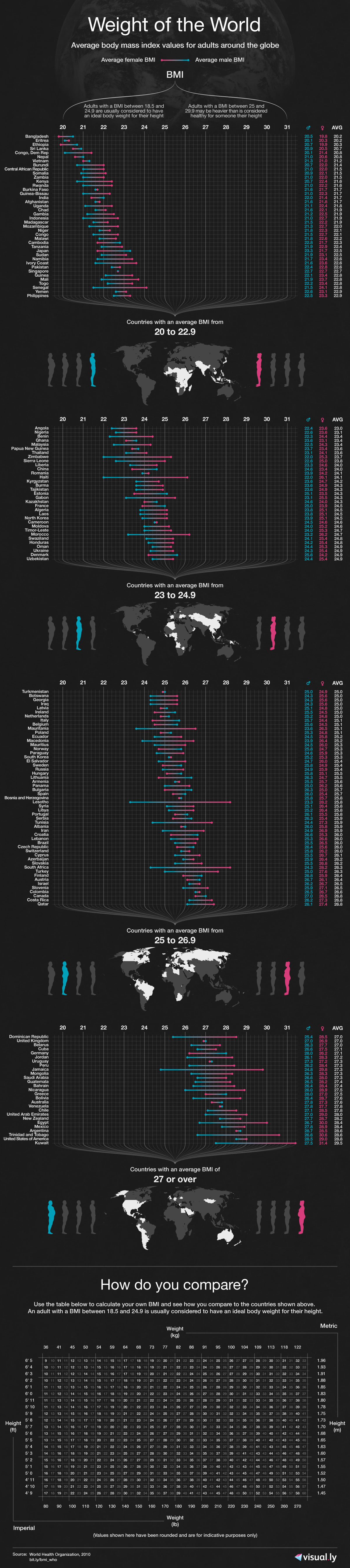
I think we are a little too comfortable with people generally taking over-eating to an extreme. A 5’ 10” male’s optimal BMI means a body weight between 130lbs and 170lbs. You’d need to be 110lbs to be severely underweight. No-one would bat an eye if they saw a severely overweight 5’10” celebrity weighing 210lbs.
> A 5’ 10” male’s optimal BMI means a body weight between 130lbs and 170lbs.
I've always found BMI to be a little suspect. I'm an average build 5'10'' and 170lbs at the upper range of optimal would make me look very, very lean (I've been there before and it is just not a flattering look), at 130lbs I would look down right skeletal and very unhealthy.
My personal optimal is 178lbs where I look and feel great, although according to the official numbers that would put me at the lower end of overweight which is just not right.
My understanding of BMI is that it's a pretty crude measure of health in that the numbers are correlated with (preventable?) deaths across an entire population and that's it. I wonder if there is some nuance of health that this single number doesn't capture too well.
Are you sure you are not just used to see slightly overweight people everywhere, and when someone is at the lower end of normal it looks extraordinary to you? I read he is 1.78m tall, that means he could be 59kg (130 lbs) and still be in the normal BMI range.
If I eat two meals in one sitting and then wait 23 hours before my next meal is this a form of intermittent fasting? I still get the same amount of calories as a normal person but there's a long period where I get nothing.
(I've been skipping breakfast my entire life so I don't really get the 3 meal thing.)
Is it? The thing is I'm eating two meals in one sitting so it's still two meals a day. I typically thought intermittent fasting meant one meal per day. Does what I'm doing still count?
I think the amount of food doesn't matter, I would say if it's in one sitting it count as one meal. People that do OMAD usually eat much more than what they would eat in a normal meal, otherwise it wouldn't be sustainable in the long term.
Intermittent Fasting just means there is a 12+ hour period between the last meal of the day and the first meal of the next day. The most typical form is two meals a day in 16:8 fashion.
I know less about cycling diets than I do fighter camps but it is incredibly common for fighters to eat at fasting levels while continuing to train. The strict weight requirements cause that.
I was of the impression that it used to be the case that cyclists did this but that it was out of fashion now.
In any case lots of people do 1500 calorie efforts at fasting intake levels. It’s not healthy long term but it’s completely ‘normal’ for done athletes.
This change was reported over 4 weeks, or 28 days.
For a 180lb person consuming, on average, 1900 kCal/day, a 37% drop in calories is a 703 kCal/day deficit below their initial equilibrium. This is 19,700 kCal over four weeks. Divided by 3600 kCal/lb, this is about 5.5 lbs. 4.5% of 180 lbs is 8.2 lbs. So, we're in the ball park. A 3-lb deficit from reduced inflammation (water) seems reasonable.
For a higher initial weight, you can get the numbers to agree exactly. I'm 6' and 182 lbs., which is just barely overweight. In the U.S., were I live, I look pretty "fit" by comparison with the average person. (I'm not, but that's another story.) According to [1], Austria, from where the participants were likely sourced, is only slightly leaner than the United States.
Therefore, their numbers seem to line up. Westerners are stuffing themselves.
Much calorie intake is just an inefficient attempt to get at micronutrients that we are missing. So less calories could just up/down regulate your metabolism and return things to a normal state assuming those fewer calories are proportionally nutrient dense.
You don't eat 100% equivalent of your body mass everyday. You probably eat 2-3% (just an assumption). So, cutting from 3% to 2% over a course of few months should not drastically lower your body mass.
>..."might increase the risk of gallstone disease"...
I do 18:6 intermittent fasting and I did have a gallstone episode. My intuition is that fasting precipitated the expulsion of stones that had formed prior to the onset of my fasting regimen. Also, while practicing intermittent fasting, I think I have a tendency to overeat during my main meal of the day, maybe as a subconscious attempt to avoid feeling hungry later on. To avoid overeating, I need to be mindful to stop eating while I still feel slightly hungry.


- Fasting > 24 hrs paradoxically gives you an extreme boost of energy and mental focus. I especially love how my olfactory sense is extremely heightened. It's pretty cool and even after all these years doesn't get old.
- Fasting is not a panacea. Depriving yourself of nutrients or eating garbage is still a bad idea even if you fast or do IF. Unfortunately, eating healthy is hard and kinda' sucks. Egg whites and chicken + broccoli gets old pretty fast.
- Fasting >7 days is a bad idea unless you know what you're doing. This is when your muscles and vital organs start contributing as an energy source (e.g. they also start breaking down).
- Your body is clever, so extended fasts will start putting you into "starvation mode" and you'll lose some of the benefits.
- There have been NO STUDIES on long-term fasting (e.g. over the course of an adult lifetime). This is a big warning sign to just be careful and not overdo it. Different people have different tolerances. Talk to your doctor.
- Even on fast days, make sure you take vitamins (I take Fish Oil, Zinc, a Multivitamin and Magnesium)