Even though it feels very fad-ish because it's been used as a buzzword/bandwagon, I don't feel like it's actually a fad.
My view is that that digital design has matured to the point where designers no longer feel they have to wow users with lots of effects and visual flourishes, allowing for a more purpose driven design. My hope/opinion is that is here to stay.
As ericd says, a lot of those little flourishes actually aid human perception and cognition. Yes, we don't need giant flashy effects or lots of animation, but that doesn't mean that the most functional design is the most minimal.
Also, it's kind've ironic that you can now have a 5k display to show off your flat, monochrome circles...
This. Shadows (fake 3D), textures, colors, and other elements may seem like a gimmick, but they are fundamentally crucial in visual cognition of the UI. What's sad is that so much UI design is driven by meaningless trends instead of more precise research data on how well UI elements work.
Are they actually crucial, though? There was a ton of gnashing of teeth about iOS 7 (and other "flat" designs) but one rarely hears those anymore… and it's not at all clear to me that less-savvy users are having more trouble operating their devices than they did a couple of years ago. In fact, it seems just the opposite, that these devices have steadily continued to integrate themselves into people's lives more than ever before. Come to think of it, it seems that the gnashing of teeth has shifted to that (these screens that we spend our lives staring at!) over the last year or two.
I'm sure there have been at least some regressions in some aspects of some user performance measurements, but it seems really clear at this point that it hasn't been a catastrophe… or even a significant problem.
It takes me significantly longer to identify control elements under the new design bible, especially the un-bordered text "buttons". Smart phones are taking off despite this, not because of it - it's because of the massive new capabilities they afford people.
Maybe not 'crucial', but definitely helpful and important.
Also, it's a bit much suggesting that it's flat design that's what's responsible for smartphone uptake. If that was the case, then hell, it was skeuomorphism that exploded the market in the first place.
well you get things like Google's Material design that have things like depth perception and strong color contrast.
It's not like we're abandoning everything, it's more about discovering new ways of doing things and then mix and matching until we get to something useful and coherent.
A lot of those flourishes were actually design affordances, though, visually denoting certain functions and making things more intuitive. Not a fan of the super-flat design trend.
As you say super flat might not be great, but all the designs preceding the current trend where extremely harsh on the visuals.
From windows XP to 7, the windows default themes and colors where disturbingly flashy and "in your face". OSX was more bland but aqua was still kitch and unneedingly strippy. iOS6 app's ultra textured or "realistic" interfaces were the peak of that trend IMO.
In the real world, not everyone likes kids playroom colors, nor grandma's 60s style wallpaper, nor steam punky design, nor green-blue metalic robot parts. Personally I like MUJI style clean and clear design, and I feel like it took that much time to have a core of people to value cleanness and simplicity in computer UI design as well.
Oh, I definitely agree, XP's playskool-esque design was way over the top, and OS X's excessive animations/reflections/etc. are obnoxious. It does seem to be getting better in that regard. I like most of Bootstrap's choices, and those seem to be diffusing out.
Meh... I'm actually a fan of XP's design, although I can't tell how much of that is actual aesthetic appreciation and how much just nostalgia. Colors are nice, yet the interface as a whole was actually less flashy than its successors, as the last pre-GPU-compositing Windows, making for a solid whole. But I also liked Aero's glossiness, which I'm happy to see somewhat reflected in Yosemite - nor did I ever have an issue with OS X, although iOS 6 was a bit much for my taste. (On the other hand, I also like iOS 7. The only design I seriously don't like is Google's, for reasons I'll elaborate on the off-chance anyone cares.)
OS X isn't flat. There is still shading and drop shadows. They just turned down the gloss from 11 to something less overbearing. When the UI gets chromed to the hilt like iOS6 or older OS X versions, it becomes a distraction from the app/content.
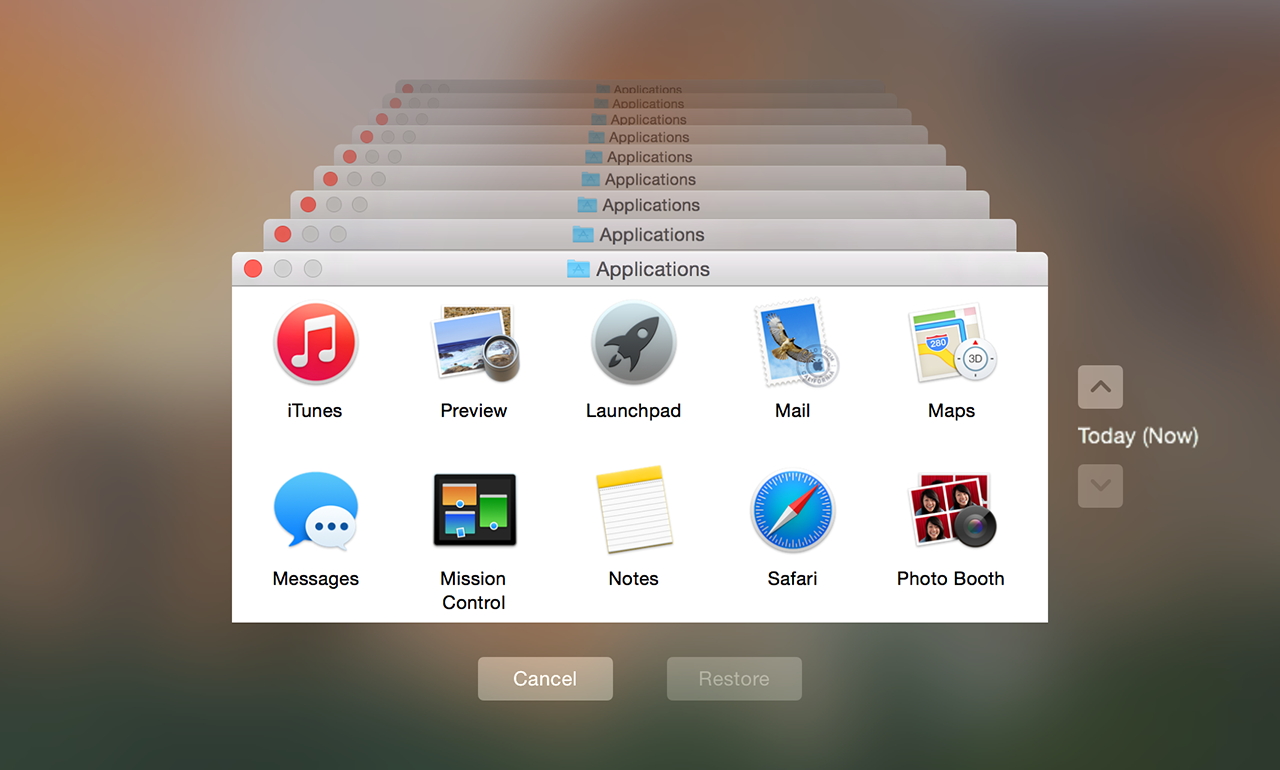
Me too. Take a look at Time Machine. As the author said, Time Machine made "backups fun, so people will want to do it". I think the time vortex background helps in achieving that. And they removed it.
The vortex gave some hype to backup 10 years ago. Was it enough to make backup widespread? Interestingly: no - backup is still under 50% among Mac users. And for those did use TM, it made the thing slower.
So moving on, cloud looks like a safer approach to backup because no friction. Yes, data security, etc. From a public service POV, though, for 99% people out there, I bet the trade off is hugely favorable to cloud stockage vs local disk failure.
So now - is iCloud drive sexy enough to want to use it? Actually that's more like the problem, it's definitely not.