Net neutrality is crucial for a free internet. This will be even more important for the future, because without it we will have tighter and tighter controls over the internet. A lack of neutrality will, among other things, allow secret deals between service providers and big platforms that will squeeze out the independent internet and accelerate a total commercialization of all aspects of the internet.
Large businesses are becoming a greater liability than ever before. Although I applaud net neutrality advocates, something greater must be done: the takedown of large corporations and rebuilding them from scratch.
I'm pro net neutrality, but if it's ever going to work we need the legislature to do their job and put it into law. They either need to broaden the powers of the FCC or - better yet - enshrine net neutrality itself as law.
This is a part of the windfall from Chevron and all according to plan. Tear down the executive structures and have a congress in conflict. Leave the rest to "states rights" for their motte. When in reality we're giving the keys for private corporations to do whatever they want.
we'll likely see similar moves with the Department of Education this year.
I fully agree with what you wrote. The question is: current laws are fit for purpose? There are many things that are wrong and supported by laws or things that can be improved but existing laws forbid that. Is this a question about net neutrality or a question about how can/should be implemented?
Same about corporate powers, especially in US where consumer protection seems to be a lot weaker than in EU, even if US has a lot more regulations.
Good points. I do feel like the current laws are still insufficient, and will ultimately fail due to the corporate control of the internet/governments. More drastic solutions are probably needed. Much better anti-trust laws perhaps to combat the excessive power of big tech, maybe.
The issue is the government has been ignoring for nearly 4 decades passing proper laws. They have been deferring to these groups to make fiat laws and calling them regulations. Laws not passed by the congress or senate. The current ruling exactly because the supreme court has basically said 'hey congress do your job and we are not deferring to these made up laws anymore'. It is going to be very messy for a long time.
I got ganged up on when this was first done in the FCC. I said it will flip flop depending on who is in power and what their motivations are. Here we are 15 years later and that is exactly what happened. Until Title III is written there will be no real change. We should not let the executive branch have law judge and jury authority. It was not designed that way, it fundamentally breaks the separation of duties. We should also not let the congress and senate and judiciary cede their authority because it is convenient at the moment.
If you look at who we elect and how there is no reason to believe they will every be capable of drafting laws on complex subject matter nor revising them to keep up with the times.
Adopting a strategy that wouldn't have worked in 1980 and probably wont work in 2080 unless the country is literally torn down and rebuilt from the ground up doesn't seem like an effective strategy. The supreme court has never just been a cold arbiter of law and they certainly aren't acting thus now. The intention isn't for congress to do their job the purpose is to gut regulation so that the parties who hired the justices by proxy can profit.
I don't see why experts in agencies can't take the regulations they write up and send that to Congress to vote on. I find the "Congress can't do this" excuse to be rather weak. If they wanted to defer their authority, I'm sure they'd have no issue rubber stamping things. If regulations can't get through in that system, I guess Congress doesn't agree with that deference.
Any regulation with meaningful effect is going to cost the people who ultimately pay to keep individual congresspeople in office. These folks in fact often spend greater than half their time fundraising not legislating or in many cases are replaced by people who will.
Because of the construction of our system your desired legislation can be stymmied by lawmakers representing barely half of states represention 25% of the population so ultimately 13% of us. Worse any meaningful parts are liable to be horse traded away for more vital concerns which are almost always going to be either a crisis or immediate budgetary matters.
See the last 40 years. Imagine your cow died decades ago and you were still milking its bones.
Current laws are not fit for purpose but that gets to the heart of what worries me about the US: we can't pass laws any more.
I mean, that's an exaggeration, but major decisions like this being decided by the courts is fundamentally wrong. If the majority of the population disagree with this court ruling we ought to very simply head to congress and pass a new law to overturn it. But we won't and everyone knows it. Not to draw too many parallels but it feels similar to the recent overturn of Roe v Wade. It feels like we, as a population, are powerless to do something the majority wants.
I think you are looking from the wrong angle. Some court decisions basically said: "based on current Constitution w. amendments, this law fails on constitutional grounds". If change is needed, the people can always amend the Constitution, then laws can be passed. What you are saying is similar to "I am in the pool and I cannot swim because there is no water, so swimming pools are bad" when the answer is "fill it with water".
This doesn't require a constitutional amendment. It requires a law granting the FCC the ability to regulate isp's in this way or a law instituting net-neutrality. These "net-neutrality" regulations were always in a legal gray area and a wasted effort by the activists pushing them without understanding anything besides "net-neutrality good".
You know that the Constitution limits the powers of the Federal government versus State powers. If this is what is the problem with the net neutrality, then you need an amendment. Several states have net neutrality laws, that suggests there is a debate on where the regulation can be implemented.
My point is that the people cannot do that. Yes, the technical ability exists, but the chances of getting anything passed is very low. So we exist in a limbo where everything gets decided by the courts.
I think this understates how essential internet access is these days. It would be very, very difficult for a lot of people to simply boycott their internet provider. Like, “not able to do your job” difficult. Few people are going to risk their job for net neutrality rules.
> It would be very, very difficult for a lot of people to simply boycott their internet provider.
As I said; "Time to actually suffer to get what you want people."
But I am not just talking about the providers, I am talking about compaines like Facebook and Google.
But my Grandfather was a coal miner in PA and they had strikes that led directly to some of their deaths by murder by agents of the coal companies, so do not talk about losing your job would be hard.
You don't see the difference between miners striking to improve their livelihoods and striking for net neutrality rules? I'd think it would be obvious far fewer people are prepared to do the latter. The stakes simply aren't as high.
> because without it we will have tighter and tighter controls over the internet.
Were you paying attention for the last 10 years? We already have tighter and tighter controls over the internet. Pretty much every government on the planet is itching to institute internet censorship, and many already did. Major content providers are tightly working with the governments to ensure no information disapproved by the government is allowed on their platforms. States are instituting digital ID schemes to control access to sites (and if you think it's only about porn you're still not paying attention). People are regularly deplatformed and banned from major internet services for expressing controversial opinions. Are you trying to scare me with something that had already happened?
> something greater must be done: the takedown of large corporations and rebuilding them from scratch.
Ah yes, of course, only the glorious proletarian revolution will save us. How does it go? Le monde va changer de base: Nous ne sommes rien, soyons tout!
Please wake me up when that happens. On the second thought, please don't, I'd rather not see it. We had enough of it in the last centrury, thankyouverymuch.
Is there any evidence that this is taking place since it's been over 7 years since it's repeal? And that it's harming competition?
I'm skeptical of introducing federal intervention preemptively as it seems like a natural extension would be censorship. If some regulatory agency is telling ISPs to allow legitimate content equally, it's not that much of a stretch to imagine they'll forbid "illegitimate" content. Think cheap fakes and other misinformation.
Yes we do have evidence. For example ISPs throttling specifically Netflix, and trying to extort money from them, when the customers already paid for the service. And continuing to do so, after Netflix offered to host middleboxes in their datacenters, to discredit their fake arguments. They are not doing that for service quality, but out of greed.
We should have had comprehensive broadband and fiber in every home for decades, but ISPs would rather throttle you, and charge you more for worse service, rather than make overdue investments in infrastructure.
Or ISPs not counting their own streaming services towards the data cap, but counting their competitors. Very anti competitive.
I don't exactly feel bad for Netflix, but can you provide a link?
Let me see if I understand.
ISPs are extorting Netflix. And Netflix is hosting middleboxes that improve quality, but they don't actually care about improving quality, they are greedy, by not wanting to be extorted by the ISPs?
And we don't build out fiber because ISPs would rather throttle you and they can't do two things at once. But doesn't throttling and extorting companies like Netflix give them more revenue to build fiber? Or somehow the new fiber and customers they could get somehow prevents their ability to throttle?
No offense but this is the typical unpersuasive argument for net neutrality I hear. It's just non-sensical and all over the place. It makes no logical sense. Maybe there's a better argument, but so much of what I hear is this and it leads me to believe that proponents are just rooting for a sports team. The equivalent of arguing with a ref after a call against your team.
The person you’re replying to was admittedly shortening the argument somewhat, so let’s expand it for you and anyone else that cares. You misread some fairly crucial points.
ISPs care about something called “transit”. Transit is when you’re given a packet by someone that you connect to directly, but you don’t have a direct path to the destination, and need to go through some other entity to get there, such as another ISP. When you pay them for that (usually as a metered charge, or simply by size of the interconnect), this is called “buying transit”. When you connect that way, though, you can also agree with the other side that it’s mutually beneficial to just interconnect. After all, you might be giving them paths to destination they can’t get to directly. When you interconnect without payment (either way! There commonly are interconnects where only one side pays), that’s called peering.
Internet ISPs exist on something called tiers. A tier 1, by actual definition, is an ISP that doesn’t pay anyone for transit because they peer with anyone. ISPs that only pay tier 1s for transit and peer with everyone they connect to that isn’t a tier 1 are called tier 2s, and so on.
Transit is expensive so ISPs strive to be at a high tier and push as much data via peerings as possible.
The best thing, of course, is when the ISP doesn’t have to go through an interconnect at all and can simply complete the full path on its own backbone, which is just smart use of assets you own.
Netflix sends ISPs a lot of data. This can make the transit an ISP uses to get to Netflix quite expensive. Netflix also offers ISPs caches, which means that Netflix is telling ISPs that they are happy to take a box with a petabyte of storage, put their most popular programming on it, meet the ISP at some exchange point, and put an interface on that cache onto the ISPs network. Now the ISP can just use its backbone to serve Netflix streams available via that cache.
Some ISPs have documented behavior of refusing to put a cache onto their network, instead asking Netflix to subvert or fund the transit cost. They don’t care about how good their customer’s Netflix experience is, they want to generate revenue. This is arguably greedy.
ISPs also have a last mile issue. Backbone networks are typically quite good in the US, but there are capacity problems where the ISP meets actual customers. Some ISPs have a documented history of taking federal grants given to improve last mile networks and just not making those actual investments. This was particularly prevalent in the 2000s. Instead, they simply offer lower speeds or introduce data caps that let them throttle end users after certain thresholds, which reduces the overall load on their last mile networks
This is a difficult demand to meet, because (as many people have said) the main causalities of net neutrality are the companies and platforms which never get started because potential founders rationally calculate that they can’t compete with existing zero-rated services when ISPs play favorites. Lack of NN has massive opportunity costs for innovation, but these are difficult to quantify.
> I'm skeptical of introducing federal intervention preemptively as it seems like a natural extension would be censorship.
Slippery slope fallacy.
The most natural side-effect from lack of net neutrality is throttling, ISPs can throttle high-bandwidth applications and ask them to pay up, if competitors pay up they have an advantage so it forces everyone to pay up for access to non-throttled customers. Smaller companies/startups will be in absolute disadvantage.
Now imagine throttling for almost any kind of application: game providers not paying for "premium access" get a 500ms delay, messaging apps not paying will have media delivery throttled (good luck sending a 20MiB video to your family when the ISP throttle it to 256kbps), it opens a new way for ISPs to monetise their networks, it opens a new way for bigger players to subjugate competition that doesn't have deep pockets.
ISPs experimenting with throttling has already happened, when data caps were a bigger thing they also sold "partnerships" with apps that wouldn't be counted towards the data cap.
it's not really a slippery slope when we're already this far down the slope. Netflix was the most obvious example. As well as ISPs benefiting their own streaming services over others (borderline censorship).
And it can't really be contested by customers because many only have 2-3 choices in their area. If they all collude...
> it's not really a slippery slope when we're already this far down the slope
My slippery slope comment was about their jump to censorship being the end result, I completely agree with you as I said the same on the other paragraphs.
I don't really think so. Anti-trust law is outdated. It may have worked for the static sort of corporation that produces stuff like a tire factory, but it doesn't work well for tech corporations. They evolve too fast, and by the time anti-trust gets around to it and the court case is done, the damage is done.
We need a whole new set of laws of technology that go beyond the feeble anti-trust laws we have today.
Every major tech corporation is grossly in violation of anti-trust laws. 'Back in the day' Microsoft lost an anti-trust lawsuit over nothing but bundling Internet Explorer with Windows, seriously! [1]
Nowadays that's not even scratching the surface of what companies are doing. But we seem to have simply stopped enforcing anti-trust for the largest corporations, about the time they all started joining PRISM. I don't think that's a coincidence. Quid pro quo.
At one point in time the concept of the separation of State and Church was revolutionary. It's time for the separation of State and Big Business/Banking. So many things could be fixed basically overnight if the relationship between corporations and the government was more adversarial, and less incestuous.
from my glimpse, it's bad enforcement and outright sleazy lobbying or conflict of interest. the laws can be better, but I find it hard to imagine any actual court case ruling in Google/Amazon's favor in anything.
Apple is a bit harder and that may be where the laws are a bit outdated. But EU is setting a good precedent when that comes around.
Sadly, the Biden Administration was the first Democratic one in decades which vigorously enforced antitrust. A Lina Khan type probably won't resurface anytime soon, if ever.
Most likely never. She made too many enemies in both major parties - who only agree on one thing: corporations are king, and we must rubber-stamp all their desires, because after all, they've bought all the lawmakers.
Time to tear down the existing political incentives and rebuild something better. To do that, we need to get big money out of politics, to replace the "lesser of two evils" voting system, and to tame partisan gerrymandering.
Yes. My entire life since I attained voting age has been choosing between a douche and a turd (South Park reference for those not immediately getting the context). I get more and more weary with each election cycle.
>> the takedown of large corporations and rebuilding them from scratch.
They are actually destroying themselves. Enshitification is killing Microsoft, Google, Netflix, Facebook, and more. Just build solid alternatives focused on user satisfaction instead of profit so people have viable alternatives.
You can't build anything great from scratch in less than 10 years.
You won't be able to when connecting to Facebook and Netflix is free and unlimited but connecting to the solid alternatives costs extra and are throttled.
We don't really need to build from scratch in less than 10 years. We don't really NEED something as good as netflix, google, or Facebook. We need smaller, better alternatives.
Ask yourself this: imagine Facebook and Twitter going down for good. Would society be worse off? Probably not. We'd quickly find alternatives. Maybe they wouldn't be as fully featured but they'd work.
The number of people complaining about the quality. They're locked in but once the pressure builds enough and a perceived viable alternative exists, it will be over. The decline will take years but it will happen.
>we will have tighter and tighter controls over the internet.
Years ago, I said this might happen. Way back when, there was no FCC and the airwaves were the Wild West and anyone could throw up an antenna and call themselves a broadcaster.
The internet is too wild and you all know it. I, too, want to be able to put together my own web site to hold content or sell my wares but, as psychologists now warn, the harm this "anything goes" content has caused us needs to be tamed.
I remember the intense response to the FCC repealing Obama era net neutrality rules on 2017.
The proponents of NN argued all these anti consumer and anti competitive practices that this will cause. It was framed as getting ahead of some of these abusive practices.
Now it's 7 years later. I haven't followed it closely but personally have not noticed many harmful or obvious exploiting of the removal of NN.
Am I just not seeing it? Do I have to wait longer? Were they waiting for this to become more permanent? What am I missing?
I bet that they haven’t done it openly (maybe we haven’t discovered it yet?) because it’s a hot issue.
But there are examples where net neutrality has protected consumers.
In 2012, At&T blocked FaceTime on its network unless you were on one of its expensive plans.
> An AT&T spokeswoman, speaking on background, disputed it was using cellular FaceTime as a "premium" feature, but acknowledged the company was using it as a lever to get users to switch over to the new plans which charge for data usage in tiers.
There is only so much cellular spectrum and the more it’s congested the more performance degrades for all other users. Rate limiting in that environment makes sense.
I understand that… As long as they rate limit their own video call service at the same rate as they do the competitions. Which I somehow doubt they’ll do (unless forced by law / regulation)
There hasn't been any fire lately, lets remove the fire extinguishers from the building.
Just because you don't see it happening overtly, doesn't mean that it's not needed. When dealing with private interests you have to presume that if something is allowed and will result in a marginal, even if insignificant rise in income, firms will do it. And considering that they've attempted to do it before, it's preferable to pursue regulation that would result in disincentives to pursue such actions, rather than let them to their own devices. You would remind a kid not to eat cookies before dinner, even if they know about it.
> if something is allowed and will result in a marginal, even if insignificant rise in income, firms will do it
In a closed system, maybe. But there are some options and the threat of new entrants that keep the system in check (e.g. SpaceLink). Regulation has a cost, and it might be able to prevent some bad behavior but it keeps competition out. That's why the most regulated industries are often the most stagnant, expensive and awful to deal with (think education, legal, health care, banking)
There's a million examples of companies not naively maximizing profits. Why doesn't McDonalds charge for napkins and ketchup? Surely some pointy haired manager suggested this to squeeze out some profit, but it would piss people off and isn't worth it. And this is a better constraint on bad behavior than some unelected regulatory body.
Internet access is a closed system for a lot of the population. Satellite internet is not meaningful competition in that area given how much of our lives are channeled through an internet connection. 5G cellphone connections are closer but if you put all household data through a cell connection the towers would surely get immediately overloaded.
> Why doesn't McDonalds charge for napkins and ketchup?
If they did I could just go to Burger King. But someone living in a town where McDonalds is the only restaurant would be powerless. (and McDonalds does now charge for sauces they used to give away for free!)
Satellite internet can't meaningfully compete with other forms of internet at scale because it can't accommodate but a fraction of them. Even terrestrial wireless internet can't really replace wired even though its certainly cheaper to deploy.
Are you saying we shouldn't trust these huge corporations to look out for our best interests? /s
The idea that these companies won't leverage the absolute hell out of rulings like this to nickel and dime the shit out of you (which we know 1000% they already do) is absurd.
The problem is, this leverage/throttling has been legal for seven years straight. We've seen tons of innovation during that time, these companies have had a long time to cause what we would see as very negative outcomes. It's a struggle to find any specific negative outcomes to point to.
Are you saying we shouldn't trust unelected regulatory bureaucrats to look out for our best interests? /s
The idea that these regulatory bodies won't leverage the absolute hell out of rulings like this to invade on free speech (which we know 1000% they already do) is absurd.
You might be thrilled at this incoming administration and their ability to appoint absolute incorruptible stewards of the public into these positions, but administrations change over time so they may eventually be handing it off to some people with bad intentions
> The idea that these regulatory bodies won't leverage the absolute hell out of rulings like this to invade on free speech (which we know 1000% they already do) is absurd.
> You might be thrilled at this incoming administration and their ability to appoint absolute incorruptible stewards of the public into these positions, but administrations change over time so they may eventually be handing it off to some people with bad intentions
What? What on earth does my stance on net neutrality have anything to do with the incoming administration? And yes, I will trust some unelected bureaucrat over the worst companies on this planet every time.
> What? What on earth does my stance on net neutrality have anything to do with the incoming administration?
You seemed very eager to allow the state to have more control over ISPs so I assumed you were bullish on the incoming administration since they're the ones appointing these unelected bureaucrats. I just mentioned that even though you may like this new administration, you may not like future administrations and think they are filled with self-serving billionaires with authoritarian tendencies and may abuse their power
> At the end of the day this is a war between two groups of wealthy corporations: ISPs don't want net neutrality because big tech traffic blows up their bandwidth allocations. Big Tech wants net neutrality because they don't want to pay for the build outs needed to sustain their outsized footprints.
Big Tech does pay. Every big site that has a huge amount of traffic also gets a huge bill, roughly proportional to the amount of traffic, from their internet providers.
I'm fully aware, ISPs always want Big Tech to pay more or in lieu of that save on costs themselves at the cost of big tech (stuff like limiting streaming resolutions) and they're willing to use controls not compatible with net neutrality to do both. Again, the US is not the first proving ground for this:
When has the idea of already making money ever stopped ISPs, Big Tech, or any large corporation from fighting for the right to make more money and/or increase their margins?
If you don't think limiting how ISPs can operate in terms of rates and carrying traffic is covered by "blanket bans on modes of operation", I don't know what to tell you.
Verizon literally referred to it as
> "arbitrary and capricious" intrusion which violates the company's right to free speech, stripping it of control over what its networks transmit and how.
Which is dramatic, but I'd say not much more melodramatic than the "Cable Package For Websites" rhetoric that was getting pushed.
-
But you're also clearly dealing with some personal issues that make you need people who don't agree with you to actually just be dumber than you? Wouldn't want to ruin the only thing you're clutching onto at this point...
(I should mention though, I'm from a country without net neutrality. It mostly looks like cheaper access to specific services for end users. You could argue that's a tad anti-competitive but that's a) not much different than bundling that already happens in the US b) not exactly the kind of fire and brimstone being promised...)
The impact was mitigated somewhat by states adding their own NN legislation. There has definitely been an increase in zero rating certain services like Spotify etc which creates new barriers to entry for smaller businesses though.
This is very common in Brazil. Most carriers give free WhatsApp and Facebook access. As many Brazilians are in the cheapest plans, this basically mean that that's all they can access on their phones.
Any link to carriers 0 rating Spotify? I believe you but am also in the same boat of looking for literally any downside to net neutrality being canned.
That said even this would hardly count as a negative for users though you're spot on about it hurting competition for other streaming services - on the other hand it's a way for ISPs to compete. Hmmm... still haven't formed an opinion on this issue yet.
>The proponents of NN argued all these anti consumer and anti competitive practices that this will cause.
And the opponents for their part suggested:
- Broadband rollout to rural areas would never happen with Net Neutrality in place
- Repealing Net Neutrality would lead to a surge in new private investment
- No private company would ever throttle traffic
- Encrypted traffic would never be treated differently
- There's no risk that private companies will leverage differentiation of traffic types to support surveillance, censorship, or data mining or selling of data
- it would restore the conditions of the 1990s and early 00s that lead to major new companies like Facebook
- Broadband prices would fall
- Special zero-rated forms of broadband traffic would become available
It's now 7 years later. I've only followed on and off, but I haven't noticed a transformative explosion in private market investment, new Facebooks, lower prices, or anything like that, that was tied to an assessment of Net Neutrality.
So, same question back to you. I've been looking for the explosion in new private investment, the steep collapse in broadband prices and the new zero rated product offerings, unleashed by the repeal of net neutrality. Was I just not seeing it? Is that just around the corner now that it's been struck down? We'll be able to come back to a thread like this in another 7 years and that will all have happened, right?
Some time a couple years ago or so, during a period of apparent network congestion, I ran a few speed tests using various services. Results from the popular service Ookla were always above the nominal speed of my service. Results from any lesser known service and my own ad hoc test were all significantly lower.
It's not proof my ISP was prioritizing the well known speed test's traffic to gaslight subscribers about the low network speeds, but I find it suspicious. After all, why wouldn't they? It's not illegal.
I always found it interesting that the big tech firms are so adamant about internet "freedom" when they've pretty much done everything they could to govern people's experience of that internet. I'm sorry if the "think about the small businesses" defense coming out the most valuable companies in existence seems a little thin. This isn't a David and Goliath fight as much as it is Godzilla vs Mothra--big companies fighting over who gets a bigger share of the profits. The net hasn't been neutral in a long time, irrespective of what the FCC has been doing. This isn't "we the people" vs big business. it's big business vs big business. "We the people" lost the fight a long time ago.
My reaction as well, the modern FAANG internet is far from free, and probably never will be again - arguments of content moderation aside. Regardless, the net neutrality movement was always about big tech protecting themselves from ISP bridge tolls, though I'm sure those costs will be passed on to consumers.
What even nonsense is this? Other than I think therefore I type.
Please can you actually explain how this is just big business vs big business? When this solidifies practices that allow major parties to unfairly dominate?
Do you even understand what net neutrality rules are/do?
I think their point is that the effects of removing net neutrality mirror the effects already seen on large platforms, which is how most people use the web. Twitter, Google, Facebook, Microsoft, etc already have very opinionated views on what content can be on their platforms, and which content gets shown to users vs which gets lost in the mist of cyberspace (or is shadow banned). So the competition we're seeing here, between providers and tech platforms, is a competition over who gets to have this form of control over the media.
They make the companies you want to work for slightly less profitable. I guess that counts as immoral. I'm just sick of this grass roots lobbying that we're all supposed to take seriously as a fight for freedom.
The internet is probably good on balance. The best thing to ever happen to humanity...forget it. The best thing to happen to humanity is most likely the practical harnessing of electricity for light and industry.
At least in urban USA, I don't think the issue will be necessarily things like "Free access to Spotify", as most folks don't have data cap limits on home internet anymore.
I definitely think ISPs will downgrade access to home VPNs. They probably really enjoy watching what sites you visit, and are probably strongly pressured to do so.
Your claim is that most urban USA households who have internet access through an ISP have data caps? I have not seen data caps on any ISP I've used, essentially ever. Are you referring to cell phone plans?
Given all of the proponents of net neutrality's wild ideas for what ISPs would do if net neutrality was abolished were completely and utterly wrong when the Trump Administration ended net neutrality, what makes you think this new prediction is accurate?
As an example, net neutrality proponents widely predicted that ISPs would begin offering 'bundles' (for example pay separately for social media sites, pay for video sites etc) [1].
Keeping peering/transit/bandwidth costs low by forcing heavy users (Netflix) to pay for what they use. Keeping ISP costs low by allowing ISPs to charge heavy bandwidth users for fatter pipes (which, by the way, is how peering agreements are supposed to work).
Net neutrality was a lie pushed by Netflix at a time they didn't want to honor their peering agreements, which mandated that the party using disproportionate amounts of bandwidth on the pipe paid for the upgrade.
All of the useful proponents of NN fell in line and lied about the doomsday should it be repealed, none of which remotely came to pass because it was a dishonest argument.
Maybe I'm being overly sensitive to this but a prediction that does not come true is not a "lie". It's just a prediction that turned out to be wrong.
The first image you linked to literally says "this COULD be the internet without net neutrality". And it's correct, it's exactly the kind of thing net neutrality enables.
What was the basis for making the discredited prediction given it had literally never happened anywhere in the world? It was just invented, the "world is ending in 2012" of arguments.
> What was the basis for making the discredited prediction given
That the change in regulation makes it possible when it was previous not possible. Your 2012 comparison doesn’t hold up.
IMO that’s the most sensible way to approach something like this, anything else is a value judgment on what you think someone is going to do based on very little. What is now possible that previously was not? That’s the core question. If no one is going to do it, why would they push to change the regulation?
No, since that's how peering agreements are supposed to work.
Generally speaking, two parties build a peering pipe between each other, let's say it's 100Gbps. All is good. Now, fast forward a few years and this peering line is reaching capacity. Who should pay? Should it be Party A who uses 70% of the capacity or Party B who uses 30% of the capacity? Net neutrality forces Party B to pay, which is totally against the spirit of the internet and these agreements.
Net neutrality is nothing more than a corporate handout to freeloading cheapskates like Netflix who started this entire outrage because they refused to pay for peering upgrades (as their peering agreements mandate).
Net neutrality literally shifted the cost of upgrading the pipes that were saturated as a direct result of Netflix traffic onto the ISPs, and therefore onto consumers. So customers who NEVER used Netflix are paying more.
Strictly speaking, there's nothing stopping AT&T from hiking prices to $499/month in areas they have effective monopolies. They don't. Prices are reasonably competitive even there. You can't invent a doomsday scenario (the world is ending in 2012!) then when it doesn't come to pass you merely adjust the timeframe (the world is ending in 2030 for real this time!). That's what those arguments were, dishonest doomsday predictions which repeatedly failed to come to fruition.
They should ban TikTok, Meta, Snapchat, X, and all of these social media apps that have AI that cause real societal harm. If they take away net neutrality, then be honest about which type of internet traffic needs to be shut down.
> Brendan Carr, a Republican member of the FCC who Trump has tapped to lead the agency, said he was pleased the court had invalidated the Biden administration's "Internet power grab".
War is peace. Freedom is slavery. Ignorance is strength.
This thread shows how much people misunderstand the key issue about this ruling. So many people talking about net-neutrality as if it was ever something actually implemented, when it was just a federal agency applying rules not designed or written for the internet and calling it net-neutrality. Net-neutrality is important, but it should be properly written into a law instead of just applying old regulations to the internet that were designed for a completely different system.
Could you expand on this further? It would really provide some hope for me if there was a silver-lining. I’m concerned that this is a step in an inevitable beginning to the corporatization of the internet.
I live in a non-net-neutral country (Sri Lanka). As far as I can tell the impact of the lack of net neutrality is that Meta pays for the portion of my phone data bill that accesses Meta properties. I've not yet heard a convincing explanation of why this is bad.
Granted, Google is getting worse but a quick search will outline the reason:
"Net Neutrality policies are a national standard by which we ensure that broadband internet service is treated as an essential service. It prohibits internet service providers from blocking, throttling, or engaging in paid prioritization of lawful content. By classifying broadband service as a “telecommunications” service under Title II of the law, the FCC restores its oversight of internet service outages, national security threats in broadband networks, and consumer protection and regains key tools to promote broadband deployment."
I am admittedly not educated about Sri Lanka, but here in the US, companies fuck people over regularly. And as such, it's often important to even the playing the field.
If you want to create your own search engine, but Google decides to partner with every major ISP in the country and pay to throttle your site you'd probably find the whole "Why do we need net neutrality" arugment pretty convincing.
It's hard for me ot understand the position that we should just let these enormous companies do whatever they want and either you're a paid shill commenting on posts like this or just honestly don't have a clue.
Hold on, that isn't really an accurate description is it? I'm originally from the US, and carriers have always been able to block or throttle customers for basically any reason. That's not a net neutrality question.
Net neutrality is about where (to use an American example) Netflix can run fiber directly to Comcast in return for Comcast not metering their customers' Netflix traffic.
Using home electricity as an analogy, “electric neutrality” means that I pay for how much electricity I use, regardless of what I use it for. My electric company can’t come in and charge me one rate for the electricity my washer and dryer use, and another for what my TV and computer use. They can’t make a deal with LG to give a “discount” to anyone with an LG refrigerator on the electricity used by it (that everyone else would absorb the cost of). They can’t “throttle” my car charger if they decide I’ve been using it “too much”. Having that allows me much greater freedom of choice, not only in the brands I choose, but in the overall way I live my life at home.
Net neutrality is the same thing. I don’t want to be constrained on what search engine isn’t blocked, or which streaming service isn’t throttled, or what service made a deal to get priority over something else I might want to use. If I have 500 mbps speed, I want 500 mbps, regardless whether I’m using it for Meta, Youtube, or farmersonly. If I have a data cap, I get to decide what to use it for.
So, what is the downside of (e.g.) of Samsung being able to subsidize the part of your power bill that pays for a Samsung refrigerator? (Obvs realistically that is harder to meter than data, but give me some rope here.)
> Having that allows me much greater freedom of choice, not only in the brands I choose, but in the overall way I live my life at home.
It would be one more way for already large and powerful companies to monopolize things and squeeze out competition. Having neutral electricity means that no company, industry, or type of product is able to constrain or manipulate my freedom of choice through the universal and ubiquitous electrical service. it isn't a situation where I feel I would be blocked from using electricity for certain thing, like running a home server. It is that I understand all too well that I am not immune to that manipulation, and over time, I would be steered and constrained and I would be worse off.
Regulating the energy efficiency of devices sold has actually saved me, and everyone money. And it does it with the goal of helping consumers, not in giving one company another lever to increase it’s profits. That is what I want, regulation that maximized consumer choice, while improving the products and services they receive.
It's also about throttling - Net Neutrality doesn't mean ISPs can't ever throttle users, it means they can't do it differently depending what the users are accessing, either everything is throttled or nothing is.
Wait even under net neutrality ISPs can absolutely throttle nodes based on what people are accessing; that's the basis of QoS, and it's entirely legal to provide QoS guarantees. What net neutrality forbids is preferentially running backbone traffic. But like Comcast has always been able to throttle tor or Gnutella.
No idea what Tor and Gnutella have to do with throttling by Google as it's a totally different issues that has nothing to do with what we're talking about.
But I really feel like the discourse here is ignoring the provider side. What net neutrality has meant is that Facebook is not allowed to subsidize data for its users. Like I said here in Sri Lanka I buy a data package for my phone and the data limits don't include Meta properties at all because Meta subsidizes our data packages, which is (or was until today) illegal in the US
I don't know that it's the "bare minimum"? Zuck wanted to loft a dirigible over India and beam free 4G service to it from the masses that was limited to Meta properties, Wikipedia, and government sites, and meter for the rest of the traffic. The plan was rejected notionally on net neutrality grounds (substantively on Indian nationalist grounds, but let's leave that aside for now). What's wrong with Zuck doing that?
It's A description, specifically an inaccurate one. ISPs can and do throttle content for multiple reasons all the time. What net neutrality forbade was content providers paying the Tier 1s for their customers' traffic.
Look at the comments here that are all the middle fucking management and senior leadership bozos with centrism fueling their holier than thou speed run of boot licking.
Ah yes, just like the time from 2017-2020 when the Trump Administration ended net neutrality and the internet disintegrated into paid bundles and speed limiting (net neutrality proponents swore that ISPs would implement these). [1]
Oh wait, none of that happened. It was a lie from the start.
Biden administration are the very same people who pressured social media companies into censorship[1]. Tens of seemingly serious people swearing that Hunter's laptop story is misinformation.
Who cares if your traffic gets a little more or less shaped when the platforms you're accessing are all neutered? Who cares how much Netflix has to pay for bandwidth when Amazon can just delete entire platforms, like they did with Parler?
"So-called open internet advocates" is the right phrase here because the Internet borne by these rules was anything but open. This policy is very much like the cookie warning in the EU, completely failed to deliver meaningful benefits.
> Biden administration are the very same people who pressured social media companies into censorship[1
Your link indicates that Twitter/affiliates donated money to Democrats (which is of course trivial to understand why - tech company from the Bay Area, of course most of its employees will slant progressive), not that "Biden pressured social media companies into censorship". Care to provide a real source for your conspiracy theory? And weren't there investigations by republicans in Congress that found nothing wrong in the whole laptop story? Why are you still stuck on it?


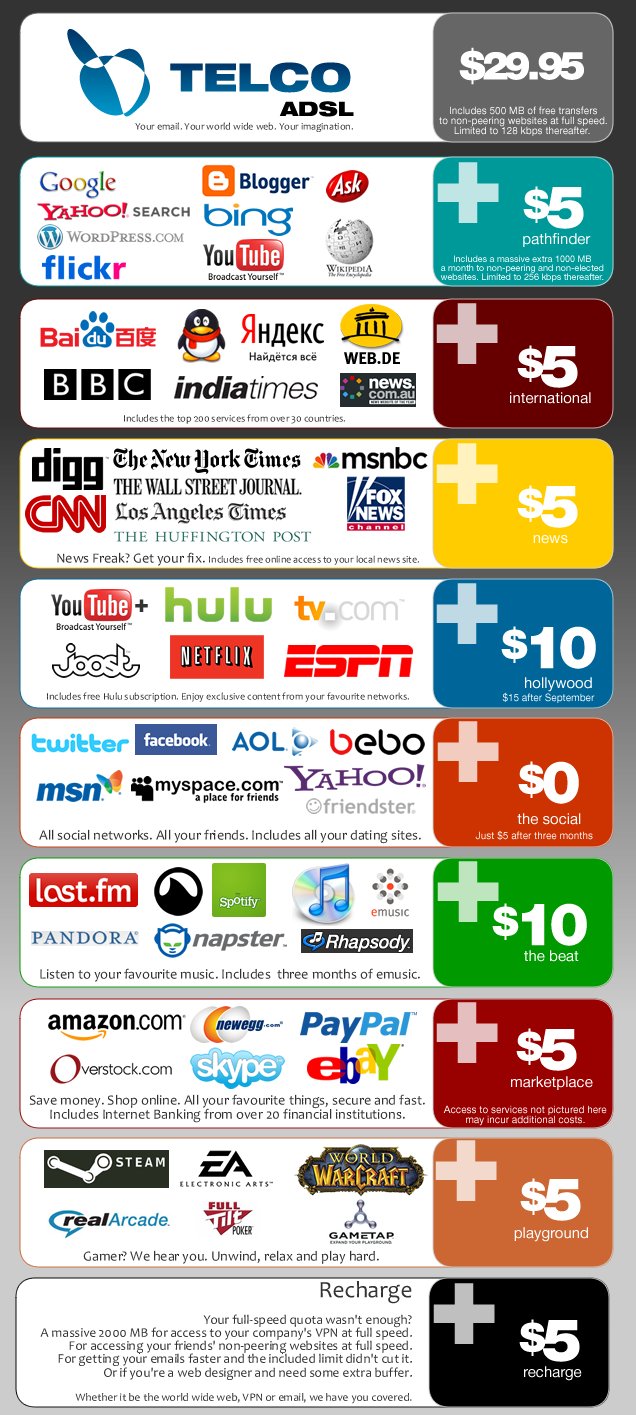
Large businesses are becoming a greater liability than ever before. Although I applaud net neutrality advocates, something greater must be done: the takedown of large corporations and rebuilding them from scratch.