they trained a huge neural network with millions of unlabeled frames from Youtube, and derived high-level features. The authors showed that the network learned without supervision the concepts of human face, human body... and cat.
That work was impressive -- but kind of over the top. From what I can tell, their dataset could at most have been like 2.5TB uncompressed. Their model took 3 days to train on 1000 16 core machines. They called this "inexpensive way to develop features from unlabeled data". Later they point out that their model was "more than an order of magnitude larger than other large networks reported in literature".
Fun idea, but definitely needs more training. It even gets things wrong on the test images (sometimes spectacularly - why those leaves in particular?).
For me the demo-images don't work, too:
Uncaught TypeError: Cannot read property 'type' of undefined on line 64 of demo.js:
if (!file.type.match(imageType)) {
And please don't offer only a drag&drop-uploader. For people like me who are not using a file manager it is impossible to use that site with local images.
Ditto for Mac/Safari. There must be something diabolical and/or useful to do with this tech but I'm struggling to come up with a good use case other than 'because kitty'
Aside from the earlier mention of 'I want to just let my cat into the house to the exclusion of others' I think it's interesting because if you're not in the computer vision world, you don't see a ton of stories or demos about detecting things other than human faces in pictures.
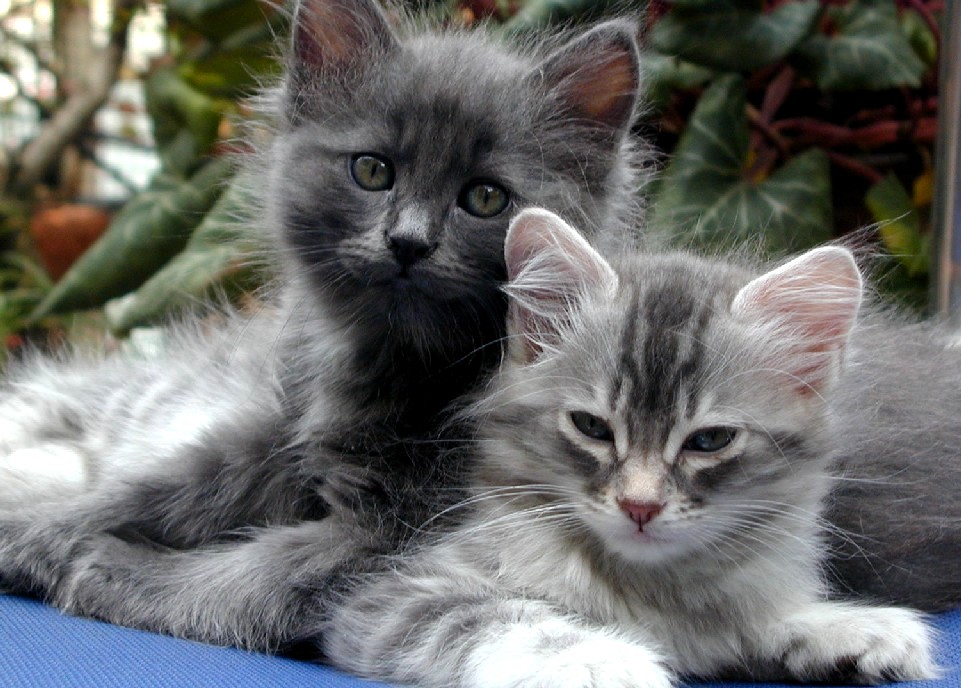
I tried a few different photos of multiple cats. It'd always get 1 correct positive, but never more than 1 correct positive. In every image's case, it would have multiple false positives in a cat's fur patterns.
Neat start, though. I have a particular interest in this subject as I'm entertain schemes that allow our cats into our garage while locking neighborhood cats out. I ran into similar issues with fur patterns during image processing techniques. I'll probably end up relying on a more simple solution: RFID tags attach to their collars.
Your cat may already have an RFID tag - they're used in the process of "chipping" cats so that they can be traced if they find themselves at a vet without their owner. If there is one, it'll be on the back of their neck.
These tags tend to migrate, particularly in older animals. Shelter workers are trained to check the entire animal as the tags often end up on the animal's side or stomach.
I love how simple the photo uploader is. I'm currently working on a new upload system for my site, does anyone know how compatible a drag and drop system that automatically shows the image like that would be? Does it work in all browsers? IE? It seems to work in all of my browsers but my target users are not very computer savy and usually have IE7, 8 or old computers.
The test image with four cats on a "Hello Kitty" rug results in only three cats being detected. The white cat on the far right has it's eyes nearly closed; maybe this is why it wasn't detected?



http://research.google.com/archive/unsupervised_icml2012.htm...
they trained a huge neural network with millions of unlabeled frames from Youtube, and derived high-level features. The authors showed that the network learned without supervision the concepts of human face, human body... and cat.