1. You need a _lot_ of insulation at 50kV
2. I'm no expert but I very much doubt you could run a motor at anything approaching that voltage. Current electric cars, for example, run c400V as the main motor supply. So there would need to be voltage conversion, which adds weight and bulk.
Quite a few of the newer EVs have 800 V batteries to make fast charging more practical with cables light enough to be handled by ordinary humans.
You can make an electric motor run on pretty much any combination of voltage and current. You just have to make the appropriate trade-offs in insulation, conductor cross section, etc.
When I went to high school the teacher told about a science fair where someone had put a sign next to his project reading:
      WARNING
   2 million Ohms
(or something like that, I don't remember the actual number of Ohms for this specific project)
A remarkable number of people kept their distance from this obviously dangerous experiment.
The chemistry-equivalent of this joke is to warn everyone around you of the presence of dangerous di-Hydrogen Oxide which kills hundreds of thousands of people every year.
> The chemistry-equivalent of this joke is to warn everyone around you of the presence of dangerous di-Hydrogen Oxide which kills hundreds of thousands of people every year.
As has been stated, voltage isn't a limitation, its the current that. Go and look at the HT wiring used in a cathode ray tube display, and you'll see it's a lot less that 12 AWG, and happily carries 10-20kV.
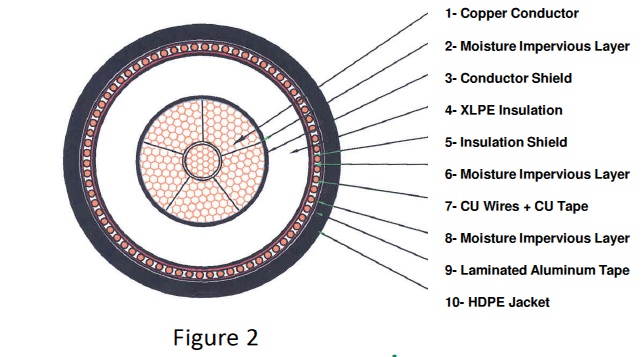
Why not? You obviously wouldn’t do it to a THHN conductor that is rated for 600v, but there are certainly #12 AWG conductors rated for higher voltages. They have a whole lot more insulation/layers than a regular 600v rated conductor, see: https://www.powerandcables.com/wp-content/uploads/2019/10/Fi...
High voltage utility distribution lines aren’t insulated by anything other than porcelain bushings and air.
The term "12 AWG" only specifies conductor thickness. Voltage is limited by insulation and current is limited by conductor thickness. Assuming sufficient insulation, it's safe to run arbitrarily high voltages through any conductor, since it doesn't even "see" the voltage.
Most store-bought wires won't have sufficient covering to prevent arcing, so you might get a short circuit somewhere. If you insulate the wires sufficiently however, any wire will take almost any voltage. It's the current you should worry about, as other commenters have already mentioned.


Not really, high speed train lines do it all the time. They usually operate at 25 kV or 50 kV and often consume a few megawatts per train.
(At 50 kV, one megawatt is only 20 amps, which you can deliver on 12 AWG wire, theoretically.)