It's a shame the article focuses so heavily on the green aspect rather than the process, but I guess BMW doesn't want to give away trade secrets, and this is just a regurgitated press release.
For example, what's going on in the first stage of the process where the paint head seems to be drawing but nothing shows up. It's it painting liquid masking tape onto the car? Just thin lines of the same paint? The robot appears to switche paint heads after doing it, suggesting it's maybe a different substance, or maybe just a different spray head.
The head have a laser measurement tool and measures the exact position of the motor hood with sub milimeter precision. Then calculates corrections for its program to apply at the exact spot everytime.
Disclaimer: I work robots in paintshops like these.
Example:
The inside of your car door have plastizol sprayed over whole edge. That is actually sprayed while the doors are (almost) closed (think open as if latched by the lock, but not flush). The nozzle is a 0.5mm wide tube, that makes 3 90° degrees turns (left, right, right), and have opening in the direction pointing back at where it started. When the carbody gets into position, fixed cameras measure preset points to make sure its in right position (wiggle room ~20-100mm). Correction gets computed from that, and robot measure pass program is moved accordingly. Now the measure process is repeated with robot head holding a laser tool, measuring tenths of milimeter deviations, wiggle room ~2mm.
If the shape is just moved within tolerances, the robot modifies apply run with corrections from measurement and goes to work. Starting at corner, weaves the nozzle into position and runs along the whole doors (sometimes pulling out and back in at some corners, but some corners are turned without pulling out). Theres usually at least half a millimeter spacing between nozzle and an edge, the precision is maintained even during fast movements.
The nozzle is thin and long (5 cm) and easily breaks or bends.
Before every spray run the tool itself is measured (and the correction is computed and used), and used only if its not bent out of tolerance. If the tool is found faulty, robot can hotplug another nozzle (have like 5 ready), measure it and go fully autonomously.
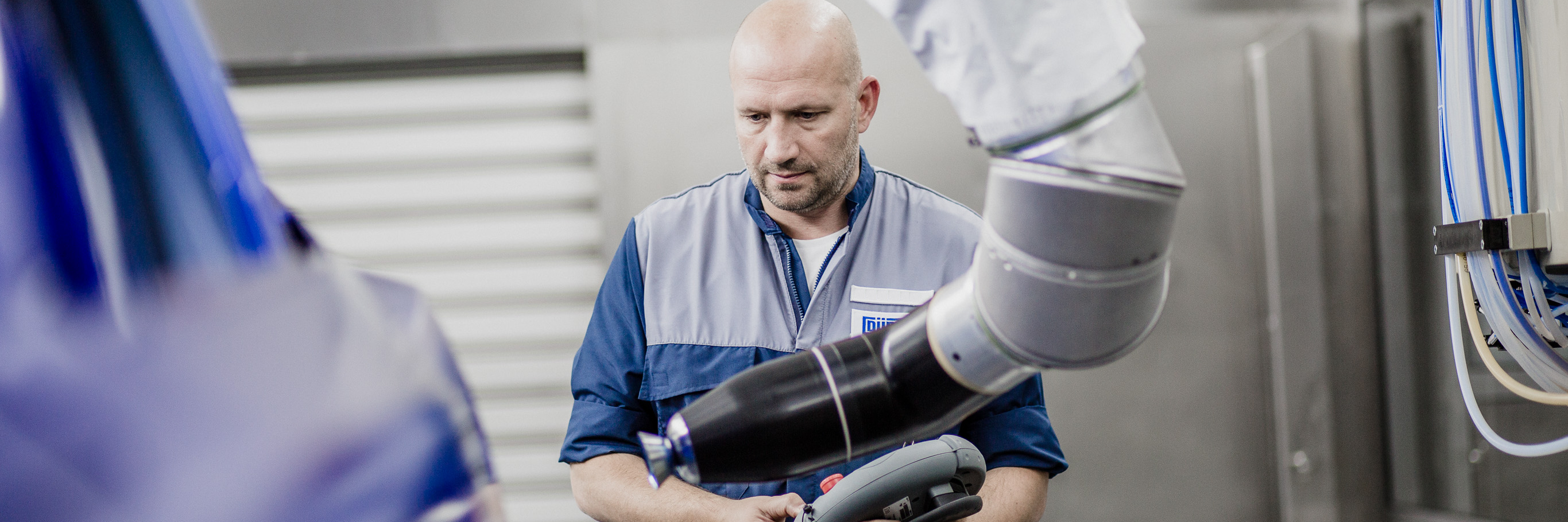
Theoretically, you dont need any CAD. The robot doesnt care about actual surface geometry. In fact, you can just move robot axis by axis (or by xyz) "by hand" (looks like this [0]), and teach points as you go.
Usually CAD is provided ahead and you can "teach" the points virtually on PC, simulate it and everything, before testing it with real robot and carbody.
For exterior painting offline preparation is often enough. For interior painting this can be fine, but sometimes you need to move few points by hand in booth coz the CAD usually dont show absolutely everything (think springs holding cardoors closed).
For applying the sealant, where required application precision is in similar range to manufacturing tolerances, it make sense to only prepare program structure, as you need to manually teach every point precisely on the same body that was just measured.


For example, what's going on in the first stage of the process where the paint head seems to be drawing but nothing shows up. It's it painting liquid masking tape onto the car? Just thin lines of the same paint? The robot appears to switche paint heads after doing it, suggesting it's maybe a different substance, or maybe just a different spray head.