TFA talks about agriculture being the biggest drain on California's water supply--I'm always disappointed that California (probably the most left-leaning state in the country) can't pass sane environmental policies... I can empathize with the impulse to defer restrictions on carbon emissions--carbon is a little intangible and even if California goes to zero co2 it is still impacted by the rest of the world's carbon policy. But water? Every Californian is impacted by the droughts and how other states or nations manage their water has little bearing on California's water supply (of course California's drought is a product of global co2 emissions but I strongly suspect California could have plenty of water if it was managed sustainably).
It’s not that simple. Water rights in California are complex, often dating back to the Gold Rush era.
It’s based on ‘first come first serve’ - the first owner to take a certain amount of water from a waterway can continue to do so.
Directly modifying those rights would take a long time and be challenged in the courts.
Also, the Central Valley is full of poor farmers who have already been badly affected by recent drought (just drive down there to look at the billboards), so restricting agricultural usage would be another nail in the coffin for their livelihoods.
Subsidize the farmers' losses and overhaul the water rights (deal with legal challenges later doesn't make the problem go away). Eminent domain as necessary. My family has farmed for centuries, so I sympathize, but sustainability is paramount.
California sold rights to pump water to farmers a century ago.
The only way to legally undo that is to use eminent domain to purchase those rights back. Given how productive and valuable the farm land is and how scarce water is those rights are now absurdly expensive… it’s an intractable problem.
this is like one of those cities that sells a century long parking enforcement contact to pay the budget today. it's so so so far watching some misgovernance today be unammendable for a series of generations.
personally I feel like there has to be some way to reassess. simply letting ancient decisions hold in pepetuity is not acceptable.
At worst it would make people think "wow, I can't trust the government to uphold agreements 100+ years out into the future if some information comes along to suggest that they shouldn't be upheld", which seems like... exactly what the public should think?
Deciding ancient laws, no matter how sucky, must all be iron-clad & that modernity/the future get no say is critically de-legitimizing, and in these cases seems to be headed quickly for cataclysm.
Giving alive people some sovereign rights over the dead, as is the case with these water rights issues, seems necessary to maintain the basic social contract, to maintain the mandate of the people. Not fixing this seems deeply de-legitimizing.
The "basic social contract" in the United States is the United States Constitution along with individual state constitutions. Our system of law is not about making the determined mob of "alive" people happy right now. Higher-trust complex societies need things to change slowly to maintain that trust. If anything, I'm even more "de-legitimized" when your state steals my water rights.
I find this intransigent view of what change might look like to be staggeringly repugnant. I think it represents a very staid, limited, unwilling view of how society ought be willing to adapt to conditions it finds itself in. calling modern situations a mob, discarding obvious crisis out of hand: that delegitimizes the trust your post claims is of such utmost importance.
you talk about slow change, but there seems to be nothing at all that society can change. we seem perpetually bound in old grants & fantastic claims. the only suggestions I've heard from anyone are that society must bargain for its basic human rights to survive, in apocalypse situations, that these vast vast vast free grants have caused.
color me very very very skeptical of your so called ideas of stability: I think you have it very wrong. there seem to be no rights given to the future, nothing reserved or allotted to the general population. I've little trust on your claim that that defines stability, that all new comers must fend for themselves amid a situation of dire need: caring only for the getsntocratic olds seems uncivil, ill governed, the very definition of illegitimate.
I'm not saying that. I'm just saying those agreements / rights are theirs until a court decides they ain't. That is the proper process. We can't just ignore them completley.
Why not tax agricultural use, and dwelling use of water above its zoned capacity at the cost to desalinate? I’ll gladly pay that premium for my Californian lettuce while the farms pack up shop and move somewhere sustainable and less expensive.
Seems like that would leave farmers left holding the bag for California's decades of mismanagement. If you subsidize the farmers then this system would work, but I suspect there are simpler ways to achieve the same ends. Notably, I don't think there will be enough people willing to pay the premium for California lettuce to make up for loss of volume, and I can't imagine California farmers packing up and moving across the country (it's particularly cruel to require them to uproot from their families, communities, etc). Seems like it would be better to pay them to farm a crop that is less water intensive or something.
It's even more complicated as aquifers cross state lines and you can end up with situations where one state has 10% of the aquifer but can draw more than 10% of the water.
The article's callout of alfalfa is an exception to the rule. Beef cattle eat a lot of human-inedible silage (byproducts of raising corn and soybeans) and for economic reasons the land they graze is typically non-arable land. Beef is a natural way for humans to benefit from the inedible byproducts of corn and soybean operations.
Re: water, typical cattle operations supply natural rainfall (gathered in ponds) and not irrigated, meaning they return the moisture they consume to the soil along with some nitrates which fertilize the plants they graze -- they do not somehow retain 106 gallons of water per pound of meat.
If you don't live in a desert, cattle are a beneficial part of the ecosystem as they extract human-edible calories from non-arable land. During drought, irrigation and supplements like alfalfa become necessary to keep a herd alive, but the problem isn't the cattle -- it's the drought.
Drive the five and its not marginal land being grazed for cattle. These are factory feedlot operations, not bucolic rangeland operations with 1500 head on 150k acres.
Can you put numbers on all those industries? I was under the impression that alfalfa for cattle feed was the most egregious waster of water on the west coast of the US, based on articles like https://www.bloomberg.com/opinion/articles/2015-05-26/why-th... and the well-known dairy subsidies, but I haven't looked at it in the last five years.
I don’t understand this internet obsession with bottling water. Surely under the worst drought conditions bottling water has to be the very last thing to stop. Literally water for humans to drink has to be a top priority.
"Water for humans to drink" comes from the faucet. The bottled water industry shouldn't exist at all, other than as a niche product for areas hit by natural disasters, remote construction or work sites, and so on.
No, and it couldn't be, which the point that you seem to be circling. Markets aren't self-governing--they don't set the rules that they abide by (including which externalities are priced in and which aren't)--that's a function of government.
> Then the negative externalities should be properly priced in.
is what I was replying to, saying the market isn't going to naturally do this because capital doesn't actually care about negative externalities until forced to.
Right, I'm pointing out that it's a nonsense comment. "The negative externalities should be properly priced in" implies government intervention, and indeed the market cannot do it. At best you're violently agreeing with everyone in the thread.
Never lived somewhere with tap water you could smell from a foot away, and taste over the flavor of any tea brewed in it, no matter how strong, huh? And yes, that's in the US.
(though, sure, a home water filter might also solve that particular problem)
> a home water filter might also solve that particular problem
Yes. I don't see why it's an issue. A lot of houses have water softeners because hard water destroys appliances. An RO filter for the kitchen isn't a lot more expensive than that.
(And I've also lived in developing countries where the water isn't always safe to drink. Boiling or filtering worked fine).
Makes some sense, still, especially for renters, if they don't want to have to move the system and have a big (yes, it's big to some people) up-front expense. If it's just for drinking water, it looks like you can get over 2500 person-days of drinking water in the form of CostCo 16.9oz 40-bottle packs ($2.95 for 40 bottles) for the same price as a cheapish RO system (~$200—you can buy about 333.3 gallons of that Costco water for that). About half a liter of plain water intake per person per day on average, in the US, from what I can tell. Even if you double that to account for tea and coffee, that's about two years' drinking water for a couple.
Considerations: that's not even the cheapest filtered water one can buy, and the RO system has consumable filters (= more expense—frankly, I wouldn't be surprised if the bottled water is straight-up cheaper, overall), maintenance, and installation to worry about.
I don't think buying bottled water regularly is necessarily irrational. FWIW, we do have an under-sink filter on our kitchen sink rather than buying bottled water, though I'm not convinced it's justifiable based on cost—we don't live in so-bad-you-can-smell-the-water land anymore, but the filtered stuff still tastes a lot better, and it's nice not to have to remember to stock up on water at the store, though we're so bad about maintaining the filter that I think if we did it right the extra time and more-stuff-to-remember would make buying drinking water more convenient after all)
Why not crank up the prices on bottled water instead? And if household water usage is minimal, why crank up prices on it at all? The reduction in demand won't make a dent in overall usage and it'll hurt a lot of poor people.
EDIT: Never mind, you said usage for drinking. I agree, things like lawns are wasteful. You could probably increase rates on households that consume more water.
A greater percentage of bottled water is drunk. Drinking being the most critical use of drinkable water. If there's a shortage that's the activity you want to most prioritise over others.
I didn't say household water use is minimal, I said a tiny portion of it is used for drinking. People use on average like 200L a day and drink like 3.
It's mostly used on showering, gardens, washing machines, toilets, pools, dishwashers. Activities that could generally be cut a fair bit. You crank up the price and my showers are definitely getting shorter, my non-existent garden pool and dishwasher would get removed if they existed, id pay attention to the water level setting on the washing machine instead of just leaving it on high, and only flush for shits. I absolutely do not believe people would eat a huge budget hit to keep these activities nor that they're already running at a much higher rate of water efficiency. Demand would plummet and more water would be available for drinking.
Everything hurts poor people more. That's how having a financial buffer works. It's basically the definition. Poor people are people who have few or no resources. You want resources to make life less painful. Cutting water use hurts poor people. Allowing things to get so bad that neighbours have water flow issues would hurt them more. It's not going to be the wealthy that go without in any scenario so "trying to fix it will hurt the poor" is a nothing statement.
> I didn't say household water use is minimal, I said a tiny portion of it is used for drinking.
I think you only read the first part of my comment and missed the edit.
Also if we're talking about drinking water, transporting it through pipes is way more efficient than putting it in plastic bottles and trucking it all over the place. Sorry, bottled water is a loser whichever way you look at it, even if it's primarily drunk.
It's exploitation of under-developed regions with ridiculous profit margins: Free water, cents for billions of PET bootles, packaged and sold for dollars.
This environmental impact of plastic and indigenous water resource impact is completely avoidable. [0][1][2][3]
The business model of the bottled water industry is to take public water from limited local supplies and then distribute it globally, obviously at a significant profit to themselves, regardless of the actual need for that water.
Globally is the key word here. I'm not familiar with bottling industries in the south west, but in general, if you're taking a scarce resource from a locality and distributing it elsewhere, it should be clear how that can quickly become problematic. It's more of an issue if that scarce resource is as fundamental to survival like water.
Ideally, the SW would be importing bottled water, not exporting water, because it's not something they have in abundance. If there are large commercial operations exporting water, they should be the first to be cut off from these operations. That seems very unlikely it would be permitted though.
Personally, I've never wanted to live in this area (or at least make a large investment in a home/property) due to the scarcity of water coupled with growth. Nothing against the region, just seems like an unecessarily impractical region to live due to environmental factors and the climate models I've seen, at least for my comfort levels.
There's plenty of drinking water if states manage their water sustainably. The biggest draw on water in most places is agriculture, not drinking water. There's no reason to pump aquifers dry and then use energy to transport water from elsewhere.
Sort-of related, but my local water supply is used for bottled water. They were drilling a new well which was not completed on time, but had already signed an agreement with the company for water rights. I was unable to wash my car, etc, but they could happily bottle water.
We have a lot of limestone here, so our water is pretty good but has significant mineral content. Without a water softener my faucets would be ruined within years, caked full of minerals.
I thought about mentioning those companies, but I considered them to be too small of a market comparatively. For example, almost everyone buys 12-24 packs of their semi-locally bottled water, including national brands Dasani & aquafina that come from local bottling companies. I can't talk about the water issues in Fiji and France, but my guess is that it's <1% the total volume of bottled water consumed in any given area (outside LA or NYC of course).
Sure. Then just say I’m mad because these water bottling companies get the water concessions for cheap (and I don’t), instead of some other made up reason that might be less honest but a more sympathetic argument.
Arguably the reason they bottle the water is because of the cheap concessions. Without those, their profit margins are a lot slimmer and maybe the industry is much smaller, leaving more water out of bottles.
They're selling the cheapest commodity in the world for more than the price of gasoline. Even with smaller margins they're still making money hand over fist.
I'm not sure I understand the word "subverting" here, those uses are for human consumption directly and food production, those feel pretty legitimate. Arguing against grassy lawns, I can see.
You can import food grown elsewhere; it's not sustainable to water-intensive food locally. Bottled water is an inefficient and carbon-intensive solution for drinking water--drink from the tap.
Wow the Bureau of Water Reclamation actually has a pretty good website where you can graph all the aspects of reservoir data. https://www.usbr.gov/rsvrWater/HistoricalApp.html I would say that less inflow to Lake Powell would be a sign of climate change. If you look at the past inflows since 1965 the most recent years seem to be in line with the past. It looks like total releases might have increased a little lately but not that much.
Unless the US embraces nuclear fission (or renewables at a scale not yet seen) for ocean water desalination the arid deserts of the southwest (and they have always been arid, that's not new) might have to return to their natural state instead of the artificial state they've been irrigated to the last century.
According to the graph in the article, the Colorado River is about 5 million acre-feet (per year, i assume) below its benchmark. That's ~6.17 billion cubic metres.
If that shortfall was made up by desalination, using 3 kWh/m3 (the low end of the range [1]), that's ~18.5 million MWh per year. California's only operating nuclear power plant produced 18.9 million MWh in 2016 [2].
So this would be a big job, but not an unthinkably big one.
Unless i've dropped some orders of magnitude somewhere in there.
The oceans have an area of ~89.2 billion acres [0]. Abstracting those 5 million acre-feet would lower sea level by 17 microns. Sea level is rising by ~3.6 mm per year [1], so you would need 211 of these setups to counteract that. Scaling up Diablo Canyon's nameplate capacity of 2256 MW, that is 475 GW. There is currently 390 GW of nuclear power in the world [2].
So, again, not unthinkable, but really quite a lot of work.
I'm thinking bigger than the Colorado river. I also think scaling up nuclear power is a good idea--the economics of managing nuclear waste imply that the cost of managing a little bit of nuclear waste is not much lower than the cost of managing a whole lot of nuclear waste, so we're already committed to most of that cost.
> And i'm not sure what you do with the water.
Use it for agriculture (presently a whole lot of agriculture depends on unsustainable access to water) and desert greening. To be clear lowering the ocean levels is a nice byproduct of producing more water, not the other way around.
Nuclear takes a long time to scale up so this certainly isn't feasible in the next 50 years even if we had the political will. It's more of an interesting long term idea.
"Brine, water comprising about five percent salt, often includes toxins such as chlorine and copper used in desalination, it said. By contrast, global sea water is about 3.5 percent salt."
"Brine can cut levels of oxygen in seawater near desalination plants"
Can we lay those huge tubes underwater to disperse it drip irrigation style? It's not like it's a lot of salt once diffused, especially with those glaciers melting.
We're already assuming far more electricity, so I'm not too concerned about the energy required to pump the brine many miles out, just worried about capital and repair costs.
>often includes toxins such as chlorine and copper used in desalination
This is very avoidable. Most extant desalination plants are in the Middle East and subject to relatively little environmental oversight. While desalination will always produce brine, introducing extra chemicals is something that can be solved at the technology level.
Entirely possible (and occurring already in the south bay), but they scale poorly - they require very large tracts of land since the pools need to be fairly shallow. They're also fairly labor intensive, between harvesting, purifying, and transporting the resulting salt.
The salt has to be transported in any case (whether salt comes from a mine or from evaporation pools). Even if we don't make it into a byproduct but just put it in a big pit of salt adjacent the evaporation pools it would probably be fine (somewhere that we don't need to worry too much about it leeching into the environment, which is already a concern for evaporation pools). Not sure what applications of salt there are or how pure it needs to be (presumably there are other applications besides table salt)? Since we're already positing very cheap energy, we can probably also posit more efficient desalinization plants (resulting brine is even more concentrated, taking the load off of evaporation pools) since I'm assuming that the energy cost is the bottleneck in desalinization efficiency.
This can be a solution - perhaps it's not a good solution, but if the other options are worse, people will gladly trade a dead zone in the ocean to prevent a dead zone around where they live and grow their food.
Desalination might be more appropriately located in the Gulf of California. There is extreme tidal variation (about 4 meters!) in the upper part of the Gulf, which means that released brine will be mixed with seawater more rapidly than in most coastal areas.
>Sea-to-Sea plans would augment the declining volume of water flowing into the Salton Sea by importing water from either the Gulf of California or the Pacific Ocean. Because such ocean water will bring tens of millions of tons of new salts into the Salton Sea, such plans also need to either pump a lot of water out of the Salton Sea to export the millions of tons of salt, desalinate the water before it enters the Salton Sea, or run multiple desalination plants at the Salton Sea itself.
Yeah, you're not going to do that without a ton of pumps. I ran the numbers once for a pipeline to the Salton Sea and it looks bad. However, if you built a canal (about ten meters wide and the same deep) and flooded the whole Imperial Valley (this isn't popular!), tidal variation would exchange all of the water on average about three times per year. There's an equation for pipe flow rate given a diameter and a pressure difference; the pipe you would need for the Salton is either unrealistically huge or has a really big pump. Hence, canal. I doubt it ever happens, of course, due to all the lost farmland/towns (and the "why bother?" factor).
What I was referring to is entirely different: the desalination occurs in Mexico and fresh water is piped around.
From reading recent news, California agriculture uses way more water than California residents. Now we need fruits and vegetables so we can't just do away with agriculture. But we can do something about which agriculture we allow in the state.
Just over 50% of the water in the Colorado River Basin is used to produce beef and dairy. This means the water consumed by the animals themselves along with the water used to grow the alfalfa they eat. Also, lots of alfalfa is sold overseas to be fed to cattle.
Almonds are by far the most water-intensive crop in the Central Valley. Much of the crop goes to almond milk.
If we could roll back these two food classes we would have much less of a water problem.
Lots of good info on the history of water rights and issues in the western US. IIRC it mentions a bunch of alfalfa (very water intensive crop) being farmed with coveted water from the Colorado river, among other peculiarities
Perhaps we shouldn't put major cities in arid regions, or we get off our behinds and get desalination going at the levels needed to sustain such cities.
The statewide average is deceptive here. The northern Front Range (South Platte basin) had a very snowy / wet spring, but the rest of the state is well below historical averages.
Unfortunately the part of Colorado that feeds much of the rest of the southwestern part of the US it's water is still below average in snowpack this year:
The geography of united states and north america is what gives us unique weather. The rocky mountains create a huge 'divide' in our geography and naturally ends up causing what is known as 'lee troughing' on the eastern side of rockies. Essentially the mountain range promotes low pressure development (storm development) on the eastern side. Which is why the other side of the mountain is so dry. Our side of the general storm system is wet, their side out west of rockies is dry.
This problem will not go away unless we change our food production methods.
This is a global challenge. While it might centralize in specific regions, food production destabilization in one region affects others obviously.
Today, we have technology that can replace soil based farming. Aero/hydro farming is already here; I purchased strawberries from my local grocery store just the other day, and they tasted great.[1] There are other, far larger B-corp certified solutions such as [2]. The economics of it still has to be figured out in some cases, yet if we invested and developed in this technology it would be far healthier for our environment in general, I believe.
I'm in eastern Europe, pay isn't too bad, rent isn't too bad, our city is getting developed, new buildings etc. We have lots of water, May was actually one of the coldest I've ever experienced. We had hardly any lockdowns because of covid, and we were fine.
Then I see all the news from California, the whole economy got closed up, there's a massive drought. Rents have been insane for years in most cities. Huge homeless and drugs problem in LA, San Francisco.
And on top of this, some of the highest tax rates in the US. For what?
What is happening to this paradise state?
And what worries me a lot is, a lot of the culture worldwide is set by people living in these conditions. Not just film, but tech now. I mean I can see why everyone in california is frustrated with capitalism and all the rest of it, but that's california... The conditions of which I've just listed.
A lot of California's problems come from the fact it IS an amazing State to live in. A paradise state as you put it. The weather, the parks, the jobs, and the diverse people. Where California went wrong is that, when people started flooding in looking for those things they didn't build any cheap housing. All they built were stupid luxury apartments and monstrous single family homes. Not enough of them either.
When you look at Eastern European population curves, most are flat. On the other hand, in half a century, California went from 15 million to 40 million people. In addition it built a HUGE agricultural industry that absorbs water from the entire western side of the nation. 1/3 of vegetables and 2/3 of tree nuts in the US come from California.
I wouldn't be surprised if California revitalizes in a few decades when they get their head out of their butts on housing. Getting rid of R1 zoning, building better transit, etc... Water on the other hand is going to be a problem unless South and Central America start growing a ton of tree nuts and drops the prices. (Probably in the smoking crater of what used to be a rainforest)
Luxury apartments doesn't mean anything other than new construction. No one ever build super low end new housing in a desirable area, the land is too expensive. You need new construction like this to push down the value of existing housing.
Not just land, but regulations and building codes are so strict that the base cost of new high density housing is so high that it isn’t economical to offer as lower rent or lower cost than “luxury” without some form of subsidy. So these things need to be built and sold or rented to the relatively wealthy so that 30 years from now they are depreciated enough that they can be offered to lower income groups.
Honestly, they are in fact Luxury apartments. Absolutely gorgeous and well appointed with huge swimming pools and excellent gyms. Maintained to impeccable standards. Beautiful kitchens with excellent appliances. The whole nine yards.
Most of those amenities other than the pool don't add very much to the cost of construction at all, especially interior finishes. When the cost of land is so high and the number of units you can build is artificially capped you have to charge a certain level of rent to hit the 3-5% margin required to get loans for a project. At a high enough rent, your renters will demand some amenities that competing projects will build.
All of the buildings you're linking to are mid-rise developments with VERY low lot coverage dictated by local zoning. The look nice, but not that amazing compared to other new development around the country.
My point being, you can't just build cheap housing on astronomically expensive land, the math doesn't work. Crazy zoning laws add to that cost. Pointing to new development as the problem is simply wrong. If people want new construction at a lower level of affordability, then they need to change laws that drive up the costs of building. If the banks won't/can't loan money to a real estate project with an expected margin of return of < 3%, then what do you expect?
It has great weather, beaches, great food, fun cities, an extremely wide range of biomes for nearby trips, and many extremely well paying jobs.
Sure it has it's problems, but I think what you're describing is an area that's rising (eastern europe) vs an area that rose in the past and is dealing with an equal balance of ups and downs. So it looks like a hellscape. That being said, the governments there do make some weird decisions, and issues with rent prices could be solved by allowing new/higher density construction.
What I'm getting at is income and standards of living are probably rising in your area faster than California, and that makes it feel like its wealthier/more pleasant on an absolute scale when it's in a phase of catching up.
This is a personal hypothesis and I have no sources for my assertion besides my own anecdotes.
I've noticed that Californians have a "we have to do something / we can't just do nothing" mentality when it comes to problems. So what ends up happening is that the California legislature will gladly pass laws which implement new bureaucracies to address whatever issue happens to be trending. This is how Californians end up with so many line items and fees tacked on to every government transaction. You wind up with a very complicated government and some bizarre rules that seem like overkill. And, the more complex a system is the more likely it is to be inefficient and ineffective due to all the moving parts.
I have similar anecdotes. To me it seems like people who pass laws forget that they need to support and maintain them into perpetuity. At first things are efficient but long-term support can fall by the wayside.
I think some laws are passed with expiration dates. I would support more of this to reassess if people still have the will to enforce and support them.
Part of me thinks it's a feature and not a bug. The politicians are artificially creating jobs and getting a reliable source of votes by doing so. And there are also downstream jobs from supporting these laws.
To me it's dumb that the government needs to issue a sticker to know which cars are EV's or Clean Air vehicles. Wouldn't it be more simple to just know that Tesla's and Toyota Prius's are clean air cars than to require people to put stickers on their bumpers that expire every four years in order to get prime parking spaces and HOV access? Additionally, there's a bunch of paperwork involved and qualification processes based on income and other things https://www.dmv.ca.gov/portal/vehicle-registration/license-p...
I'm sure that this bass-ackwards system provides plenty of work though.
The reason for those stickers is that they're color coded. My Tesla allows me access to the carpool lane for 2 years and no more. It's a temporary carrot, not a permanent one.
California is this land of plenty that grew so fast that it's almost like a country in of itself. That growth happened at a particular place in time that really colored the governance, and is almost dysfunctional by design to allow everyone to function!
So you have the features of a big state, with some of the quirky weirdness of western governance (propositions, etc). I'm not an expert on California, but looking at it, it feels like a place that selected the best thing and worst thing about governance in Florida, New York, Idaho, New Jersey, Illinois and Virginia, and did all of them.
What drives up prices? Demand. What pushes people out of housing? Those prices.
NIMBYism, density restrictions, etc, are largely "universal" US policies, vs liberal/conservatism splits, so it's the demand that's the difference here between the rest of the country. Note the difference in population density between a Houston and a Los Angeles. LA just ran out of neighboring land to sprawl into first, yet the demand kept coming...
And on top of it, there's a mismatch between where people want to live and where jobs are available, so you've got homeless in CA cities and unfilled jobs in the middle of the country...
Those prices are increasingly starting to cause more and more people to leave, but still predominantly lower-and-middle-income people - and the demand and prices are being driven by the high-income or high-wealth people - so I'm not sure it'll change much.
This is more reflective of the media bubble you are living in; it’s not nearly as bad as you think. Especially if you’re into tech (say you read hacker news) any problem that exists in California (where a lot of tech people live) is a hot discussion topic.
California's a big economy. But it's not (at least superficially) outsized relative to other parts of the United States that contain similar populations.
California is overrated, and now people are seeing it. Things that were easy to turn a blind eye to before are now becoming more and more difficult to deal with: homelessness, drug addiction, forest fires, droughts, wealth disparity, rent, commutes, taxes. I've never found california outstanding or attractive, and the issues that people are starting to point out now have existed for ages. Even in 80s/90s media you can already see a lot of the issues that we're disussing. Whatever the reason, I hope people continue sticking their head in the sand and moving to CA to leave the rest of the country open for people who don't like the californian mentality
Pay might not be "too bad" in eastern Europe but it is certainly not California levels. Not sure what the whole economy got closed up means, but for the average software engineer things really didn't change economically.
I live in LA and while we have our problems, it's still a paradise state. Still 100s of cultures running all kinds of businesses and restaurants. The only thing that's a bit blech is the high number of opiate addicts that roam the streets but it's a complex problem to solve. We really need some kind of mandatory drug rehab and housing without causing individuals rights to be taken away.
I've lived in California for many years, as in 3 other states, and I can say that while the opinion that California is a "paradise state" is common among Californians, it's very far from unanimous, especially if you talk to people who don't live there. Personally, I disliked California quite a lot and I decided to leave it despite the (not too) negative impact on my career.
California is fairly racially diverse, but isn't that ideologically diverse - election results will clearly show that. I have conservative friends (both Trump conservatives and anti-Trump conservatives) who very frequently complain about the lack of diversity in the state. It's great if you are a liberal, not so much otherwise.
The weather in California is indeed good, but not for everybody. Its famed summers are very dry. If you like sun, you will love California summers, but you can get a LOT of dry days in a row. If you like a balanced mix of rain and sun, you will not like the summers in most of California. Also, because of this, a lot of the state's urban areas - especially in SoCal - is very brown and not really that pretty if you like the lush East Coast forests.
California beaches are not that good depending on what you expect from a beach. It's easy to do fun activities at the beach, but the water is quite cold and the sand isn't to everybody's tastes. Parking and driving times can also be brutal in the urban beaches. Very many people would rather go to the beaches in Florida or in the Carolinas than California, not including of course beaches overseas. I personally disliked the beaches there and only went a couple of times over the years.
Overall, I think the reason many people say California is a paradise is that it's a pretty unique state with a lot of personality (for better or worse), so if you are into the things California is good at, then California is the place for you because you won't find their particular mix anywhere else in the US.
But it remains to be seen that this particular mix of traits would be considered a "paradise" for most people.
What I'm saying above is somewhat obvious, as in "If you like California you like California". But when people make grand statements such as "this state is a paradise", one would assume that the vast majority of people who go to California would absolutely love it. But I'm not sure that's the case, especially if you include the enormous number of man-made problems we discuss so much.
Hey, I just want to say, I appreciate your well-thought out response. CA isn't for everyone but I've lived a similar life to you (lived in California, Utah, Illinois, and Georgia) and I loved everything about each place. Chicago was my least favorite due to the bitter cold in the winters but every state has some nice things to offer.
I can't imagine ever choosing a place to live based on what my neighbor's political ideology is. It's a sad reflection on the state of this country that CA is the conservative prime evil and the south is full of dumb rednecks to liberals.
It's amazing what actually going to places reveals - that there are actual human beings that live in these places, and perhaps aren't as unreasonable as twitter makes you think.
There are a lot of hand-waving, speculative answers in the responses to this question, but the reality of the answer is that it actually goes far beyond what is happening in just California.
Firstly, I think its important to note that everything you cite as an issue in California is happening writ large across the United States. Every issue you cite is repeated again and again in every productive economic center across the United States. Absurd rents/ housing prices/ CoL, devastating issues with homelessness and drug abuse, increasing devastation from climate related weather issues. California stands out as particularly addressable because for better or worse (or due to the sierras and the southern desert), California is a bit of an island unto its self.
I grew up in southern California and watched the impacts of the 2007-2009 economic collapse in real time. I was extensively involved in activism related to homelessness at the time. I watched families and communities become absolutely devastated by the economic (and resulting homelessness and drug abuse that inevitably follow) fallout from those events. To summarize, California (and the US through analogy), never actually recovered from the 2008 crisis. The families that fell during that time never really got up again. Working class (labor) families went from thinking they could support their first and second children through community college and eventually four year university, to barely scraping by or living in slow decline. The vast majority of families impacted by the 2007-9 economic collapse never actually recovered, and have basically limped along or tread water since then.
The result has been an ever increasing disparity between the rich and the poor in California. In few places is this as well displayed as in the Bay area. The amount of wealth that has accumulated there is almost preposterous; and yet, it fails to hide an utter epidemic of homelessness and the problems that accumulate in its presence.
Several in this thread cite governance issues in the state of California. I call bullshit on this. The reality is that California is a huge and complex state with more economic activity than most countries. It shouldn't surprise you that it requires a complex bureaucracy to respond to that.
Very simply, the US stopped taxing or regulating wealth in the mid-late 2000's, and in the post 2008 era made it clear it had no intention of holding any one accountable for their actions in financial markets. Almost everything you see politically, socially, and economically in the United States is a direct consequence of that era.
Its my opinion is that the US is in serious decline and on a random walk towards a failed state (if it isn't there already? how do you define a failure mode for a country?). The US is unable or uninterested in taxing wealth or its highest income earners, and as a consequence, the wealth curve has gone asymptotic. The distribution of wealth in a society is key to its stability, and as the kurtosis becomes more and more positive, people begin to lose any incentive to participate.
The solutions to these problems are quite simple and no new technology is required to implement them. Return to a 90% tax burden on highest income earners and tax wealth directly. Force billionaires to spend their money or lose it. IF they want to take their ball and go home, then they lose their seat at the playground. The US has had policies like this in the past and they've shown their effectiveness.
In regards to the specific drought issue, the state was effectively plumbed during an abnormally wet era. What you are seeing here described as 'drought' is not too far off from the historic norms. Coupled with drought, California is also seeing its wettest years on record (2017/18), but due to climate forcings, its all rain and no snow.
I think the final emphasis that I would like to place is that what is happening in California is repeated all across the United States. Climate issues, housing prices detached from reality, homelessness and drug addiction running rampant, and no ability or will from the political apparatus to respond to these issues.
Wish I could upvote this more. Just thinking back on that time and hearing from my parents about multiple middle-aged male members of their church committing suicide during that time. There were more than just economic effects for so many yet once the stock market bounced up again, things were left ignored, left to simmer until we got the craziness of the past 4-5 years. One could say the lack of accountability after '08 set the stage.
In a word, history. If you just look at the last few decades you're seeing only a snapshot of an explosion.
California (the USA state) is young, ~150 years old.
For thousands of years only ~100k-300k people lived here.
> Settled by successive waves of arrivals during at least the last 13,000 years,[40] California was one of the most culturally and linguistically diverse areas in pre-Columbian North America. Various estimates of the native population range from 100,000 to 300,000.
The Spanish only got started in a big way in 1769 or so, then...
> In 1821, the Mexican War of Independence gave Mexico (including California) independence from Spain. For the next 25 years, Alta California remained as a remote, sparsely populated, northwestern administrative district of the newly independent country of Mexico.
Then we Americans got in on the act.
> When Commodore John D. Sloat of the United States Navy sailed into Monterey Bay and began the military occupation of California by the United States, Northern California capitulated in less than a month to the United States forces.[67] After a series of defensive battles in Southern California, the Treaty of Cahuenga was signed by the Californios on January 13, 1847, securing American control in California.
But before anything could really happen gold was discovered.
> In 1848, only one week before the official American annexation of the area, gold was discovered in California, this being an event which was to forever alter both the state's demographics and its finances. Soon afterward, a massive influx of immigration into the area resulted, as prospectors and miners arrived by the thousands. The population burgeoned with United States citizens, Europeans, Chinese and other immigrants during the great California Gold Rush. By the time of California's application for statehood in 1850, the settler population of California had multiplied to 100,000. By 1854, more than 300,000 settlers had come.[70] Between 1847 and 1870, the population of San Francisco increased from 500 to 150,000.[71] California was suddenly no longer a sparsely populated backwater, but seemingly overnight it had grown into a major population center.
During the ~150 years since, California has become "the largest sub-national economy in the world" with a population of nearly 40M people.
> The economy of California, with a gross state product of $3.2 trillion as of 2019, is the largest sub-national economy in the world.[14] If it were a country, it would be the 37th most populous country and the fifth largest economy as of 2020.
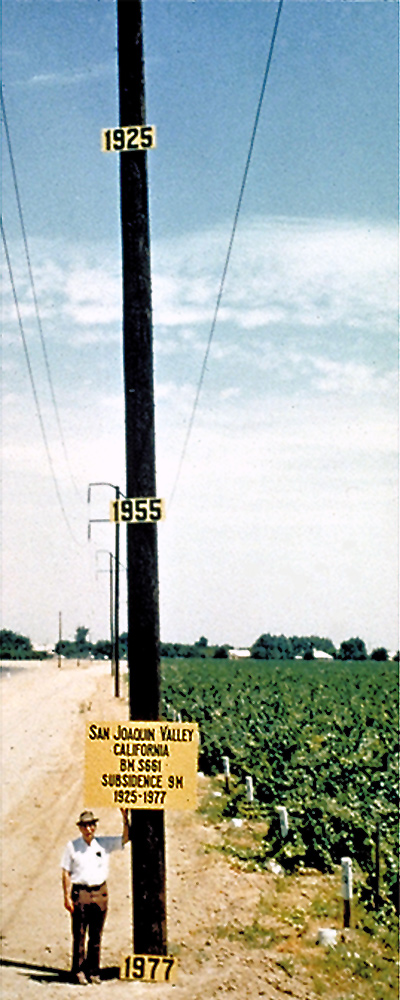
All this happened in the blink of an eye, and before there was a lot of what we might call "adult supervision", in the sense that things like water supply were dealt with without deep thought about long-term consequences.
E.g. "land subsidence": We have taken so much water from the ground that the San Joaquin Valley has sunk many meters! Here's the classic photo showing the subsidence:
Odd that you blame capitalism - for things like housing that was an entirely self-created problem based on rules and regulations that prevented the free market from actually working.
As a result of the tech bubble popping greenspan lowered interest rates for 10 years to almost 0, effectively meaning banks could lend any amount of money, but also couldn't earn any money from actual interest and needed to find all sorts of ways to make a profit, e.g. repacking and selling bad loans to other banks and pensions.
I'd argue if we let the tech bubble pop properly, have a recession for 2-3 years, but keep interest rates at higher rates, it would have preventing a housing bubble.
And that's down to greenspan, and government intervention, not the market.
Government pushed for higher homeownership by tinkering with mortgages, taxes and regulations which resulted in banks issuing increasingly unsafe loans.
Every failure of capitalism is always the government's fault (as if those are separate somehow?) and any success is always despite government, not because of it. That's always the response to this kind of question.
Ha! This reminds me of being a 20-something on the East Coast during the 1990s. I remember thinking, "Earthquakes? Fires? Landslides? Police Brutality? Gangs? Riots? OJ Simpson??? Who would ever want to live in that hellscape!??" Happily I had a girlfriend at the time who was from California and she patiently convinced me it was the right place for me. I moved here in 1997 and have loved it ever since.
Don't believe all the crazy hyperbolic news - it's always overblown - and definitely don't believe the onslaught of right-wing propaganda.
California is likely the most regulated state and has the most “”socialist”” policies/laws. Not sure why they would be complaining as they are the least “capitalist” state in the US.
The laws and regulations they pass are directly contributing to homelessness and lack of housing.
>There's a similar number of people crammed into a similar geographical area on the east coast.
The east coast has unlimited supplies of fresh water. California does not. The east coast megalopolis is also situated on a coastal plain, with a deep hinterland unconstrained by any mountainous geography. California crams a similar amount of people into a tiny sliver of coastal land in between the mountains and the sea, surrounded by some of the driest deserts in the world.
Well, the decline in precipitation is due to changing air circulation related to climate change. Speaking very broadly, the Southwest is likely to get drier, while the rest of the US will either get wetter or stay the same. We don't pay attention to areas with increased precipitation, although it might lead to some flooding: it's generally easier to deal with than drought. But obviously droughts are not related to the effects of locally determined economic policy in the short term (drought resilience contrasts).
What else is happening is primarily due to the fact that California's population has grown very rapidly in a short period of time. Historically, population transfers like this were accompanied by wars and massacres. By that standard, California has been relatively peaceful and successful since the end of the California Genocide.
We can point fingers at bad policies responsible for specific problems, but the overall immaturity of the political system in California is the general underlying factor. Examples include the minuscule size of the California legislature relative to its population, or the too-big counties in SoCal that were drawn when nobody lived there.
It might hopefully reduce the barrier to entry into state politics; therefore, it might increase voter attention to state politics. A major limitation of the US political system is that a lot of voters today ignore state politics and only focus on national politics. Measures that increase the chance politicians are meaningfully connected to their local community can be one way to improve that. Also, it increases the cost of buying off legislators, although this part has limits.
According to the cube root rule, the natural size of California's House of Representatives is about 340! That's a far cry from its current 80.
Drought has been part of CA's climate history for centuries.
Rents have been insane for years in most cities
Objectively false, unless by "most cities" you mean exclusively the major metropolitan areas like LA, SF, and San Diego. CA has hundreds of cities with affordable rents, some of which are even located within the LA, SF, and San Diego metropolitan areas.
Huge homeless and drugs problem in LA, San Francisco.
Yes, with the caveat that more than 50% of the homeless in LA and SF are not locals. They're out-of-staters that either came to LA/SF or were shipped here by their home states to avoid housing them. (Texas especially is notorious for this; former governor Rick Perry publicly bragged that Texas' homeless solution was to buy them tickets to Santa Monica.)
For what?
Amazing weather. Amazing beaches, and mountains, and deserts, and forests. Amazing food. Amazing people. Amazing culture. One of the world's biggest economies (as a sovereign nation, California's economy would rank ahead of India, a country of more than a billion people, Germany, the economic engine of the EU, and the UK, the former financial center of the world).
I am honestly startled by the exhuberant hubris -- from the first link:
"Earlier studies were largely model projections of the future," said lead author Park Williams, a bioclimatologist at Columbia University's Lamont-Doherty Earth Observatory. "We're no longer looking at projections, but at where we are now. We now have enough observations of current drought and tree-ring records of past drought to say that we're on the same trajectory as the worst prehistoric droughts."
Yes, it's brain surgery. Desalination requires lots of energy, which is another thing that California is in short supply of. Hope they like more rolling blackouts.
It's surprising that in 2021, people in one of the most industrialized countries in the world still rely on such transient things as snowpack, rain, and river flow for water. Like our primitive ancestors thousands of years ago. Imagine if we still used sail ships (outside of amateur/recreational activities).
Desal is coming, but we should know the scope of the undertaking.
California's water usage could be met with about 2000 desal plants each producing about 20 million gallons per day [1]. (Which would be over 2 plants per mile of coastline.)
Of course, it's not like all the rain has stopped immediately so they wouldn't have to go all in. But even going 10% in is going to be a heavy lift.
Ag is a major water user, and I feel we could do a lot more work there to get equal yields for less water... It just costs more.
Yeah I think we should aim for all non-agricultural water covered by desalination first. That should be relatively easily. Then we figure out what to do about the agriculture.
You can look at some aspects of the theory for anthropocentric climate change for falsifiable statements. The explanation for the rise of carbon dioxide in the atmosphere is that humans burn fossil fuels, such as coal, oil, and natural gas. All of which contain no carbon-13 isotopes because of their isolation underground, whereas the carbon released from living things does contain carbon-13, which is formed from the presence on cosmic rays. If nature, and not humans, are the source of carbon emissions, we would expect to see no decrease, with respect to time, in the proportion of carbon dioxide molecules containing carbon-13 atoms in earths atmosphere.
> Global estimates of the annual present-day CO2 output of the Earth’s degassing subaerial and submarine volcanoes range from 0.13 to 0.44 billion metric tons (gigatons) per year
> Anthropogenic CO2 emissions—responsible for a projected 35 gigatons of CO2 in 2010 [Friedlingstein et al., 2010] — clearly dwarf all estimates of the annual present-day global volcanic CO2 emission rate.
Gerlach, T., (2011), Volcanic versus anthropogenic carbon dioxide, Eos Trans. AGU, 92( 24), 201.