No country would commit to any new nuclear plants unless it is a cover for a weapons program. (UK)
Here is a simple test, would any privately-owned utility buy a new nuclear power plant without a government guarantee? No.
A nuclear plant if ever finished as half are abandoned takes about 20 yrs to build (eg Flamanville / Olkiluoto)
A 1G PV plant with storage with 25% utilisation would be built in a year. With a capital cost of 7%-10% of nuclear or about 1/3 adjusting for utilisation.
There are three costs for a powerplant:
1. Capital costs - most are 20%- 30% equity and the rest debt.
2. Fuel costs - How much is the coal, gas or other fuels used to create the power.
3. Operations and Maintenance (O&M) - All thermal plants (solar thermal, nuclear, gas or coal etc) use high-pressure steam. The O&M on steam is about USD 20 per MW-h.
So, if you had a solar thermal plant (Ivanpah) the steam O&M is about the same price as total generation from PV.
Based on the average of Flamanville, Olkiluoto and Hinkley Point here are some reasonable guesses.
Capital Cost: USD 15 per watt (pv with storage USD 0.50)
Where do all these countries get their reactors from? I don’t know about most of them, but I remember reading that Swedens was Westinghouse, and Finland is getting their latest one from France?
The majority of the Swedish reactors were designed and built by the Swedish ASEA (now ABB), but their nuclear division was sold to Westinghouse in 2000
So far as you know. My impression is that especially Japan's strategy is always to keep itself at the threshold of becoming a full nuclear weapons with very little effort given the Geo political situation. They already have a full fledged delivery mechanism in their space launch program. Given how cheap SpaceX is, the only reason for keeping these programs around is really weapons delivery.
Given the even more unique political situation of Taiwan and the strategic global importance of TSMC, it's very likely they have some option to weaponize - even if only dirty bombs.
Japan has a deniable weapons program. They've accumulated a very large stockpile of reactor grade Pu. This would require some effort to turn into adequately efficient weapons, but with modern designs it should be possible.
Yeah, but China does. And if the US nuclear umbrella shows signs of being withdrawn estimates of how long it would take Japan to get the bomb vary from six weeks to six months. I doubt Taiwan is much different. Sweden is in a similar position re:Russia rather than China.
> In the early 1960s U.S. nuclear submarines armed with mid-range nuclear missiles of type Polaris A-1 were deployed outside the Swedish west coast. Range and safety considerations made this a good area from which to launch a retaliatory nuclear strike on Moscow. The submarines had to be very close to the Swedish coast to hit their intended targets though. As a consequence of this, in 1960, the same year that the submarines were first deployed, the U.S. provided Sweden with a military security guarantee. The U.S. promised to provide military force in aid of Sweden in case of Soviet aggression. This guarantee was kept from the Swedish public until 1994, when a Swedish research commission found evidence for it. As part of the military cooperation the U.S. provided much help in the development of the Saab 37 Viggen, as a strong Swedish air force was seen as necessary to keep Soviet anti-submarine aircraft from operating in the missile launch area. In return Swedish scientists at the Royal Institute of Technology made considerable contributions to enhancing the targeting performance of the Polaris missiles.
Could you say more about this? Or link some articles? I'm interested as there are some distant plans to build nuclear units here in Poland and the last time around such plans became a costly fiasco. That was in a different time though, around Chernobyl and the fall of communism.
I'll try to find some articles in English, but just this headline says a lot: "(premiér) Babiš prosazuje expanzi jaderné energie, i kdyby měl porušit právo EU" - "(prime minister) Babiš advocates the expansion of nuclear energy, even if it is to violate EU law".
> A nuclear plant if ever finished as half are abandoned
It seems the very best argument anti-nuclear people have is that their own interference via politics will ruin the cost-effective nature of the operation...
It has more to do with the incompetence of the previous generation of nuclear powerplant designs and simply the nature of the idea. Big unique power plants cost "big unique power plant" money.
> There are three costs for a powerplant (Capital costs, Fuel costs, Operations and Maintenance)
In which category should be put the cost of negative pricing from oversupply?
We also have costs associated with policy. A hydro plant can't just dump water with no regard to downstream or they cause flooding. They can also not just drop water levels in lake or rivers with no regard to the environment. Power plants need to cooperate and that cooperation is a kind of cost which is hard to covert to fuel costs.
In the case that a government operate a powerplant we also have the liability cost of making sure that demand is meet. The article talk about the energy Germany produce and cost associated with it, not individual plants. Germany as a nation has costs associated with meeting energy demands, including importing/exporting energy to balance the grid. Not sure external costs like those can be combined in one of the above three categories.


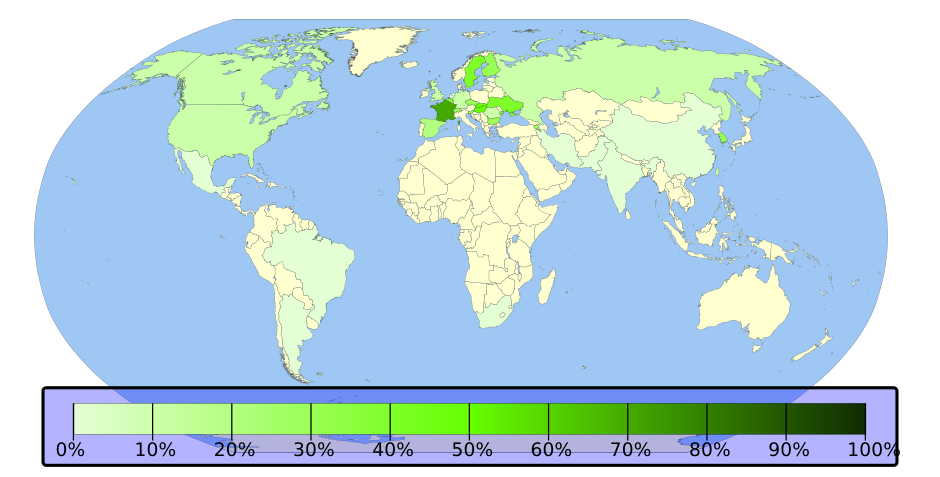
No country would commit to any new nuclear plants unless it is a cover for a weapons program. (UK)
Here is a simple test, would any privately-owned utility buy a new nuclear power plant without a government guarantee? No.
A nuclear plant if ever finished as half are abandoned takes about 20 yrs to build (eg Flamanville / Olkiluoto)
A 1G PV plant with storage with 25% utilisation would be built in a year. With a capital cost of 7%-10% of nuclear or about 1/3 adjusting for utilisation.
There are three costs for a powerplant:
1. Capital costs - most are 20%- 30% equity and the rest debt.
2. Fuel costs - How much is the coal, gas or other fuels used to create the power.
3. Operations and Maintenance (O&M) - All thermal plants (solar thermal, nuclear, gas or coal etc) use high-pressure steam. The O&M on steam is about USD 20 per MW-h.
So, if you had a solar thermal plant (Ivanpah) the steam O&M is about the same price as total generation from PV.
Based on the average of Flamanville, Olkiluoto and Hinkley Point here are some reasonable guesses.
Capital Cost: USD 15 per watt (pv with storage USD 0.50)
O&M - USD 40 per MW-h (Ops 10 + steam 20 + closure 10)
Fuel - USD 10 per MW-h