"Almost all animals are bilateral," he said. The code for having two sides to everything seems to have got embedded in our DNA very early in the evolution of life—perhaps before appendages like legs, fins or flippers even evolved. Once that trait for bilateral symmetry was baked in, it was hard to change."
What about starfish and other echinoderms? They may not have exactly three limbs, but they aren't bilaterally symmetrical, and they are animals.
Yep. If you look carefully at a most starfish, you can see that they are bilaterally symmetric. For example, when there are five legs, if you mentally halve the animal along a leg, only one of the five legs results in both sides matching.
I have one head and four appendages (two for each side, but only one head bilateral down the middle). I don't see why they couldn't have a leg, bilateral down the middle ( like a head?)
Anyone know if there is "handedness" in tails, particularly in monkeys where they use their tails while climbing. Do individuals always curl their tails clockwise or anticlockwise around a branch?
Well, technically you have a tail too. I suppose a better description would be a spine, stunted in one end (tailbone), extended at the top (head), with two set of limb pairs (arms, legs).
Well, if I were a starfish, I would take issue with that dismissive phrase. They are members of a large, and, I assume, proud phylum.
"Echinodermata [is the] second-largest grouping of deuterostomes (a superphylum), after the chordates...Echinoderms are also the largest phylum that has no freshwater or terrestrial (land-based) representatives."
You've misunderstood what bilateral means, it doesn't mean "two of each", it roughly means that there exists a point at which you could bisect the animal with a mirror and "see" the hidden side.
So e.g. humans are bilateral even though we only have one nose, mouth, anus, penis etc, because if you mirror half of a human bisected down the middle you "see" the other side.
The same can apply for animals that have an odd number of appendages such as starfish and other echinoderms.
If that's the definition of bilateral, the article title makes no sense as this property wouldn't preclude animals having three legs. So the definition intended in the article must be narrower.
Neither the article nor the paper makes that claim about bilateral symmetry. From the abstract of the paper:
"As is reviewed here, the strongest constraint on the evolution of a triped is phylogenetic: namely, the early genetic adoption of a bilaterally symmetrical body plan occurring before the advent of limbs. Presumably, this would greatly constrain any three‐legged animal from ever evolving."
In other words, an animal can have an odd number of legs and be bilateral, but due to how animals grow and develop it's less likely to evolve than an even number of legs.
> why are there no animals with three legs? That might go back a long, long way, Thomson said.
> "Almost all animals are bilateral," he said. The code for having two sides to everything seems to have got embedded in our DNA very early in the evolution of life—perhaps before appendages like legs, fins or flippers even evolved. Once that trait for bilateral symmetry was baked in, it was hard to change.
(emphases mine)
Thomson suggests bilateral symmetry as the reason for not having three legs. It's strongly implied that they're mutually exclusive. Not sure how else you could read this excerpt.
By "that trait" I believe he's referring to that particular way of getting to bilateral symmetry, not that an organism that doesn't do it like that can't be bilaterally symmetric.
As an example, think of what it would take to add a third leg to a human being. Now we have two and one leg is a mirror image of the other. Those would presumably be the outer legs, how's the central leg going to look like? Is it going to be a copy of either the right or left leg, or some combination with 9 toes (4 outer, big toe in the middle) etc.?
Carrying that sort of information in the DNA is going to be harder than following the default template of "make this here and mirror it", which is how most structures are encoded in DNA.
Furthermore I think the reason the paper's abstract mentions phylogenetics (but I don't know, I can't access the full thing) is to say something to the effect that if an organism doesn't have any hands or legs, adding them in pairs of two is inherently simpler than adding three, since the rest of the body structure is already mostly following that template.
Once you start going down that road it's hard to "go back", which is why modern animals carry a lot of structures that are only the way they are today because they evolved from some initial past state.
"As an example, think of what it would take to add a third leg to a human being"
Apparently the way radial symmetry actually develops is that one side of the body grows and the other withers away, and the remaining side produces the radial parts.
The funny thing here is that the particular example is relevant, because sea stars and other echinoderms belong to the taxon Bilateria (look at their larvae!). And it illustrates the difficulty you run into when you try to use morphology or other features to derive your taxonomy.
Cnidaria are an interesting comparison, because they are radially symmetric but not members of Bilateria. They are among the closest relatives to Bilateria.
(People may recall the article about Ctenophores that was posted recently, which are also not in Bilateria, and are actually much more distant, even from Cnidarians.)
This is a misreading of the parent comment—“there exists a point”. In general you can dig up problems with using morphology for your taxonomy, but you haven’t actually discovered a problem here. The bilateral animals go through a development phase where they are bilaterally symmetric.
Oh, a point in time. I was thinking space. By the way, that part really needs clarification, because it can be trivially true - given indistinguishable cells, one to three cells or four cells on a plane are always mirror symmetric...
This line confused me as a place to end the answer to this question.
For instance, a creature with a tail is still bilaterally symmeteric. Us human males are still bilaterally symmetric. A full third leg would still be bilaterally symmeteric.
It would need toes of the same size on each side and a symmetric knee plus muscles to control it, I think it would need a leg and foot or hoove design completely independent from the outer ones, it couldn't copy or reuse the existing design, so less likely to evolve.
But if the kangooroo tail counts as a leg, it's indeed very different, but symmetric.
Yeah, it would seem that we have plenty of three-legged animals already. A stout tail is what you get when you try to make a third leg that is perfectly symmetric and optimized for being positioned in the middle.
Yes, things like starfish start out as bilaterally symmetric, both developmentally and evolutionarily.
But according to what I was just reading, the way a five limbed radially symmetric creature develops is not by growing two halves where each half is two and a half limbs.
What echinoderms supposedly do is the left half of their body grows disproportionately and the right half gets absorbed, and all the limbs grow from the left half.
In any case, if you do think it possible to also grow a third leg by halves, then presumably you are even more in agreement that bilateral symmetry does not prevent odd numbers of legs.
>A full third leg would still be bilaterally symmeteric.
Not necessarily. You could have 2 legs on each side, and a symmetrical looking leg (e.g. hooves, or human like but with 2 toes on each side) on the center.
But he's right in that echinoderms split off before much in the way of legs, fins and flippers evolved. (despite technically being members of Bilateria as someone else points out)
Difference in environment. And odd numbered appendage on land is costly and does not provide a speed advantage (Enough to offset cost). In sea, locomotion is completely different and an odd number appendage could linearly provide benefit commensurate with cost.
I wonder if anyone has tried an evolutionary locomotion algorithm that has bi-pedal and tri-pedal animals compete. See if it can even come up with a reasonable try-pedal model.
I saw an early (think mid-90's) attempt at this when I was in college. The only tripod that was successful was something along the lines of what kangaroos do, hopping with two while using a robust tail as a spring.
Most quadroped mammals can run by moving their legs in pairs, in this mode one of the pairs could be replaced by a single leg. Would make normal walking awkward though.
And indeed some almost exclusively move like that, namely leporids (rabbits and hares). They do not have a regular walking gait because the back legs are so long and specialized for jumping.
I actually dislike this style of article writing, or title writing.
The title leads me to believe that I will find an answer to that question in the article, but it just talks about the subject for a while until they decide to end it.
The article was good though, so perhaps just a different title?
Tarantulas have 3 legs, with 5 spares, i thought, having just seen one this morning out with our dog, though i realize that's a technicality wrt the posed question.


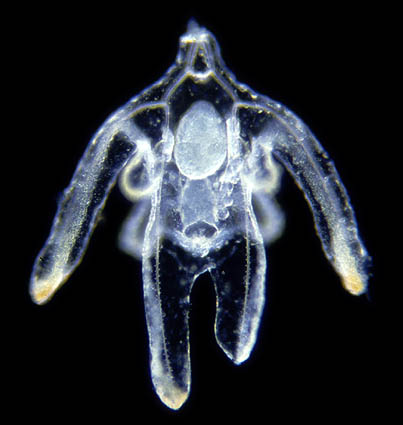
What about starfish and other echinoderms? They may not have exactly three limbs, but they aren't bilaterally symmetrical, and they are animals.