I think the imposition of this burden on engineers is the result of our belief that our legislators are too incompetent or unwilling to act in the fact of clear moral hazards.
Tech has a very strong history of conscientious objectors. They're not the problem. Other institutions need to do their part.
But we do all have shared values. In fact, I think we all agree on most of everything. Imagine there was a button you could press where each and every person would suddenly receive at least a nice house, a bit of land to call their own, and a pleasant good paying job. There's not a single person, regardless of ideology, that wouldn't press this button. Another button to get rid of all crime? Yip, gonna be pushed. Another to get rid of all poverty? Everybody wants the exact same things. The only thing we disagree on is the best route to get there.
That said, I completely agree with you that there is a perception of the lack of any shared value. So why might this be? The 2016 election was interesting. How many people voted for Hillary thinking 'Yes, this person truly stands for what I believe in and will make a phenomenal president.'? How many voted for her because the alternative was completely unthinkable. And the exact same holds true for those that voted for Trump. Think about what a remarkable bit of social engineering that is. In a democracy, you've managed to get tens of millions of people to vote for people they don't actually like or event want in office. And all you had to do was to make people loathe, and fear, the alternative sufficiently.
Division helps entrench establishment forces. You can even see this in the choice of which issues get elevated to the national level. What is the weapon most typically used in mass homicides? What percent of homicides are rifles used in? I think the majority of Americans would get these questions completely wrong. Because the issues that we elevate paint a picture that is not in accordance with statistical reality. That reality being that pistols are the primary weapon of mass homicides, and with rifles being responsible for about 2% of all homicides. [1] Our homicide rate is driven by cheap little pistols. The year to year variance in pistol homicide is frequently larger than the entire sum of all rifle homicides. In other words if we had a magical button to get rid of all rifles, "assault" or not, you wouldn't even notice a drop in the homicide rate. It'd be statistical noise.
But the issue is promoted because it's extremely divisive. It makes people fear and hate one another and further drive this perception that we have no shared values. And what that translates to is at the polls you won't vote for who you want, but will instead vote against who you do not want. And that translates to voting for the establishment candidate who, by definition, will have shown themselves to be the most 'electable'. And then we all end up disappointed, and then do this again 4 years later. Only this time the establishment candidate is truly different, honest! Or in the case of an incumbent, they'll actually do what they've been promising now - they just need 4 more years, honest!
> There's not a single person, regardless of ideology, that wouldn't press this button.
You have vastly more faith in humanity than I do.
There is an entire class of people who define their success based on how much more they have than everyone else. It isn't enough for these people to be successful, healthy, and financially stable; it is necessary, for their happiness, that other people not have these things.
Many of the problems we currently face have, if not solutions, proven mitigations. These mitigations are complete non-starters in America, though, because a significant minority of people have been convinced that "those people" haven't earned it.
> It makes people fear and hate one another and further drive this perception that we have no shared values.
A more important issue is the fact that our legislatures are structured to have exactly zero concern for our shared values. If we take your cheap little pistols example (which is entirely accurate, as far as I can tell), we have one of those clear mitigations: universal background checks. This mitigation enjoys somewhere around 90% public support. It will never, ever pass as long as the NRA is allowed to terrorize politicians into voting against the public good.
I think the examples you offer are a pretty good example of the point. For instance you're presumably alluding to welfare, and people being upset seeing things such as somebody paying for food with food stamps while browsing on their $400 iPhone or walking their groceries out to their new car. It's not unreasonable to characterize this as somebody being unhappy because other people do not not have things, if you'll excuse the double negative. But is this really what it is?
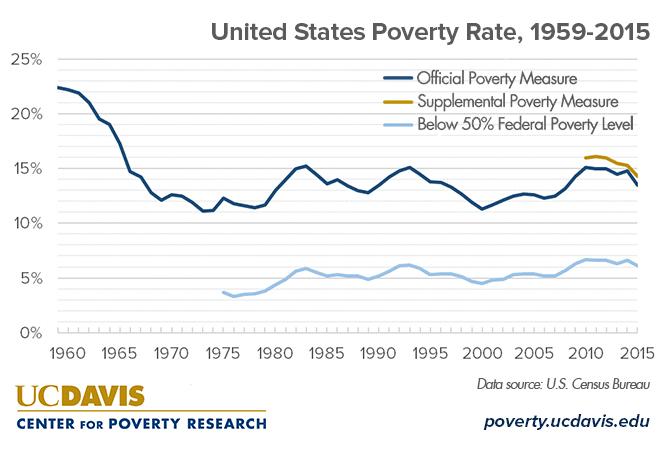
Should the purpose of welfare be to solve poverty or to sustain it? This is another one of those questions that I think we'd all agree on. Nobody wants poverty and so welfare, as one of our primary means of combating it, should do exactly that. It should combat it. Is it succeeding? This is something we can look for objective information on. This [1] is a graph of the US poverty rate. It's clear that welfare is not effectively reducing poverty. One of the oldest proverbs, that's generally appeared throughout the world in completely independent cultures 'is give a man a fish and you feed him for a day; teach a man to fish and you feed him for a lifetime.'
Our capitalist society is fundamentally unfair in one way. The best way to make money is to have money. Start as a billionaire and unless you're a complete idiot (or alternatively voluntarily engaging in extremely high risk enterprise) you're going to die a billionaire. And this goes all the way down. It's much easier to earn $15,000 when starting with $5,000 than it is to earn $10,000 when starting with $0 - even though it's the exact same increase in capital.
If a person is so poor they cannot reasonably afford to even feed themselves, is it a wise investment of what little capital they have to buy a luxury electronic device? Or a new vehicle? Is this the sort of behavior that's going to help them get out of poverty? I think people see these behaviors as a failing of the welfare system. Instead of getting people out of poverty, it's simply sustaining it.
And there are major corporate interests that are invested in sustained poverty. For instance WalMart in their SEC filings actually lists food stamps as one of their major profit conditionals [2]. About 20% of all food stamp outlays end up being spent at WalMart - around $13 billion in recent times. Quite an interesting system we've created. Welfare subsidizes low wages at WalMart, and then caps it off by directing massive amounts of money back to the company. Kraft Foods is another big advocate for welfare and its expansion. About 1/6th of their entire revenue coming from food stamp purchases.
And their are also political gains to be had from sustained poverty. Today around 40,000,000 people are dependent on food stamps. Politicians who promise to expand these sort of programs are likely to disproportionately receive their vote. This creates an incentive to simultaneously service these people, but also keep them dependent. See LBJ's quotes on how he viewed the Civil Rights Act (which he passed), or what he referred to it as privately, for an example of this issue. I will not repeat his language here.
This is really just scratching the surface, but this post is already unreasonable long so I'll cut it here. But I hope I've framed at least the start of a case for showing that when people are not necessarily the biggest fans of programs such as welfare, there are reasons beyond disdainful views of those receiving it, or a desire for them to stay impoverished.
> The only thing we disagree on is the best route to get there.
So we agree on most of everything, except this massive, critical thing?
Even aside from that, your examples of shared values also don't strike me as universally agreeable. I find many of these apparently agreeable things just poorly defined. It's much more obvious why these issues are so divisive when you dig a little deeper.
What exactly would getting rid of all crime mean? Because people disagree on what should be considered a crime.
Getting rid of poverty? Well, what kind of poverty do you mean? Because poverty in many ways is relative. Getting rid of all poverty implies getting rid of all wealth inequality. Is that really something you believe everyone agrees on?
Everyone owning their own land? I'd be surprised if everyone agreed on private land ownership. Everyone has a nice house? What kind of house? I'm not sure everyone wants to live in a suburbia.
>> Imagine there was a button you could press where each and every person would suddenly receive at least a nice house, a bit of land to call their own, and a pleasant good paying job. There's not a single person, regardless of ideology, that wouldn't press this button.
No I would not push that button. I think everyone should have a roof over their head, but only value-producing people should have a nice house.
Also, I think that the reward should be based purely on value production of the individual, without any regard for ownership of capital (the means of production).
Also, individuals should not be rewarded for capturing the value created by others (I.e. entrepreneurship).
There should be a clear distinction between activities which create value versus the ones which capture value.
We need a system which enables creators instead of entrepreneurs.
By the way, the word 'entrepreneur' is French and it literally means 'someone who takes what is between'; not someone who creates value.
>> Another button to get rid of all crime? Yip, gonna be pushed.
If we had a decent system, I would agree. But in the current system, I think that crime might as well just be legalized. The definition of crime is extremely unclear.
There are so many white-collar activities which are not considered crimes by the legal system but whose consequences are actually far worse for society than all the blue collar crimes added up together - In fact, you could argue that blue collar crime would not exist if it weren't for white collar operators rigging the game and effectively forcing poor people into a life of blue collar crime.
>> Another to get rid of all poverty?
Sure, but people need to be educated in order to be able to lead a socially conscientious life outside of poverty.
If you lifted everyone out of poverty with the push of a button, they'd eat the conscientious middle class for breakfast the next day.
I agree with your main thesis, but also: It's time that we start teaching kids at school about technology. And I mean actual technology, not how to make a pretty slides presentation on Powerpoint/libreOffice. I mean the importance of your data, how companies exploit it, what is a CPU, what is RAM, what is an operating system, what is security, cryptography, domain names, how ISPs work, etc.
I wrote a response to an email today, someone had sent me two ethics position papers. I pigeon-holed my own response after I wrote "it's time policy makers start assuming responsibility for understanding more logic than just policy logic. Math must be part of their domain expertise".
Mainly I shelved my response because I doubt the policy people on the thread would have taken that very well. But the truth is looming large these days.
Experts are a nice resource to have, but they're not a cure-all.
Not all of our legislature's representatives have systemically good incentives. Regardless of their ability to understand complexity, complexity offers them the ability to obfuscate. Ignoring any bad faith or corruption, though, our legislatures are also a limited compute resource.
If the complexity of modern society rises by orders of magnitude, the tools legislatures previously used to tackle complexity may not scale to the new challenges, or may simply be too slow to address the issues while they are relevant.
One of my first areas of research was mapping legislature throughput to variations in rates of technological change. It appears most western governments addressed social issues arising out of the industrial revolution, for instance, exceptionally slowly. To summarize a few years of reading in the library stacks: the relationship between social complexity and quality of governance is not well understood.
In the discourse that followed WW2 we put the same burden on soldiers and we still today prosecute German soldiers who worked in concentration camps (see [1], for a book keeper sentenced to prison time in 2015; not actually involved in killings).
Who, if not we, the engineers who really understand the implications of our actions, should stand up?
A moral hazard happens when an entity is somehow insured against something (e.g. health insurance), so is rationally more likely to behave in some "bad" way (e.g. driving recklessly).
I'm not seeing how this a moral hazard, do you just mean "immoral"?
"Insured" can be interpreted very broadly; moral hazard is whenever the negative outcomes of a risky decision are directed away from oneself. A CEO considering the option of a layoff is a moral hazard as she will make her board happy at the expense of her employees. Either way she has nothing to lose.
>"Insured" can be interpreted very broadly; moral hazard is whenever the negative outcomes of a risky decision are directed away from oneself.
Nope! That's called an externality. A moral hazard is a type of externality, but is very focused on a particular set of instances in the definition I provided.
My comment used the term in the exact manner described by the comment you're replying to, to describe a state of affairs whereby incentives are systemically perverse because risk is not properly allocated.
A recent review I looked through indicates that the term has been historically used for different purposes in economics, insurance and probability literature. If the language of externalities is easier to understand for you, feel free to mentally substitute it in.
I could have couched the comment in the language of externalities and made a similar point, but it would lose the rhetorical flourish of hinting that legislatures themselves discount risk associated with their actions (or lack thereof).
Sure, though, to be pedantic, a common example of moral hazard is the increased likelihood of driving recklessly in the presence of mandatory seat belts. See https://web.stanford.edu/~leinav/pubs/RESTAT2003.pdf
That’s not a moral hazard. The word doesn’t even appear in the paper. It’s just an example of somewhat efficiently choosing a different point on the risk/reward continuum when the payoffs change.
A moral hazard is choosing a selfish course of action with negative external effects.
This is a burden that lies with us all, individually. We are all individually responsible for our actions. Its absurd to suggest that somehow we should outsource our morality and the responsibility for our actions to politicians or legislators. Whether or not our system (and society) is horribly broken on every level (it is) has no bearing on the personal responsibility we all bear for what we do as individuals.
That’s less sinister than you might think. New legislation is more common for new industries.
Consider the internet began as the Arpanet is just 50 years ago. For much of that time the idea that the average person would be online from their own home would have seemed like crazy science fiction.
The thing is, the legislation is tweaked to the benefit of the giants, not against them. At least in general.
Not even federal government with their delusions of absolute control can do anything. (Say, FISA insanity.)
Net neutrality was a contest between two big corps. Patent battles ruled to support American business despite clear violations? (Qualcomm et al.)
The used to be laws considering encryption to be munitions. Silly attempt to sabotage it AKA Clipper. Yet somehow AI systems to discriminate explicitly sold to opposing regimes are not despite being much more applicable.
On the other hand, there is Comcast and Time Warner.
I think the public benifits from that to some degree. A search engine index is inherently a derivative work and without updated legislation could easily qualify as copyright infringement.
I am not saying is fair, but other industries which get away with actually killing people (ex: fine particle pollution from coal power plants). So, bias is somewhat expected from how our system works, it’s just not all bad.
Assume that a hypothetical future government that you find yourself living under is not good.
Assume furthermore that a future hypothetical company is equally not good and the two collude to do not good things together.
Now assume you’re motivated to do something about it. Sucks for you, they have already predicted that and cleansed you because they know everything you’ve ever read and it was a high probability that you’d be against them.
Consider another situation where hypothetical evil overlords know exactly what buttons press in order to influence you to act a certain way. They press them regularly. You dance as expected.
Both circumstances undermine your personal autonomy and right to self determination. Furthermore they undermine the humanity that we share where our society is no longer controlled by the needs of humans, but instead arbitrary algorithms coded for whatever mundanely evil purpose.
And that’s the point (that you’ve more or less hit on), this is evil, but also so boring that it is actually a threat to society because no one will care enough to do anything.
For those that want a more practical example, Russia has just passed a law requiring that all internet traffic be sent to their equivalent of the NSA and FBI, with all traffic sent in the clear [1]. If you're an adtech company in Russia, with historical data you are probably being subpoenaed for that historical information. Think about Turkey, which has had mass purges since 2016. Academics, judges, ordinary citizens have been jailed or disappeared for having gone to the wrong school, having attended the wrong house of worship, for being friends with the wrong people. The government isn't tracking these people down via paper records, they're tracking them down using ordinary technology.
It's not about step 1, which is to sell you more barbies. It's about step 4, step 5 where suddenly a bad actor has access to all this data and can see that people who make this search have a 10% chance of opposing the current leader/president/ruling party etc.
Does increased government authority over the tech industry make abusive access to its data and eyeballs less likely, or more likely? How would such a collaboration start? My money's on "It sure would be a shame if we audited the shit out of your infrastructure and hit you with everything we can find in the 500,000 page rulebook... or you could do me this one favor."
Doing something about a bad government is called terrorism. Rooting out such people before they act is called preventing radicalization, stemming the flow of hatred and bigotry (the #1 talking point in calls to regulate tech).
Knowing what buttons to press to influence populations to act a certain way is called called campaigning. Belief in democracy is exactly equal to belief that whoever is best at that each election cycle should have the most power.
Abuses are just that. If a corrupt person is using the law corruptly in order to achieve something illegal, and getting away with it, that is something we should root out. Including your hypothetical racket.
Creating laws to prevent the population from being abused and manipulated via big data is somewhat orthogonal to that, as it would be a separate set of laws. we can’t not do something just because it might be abused by those implementing it. We have to include reasonable limits to the powers we grant.
We don’t do away with all rule of law because it is occasionally abused, we prosecute the abusers under said laws and create new laws when loopholes are inevitably found.
You make that sound trivial. It isn't just about barbies. Technology has infinitely times multiplied our communication bandwidth. Giving government complete control over the personal data of people literally makes the government all seeing eye, which has never been possible before.
You might trust your government enough to be okay with this, but don't forget that government is made up of humans, with there own personal whims and idiocricies. Do you really want to live in a world where people around you might have power to completely end you? Will you be able to speak freely in such a world?
This level of power is a very new thing, and the people on higher order (wrongly) think that it's all good and they can keep going about there business as before.
As the article repeatedly states, the problem is Dragonfly, things like Cisco's and Yahoo's famous lawsuits, and Apple's handing over of iCloud keys. Nobody is conscientiously objecting to your scenario.


Tech has a very strong history of conscientious objectors. They're not the problem. Other institutions need to do their part.