This word gets thrown around a lot but, hipsters!
As others have attested there is nothing good about tapes. There are very good reasons why vinyl has survived (You can manipulate it with your hand when djing, and see the music on it, also its technically possible to get better sound quality than digital via high quality, high speed, vinyl and an all analog recording to stamping process) But tapes, no, they are shit. The only reason to use them is some form of conspicuous consumption, signaling how cool and wacky u are.
additional, if u really want a kooky old physical medium go with minidiscs! They were amazing!
>(...)also its technically possible to get better sound quality than digital via high quality, high speed, vinyl and an all analog recording to stamping process
-This, with all due respect, is a myth. Much as I love my LPs, by any objective criteria the CD (or any digital media) beats them handsomely. Dynamic range, frequency response, noise floor, channel separation - even on the best mastered, half-speed cut, heavy vinyl albums noise and distortion is orders of magnitude larger than on any competently mastered CD.
Note 'competently mastered'; it is unarguably true that some recordings are destroyed during mastering for CD as part of the so-called loudness wars; this problem is less of an issue when mastering for vinyl as the audience buying LPs often do so precisely to escape from the loudness wars and the problems caused by it.
However, this is a defect by decision; it is not due to any inherent limitation of the CD medium compared to the LP.
Yeah, it's true that CDs are technically superior. But vinyl is certainly high enough quality that it's good enough. Tape is noticeably low quality. But vinyl records, regardless of their technically deficiencies, sound really good. And, at the end of the day, if music sounds good, it is good.
I agree fully; I still buy LPs on occasion as I enjoy listening to them more - the whole ritual of getting ready for playback, the large cover you can enjoy while listening..
While not perfect, it is plenty good enough - and, my personal take is that I do not buy <insert media here> to have a perfect reproduction of whatever was created in a studio - I buy <insert media here> to enjoy myself. LPs are brilliant for that purpose.
There is one criterion on which the LP still wins - time resolution.
The human ear can perceive differences in the 5-to-10-microsecond range (you can prove this by testing our ability to work out where a sound came from, based on differences in arrival time at our ears). Successive samples on a CD are 22 microseconds apart - so a CD cannot encode two impulses 5us apart[0].
An analogue medium like vinyl, however, can do just that. Some audio engineers speculate that this is what underlies the supposed "digital sound" - people are in fact identifying a loss of timing information.
[0] It gets complicated fast, here - the Nyquist theorem says a CD can easily encode a 5us phase difference between two tones - and if the human ear were a linear device with a strict low-pass filter in front of it, that would be the same thing as a 5us time difference between impulses. But the ear is wickedly nonlinear and seems to "care" about impulses for reasons that make obvious evolutionary sense. Long story short, for all their faults LPs do seem to have distinct advantages over CDs when it comes to time resolution.
I think it's possible that there's a subjective advantage to the simplicity of vinyl, the fact that the listener can see and easily comprehend some of how it works, and since music is subjective, it's the only quality that really matters.
I just had a discussion with some people who know a lot about music who said that vinyl sounded better because it recorded the shape of the sound waves in music. They didn't have an explanation for how CDs or digital formats like FLAC worked other than that they did some kind of incomprehensible digital process to create sound. I argued that all sound has to be coverted to an analog wave in the end, and they were open to the idea, but I think this perception shows that how people understand the process of how music is created affects their perception of it, just like many or most people would say that music sounds better when it is played live, even while being manipulated through electronic equipment, rather than being recorded on electronic equipment and then played.
Arguably the same process of "competent" mastering that increases dynamic range etc results in a product with less fidelity to how recordings from certain eras were originally enjoyed[1]. There were comparatively few recordings made that were intended to be consumed exclusively on cassette.
[1] Granted, it would have been perfectly possible to master CD audio to vinyl's sonic limitations and even introduce artificial noise if sound engineers chose to do so, and plenty of digital players give you some scope to modify dynamic range
Well if we're being strictly accurate it could mean preserve meaningful dynamic range of the master recording in a manner which ensures that it'll sound like it has a greater dynamic range when played using the new output medium than the vinyl recordings which everyone's actually used to listening to the song on. But that's rather cumbersome phrasing amounting to essentially the same thing, besides which I'm pretty sure that in practice a lot of remastering involved actively increasing dynamic range etc. relative to the original master tape because the sound engineers (i) wanted to restore dynamics and other aspects of sound quality lost during the original mastering process and (ii) thought it sounded better and would sell more CDs. I guess ultimately it depends whether it's believed that fidelity to how it sounded to the original sound engineer mixing it in the recording studio or fidelity to how it sounded to a generation growing up listening to records is the priority.
Actually, mastering decreases dynamic range, largely to increase apparent volume (apparent volume is RMS, not peak-to-peak. To be very vague, the RMS of 0 to -10 is -5, and the RMS of 0 to -20 is -10. The more dynamic range, the less apparent volume).
The intent of the mixing engineer and mastering engineer is to make a recording that sounds good everywhere, not just on studio monitors. When I mix records (I've produced several), I check every "final" mix on cheap earbuds and in my bad car stereo. Sounding good on my very expensive Tannoy studio monitors is meaningless if it doesn't sound good in someone else's car.
For that matter, most pop records are mixed on subjectively awful speakers. The most popular pro mixing speaker is the Yamaha NS-10. They sound shrill, piercing, and nasty, with a sharp eq spike right in the 2khz range where ears are most sensitive. If you can make a mix sound good on those, it should sound good anywhere! A lot of mixers also rely on Auratones, which are tiny 5" drivers, often used in mono. No lows, no highs. They're incredibly honest about levels.
I thought it was an inherent limitation in LPs (track skipping probability increases with loudness) that meant they are not mastered into oblivion like CDs?
-If you wanted to, you could master an LP with 0 dynamic range; it would work just fine. (Provided the average signal level was low enough to keep the needle from going haywire attempting to follow the LF grooves)
What quickly becomes a problem for LPs is too much energy in the LF/bass region, which will cause the needle to skip and jump all over the place.
The RIAA correction curve is a measure to alleviate this problem, as it strongly emphasizes low frequencies on playback (and, inversely, reduces them before cutting the master disc, leaving much less LF content in the grooves than would otherwise be needed for accurate reproduction.)
I suspect (Mind, this is just a guess) that when someone says an album has 'a separate master for vinyl', what they are really saying is that someone took a copy of the album master before it was sent through the last loudness war compressor - and sent that copy to the LP plant, using the compressed-as-heck master for any other format.
There's a lot more to mastering than "sent through the last loudness war compressor", for cd as well as vinyl. Not a guess - I've sat in the room with a mastering engineer while working and talked to him about it.
I believe you; I hardly know the first thing of the process - and should've made it clear that I didn't. (the comment being intended somewhat tongue-in-cheek)
Mastering at album-length is largely about coherence... making a bunch of separately recorded things with often wildly varying sounds sound like a single piece of music. It involves a combination of gentle compression and brickwall limiting, broadband equalization and high-Q deep-cut equalization. Some of it is visual metrics (especially looking for frequency problems), and some of it is just ears. A good master will sound good on any playback equipment. This is where I point and laugh at all the people lauding the "accuracy" of their favorite medium. Speakers and amps are the limiting factor, not the medium! I've been dinged by a mastering engineer for accidentally having a 32hz synth tone (a sub-bass sound) on a mix. He eq'd it away. My mixing system couldn't reproduce it - hardly any can. But it wastes tremendous power and distorts amps and speakers, so out it goes.
For cd, it's usually brickwall-limited to no more than 10db max dynamic range (often no more than 6db). This makes things sound "better" on typical playback equipment, which is... not good, compared to the sound of live instruments in a room.
Vinyl is a different beast. It needs RIAA equalization on the master (which is reverse-eq'd by the playback equipment) to managed the size of bass grooves and keep the needle from jumping out of the track, and to make the highs physically big enough for the needle to pick up well. Dynamics are constrained by the physical limitations of the media. So it's a separate master.
That's not a big deal, though. The constraints of vinyl slot in quite well with the constraints of speakers and amps! This is why vinyl, despite its on-paper inferiority, can sound as good or better than digital.
But in the end, it's all about the speakers. I mix on a pair of Tannoy System 12 speakers and an old UREI studio amp that would be the envy of many hi-fi nerds - but I don't consider a mix done until it sounds good on my stock iPhone earbuds and shitty car stereo. Mix to the output, not the medium.
If anything vinyl has more of a problem with dynamic range. Most LPs are cut with a variable width groove, ie. the grooves are actually cut closer together during softer sections so that more music can be cut on the disc. As long as the groove doesn't pop out (as would happen with a large stereo separation in the low frequency content) or physically meet the other groove then not popping out is just a matter of correctly weighting your cartridge (more weight wears the record out faster, though. So having no dynamic range would actually make it easier to cut and ensure that this doesn't happen.
I listen to vinyl myself, and I also have some limited knowledge of the science involved. I don't claim to be any sort of an expert in acoustics but I do have a basic grounding in DSP from my undergraduate days as well as high-school physics to refer to ...
I have to say I enjoy vinyl for a number of non-qualitative reasons. Nostalgia. Tactility. The cover art. The fact that the medium feels like it has more of a "wholeness" to it. My system is fairly modest: A pair of battered Technics turntables plugged through a mixer as preamp into a bog-standard stereo. It's certainly not audiophile quality.
But I am constantly struck by how visitors comment on the sound quality when I play my records for them. To a certain extent, I can put it down to a placebo effect, but many often refer to a "warmer" sound. Even with the dust-crackles and occasional pops!
There are a couple of things I could think of that could explain it. Firstly is that the accepted human range of hearing is 20 Hz to 20 kHz .. from what I recall of CD sampling it is set at 44.1k samples per-second, twice the dynamic-range in anticipation of Nyquist aliasing.
I can't help but wonder if there are "inaudible" frequencies that are chopped out in this scheme. The deep bass-tones that our ears don't pick up but are felt in our body. These frequencies could resonate external physical fixtures perhaps creating a more immersive acoustic experience.
I've also heard it been said that these inaudible frequencies can be picked up by the body, in particular the stomach and chest cavity, which could give the sound a more visceral quality. Certainly this is the case in a club or even a lounge setting. Apart from being able to physically scratch and manipulate this would also explain why vinyl has persisted moreso in these environments.
Aside from this acoustic hocus pocus there might be a more fundamental reason for perceived qualitative differences, and that is to do with implementation. CD as a technology is sufficiently provisioned to capture the entire range of human audio, but for reproduction you are always at the mercy of your DAC.
It's important to remember that when you're listening to digital sound you are listening to an analogue signal that's reproduced by modulating an oscillator, whereas with an analogue recording you're listening to the original analogue signal.
This isn't an issue for well built sound system but is that most people's experience? Whereas whenever we listen to records the DAC simply isn't an issue. This may not result in "better" sound but it would make it distinguishably "different". I remember being struck, when repairing one of my turntables just how little electronics there was on the audio line: Pretty much a straight uninterrupted line from the stylus out to the pre-amp.
One final thought is that, who even listens to CDs any more? We're so used to listening to music on our phones or computers, from a number of formats at varying compression levels and of varying quality, through poor quality headphones or car stereo systems. It could just be that our expectations have been slowly been lowered by ever decreasing reductions in quality to the point that when we do hear something reproduced as its master intended it is a notable experience.
The "inaudible" low frequencies are absolutely removed during mixing, or by the mastering engineer. There's probably no content below 50hz on anything you listen to. Few speakers can reproduce such low sounds (and fewer still do it with any sort of fidelity, and fewer of those are in rooms that won't freak out at the low frequencies). But the amp and speaker use enormous power trying to reproduce them! It seriously injures the sounds we can actually hear to reproduce the sounds we can't hear.
Amps and speakers are the real limiting factors, not the recording medium. They distort very easily (and never read the distortion figures of amps - they're not anything like real world conditions). Mixing is done to make the speakers work well, not to be "accurate".
edit: When tracking and mixing records, I routinely put a high-pass filter on every single track, specifically to prevent subsonic rumble. I often low-pass tracks as well, to limit noise, hiss, and distortion artifacts. This is so routine that even many microphones have a built-in high-pass switch. In mixing, I might high-pass guitars as high as 300hz, throwing away whole octaves of low-frequency information. This is to keep it from conflicting with kick drums, bass guitar, and other instruments that need that space. Solo the guitar in the mix, and it sounds weird. In context, you can't hear the difference in the guitar, and the mix itself sounds better.
Is this a more modern practice, in the same vein as the whole compression thing or would it be something they've been doing all along? I always liked the idea of the "Naked Sound" though perhaps this hasn't ever been a thing ...
No, it's always been the practice, since the 1950s at least. Microphones and media that could reproduce far more accurately than amps/speakers have been around since at least the 1940s. Modern mixing developed in the mid/late 1960s and into the 1970s.
Mixing any sort of multitracked pop music is extremely artificial. Consider any record where an acoustic guitar and an electric guitar are roughly the same volume. In practice, you can't even hear an acoustic guitar next to a raging guitar amp! In the stereo field, things are panned hard left, hard right, or center (there's even a word for it - LCR. Off-center panning sounds weird). Radical eq alterations, compression, multi-miking techniques... heck, move a microphone an inch relative to an acoustic guitar, and it can sound completely different. I have started using two mics on acoustic guitars - one about a foot away, and the other six or more feet away, and blending them. The blend sounds better than either mic by itself. And then there are synths, drum machines, and other direct electronic instruments...
Yeah, "naked sound" in recording doesn't exist. I've been playing acoustic guitar for over 30 years, and play drums and sing and do a lot of live folk music. Recorded/amplified music sounds VERY different. And it should.
Interesting. Note: deep bass notes are reproduced just fine with digitization. Sampling at 44.1kHz doesn't mean only high-frequency sounds are represented. You only have to sample at say 100Hz or more to get bass notes.
I didn't mean to suggest that sample-rate had anything to do with discarding the bass. Name-dropping Nyquist just to show off I have a little knowledge. Just that such signals may be discarded as a matter of course by filters on either side (recording/reproduction) on the basis that they are "inaudible".
Dynamic range? Post-mastering, vinyl has a larger dynamic range than any cd. Most cds have no more than 6db real dynamic range. Frequency response? How many people own speakers that can go below 70hz, or can hear about 15khz? (Midrange is where it's at) Noise floor? Ok, I can give cd that one. Channel separation? A/B and you won't hear a difference.
Moreover, anyone arguing for "realism" and "accuracy" while blasting the sound of a 100 watt Marshall stack through tinny-sounding earbuds on a recording where an acoustic guitar is louder than the drum kit and the keyboards sound like they were recorded in the Grand Canyon is really, really missing the point.
Recently I had the priviledge to hear a high quality LP (Dire Straits - Brothers in Arms) on high-end equipment (100k speakers, 40k amp, 35k Player) and switch back and forth to a FLAC that came from another expensive looking box directly into the same amp.
There was a definite difference in quality between the LP and the FLAC file, especially when switching from good (LP) to bad(file).
I can only assume but not guarantee that the FLAC file was produced correctly; otherwise the technical environment seemed to be close to perfection. The quality however dropped of considerably with all the other LPs we've tried for many reasons. Quality seems to depend on the recording, mixing and actual physical quality of the LP a lot.
This experience changed my view on the issue for now :)
This is as good a time as any to refer to Ivor Tiefenbrun (Of Linn fame) and his claim that digital was a dud (He didn't use those words, but anyway...)
Short version - the Boston Audio Society invited him to listen to one of his own turntables, using music of his choosing - and also listen (blind!) to the signal from the turntable passed through an A/D-D/A loop. He couldn´'t tell the difference.
Didn't mean to prove anything here. I mentioned myself that I can't prove the FLAC was up to par and there might be all sorts of biases at work, who knows.
The "box" had the hard disks and DAC inside, don't know the correct term. Connection was with short, chunky cables. We switched back and forth using a switch on the amp without any delay. I wouldn't blame the hardware in this situation.
I haven't listened to much vinyl in my life but maybe it subconscioulsy triggers some memories but I do not consciously prefer vinyl in any way and as a contrarian I wouldn't mind calling out BS.
Describing sound is hard but I experienced the music a lot better with the LP, would try and call the FLAC "flat, boring, less dynamic" when comparing directly.
All I'm saying is, if you get the chance, listen to a good LP on some audiophile's equipment.
>All I'm saying is, if you get the chance, listen to a good LP on some audiophile's equipment.
This I agree fully with. However, this is also (IMHO) part of vinyl's challenge - the entry cost for getting blow-me-away-results is much, much higher than for a digital system.
Now, assuming we use the same speakers (Which, if anything, is the one link in the chain where one should put the most of one's budget!) and amps and are left only with the source part:
You can get an excellent DAC for a couple of hundred dollars. If you want something top-of-the-line, inarguably reference-grade, that'll set you back a couple of kilobucks. (There are lots of more expensive DACs; however, at $2k or thereabouts, the Benchmark DAC2 hardly leaves any room for improvement in other factors than user interface and bragging rights.)
As for source - with the DAC sorted, you can use just about anything. Laptop. Old CD-player with a digital output. Anything will do. Total cost (excluding amps/speakers) for a reference-grade system: $2,100 or so. For a system which gets you 99% of the way there - $300 or so. (Obviously, these are very rough ballpark figures, intended to stress the point more than anything else.)
So, how does the analog side of things look?
Good LP players cannot by their very nature be very cheap; there's simply too much precision mechanics about. So, let us say that a 'very good' LP player is the Linn LP12 with no upgrades. That alone appears to set you back in excess of $3k, luckily including what I assume to be a decent, though not stellar pickup.
Adding to that, you need a RIAA preamp; disregard the cheapest ones - look inside, and all you'll find is an op-amp, a voltage regulator and a simple second-order filter. Say, (I am just guessing here, having built my own RIAA preamp years ago) - $500-1,000 will get you up from the basic designs and into the realm of things which can do the LP12 justice. Grand total - $3,500-4,000.
So, twice the cost of the digital reference - and this is still a -by audiophile standards- very basic analog system with lots of room for improvement. Also, chances are the $300 digital system will run circles around it - even more so if you buy some cheap DSP plugins which can emulate the characteristics of LP playback, giving you an experience closer to what vinyl would sound like.
That being said, I fully understand the people who appreciate the tinkering potential of analog systems; you can mix and match accessories and components to a much larger degree than in digital systems, adjust various properties (needle weight; tracking force &c) all influencing the sound; however, when you do that (I do!) you are not necessarily doing it for the sake of faithful reproduction, but rather as a very expensive, very limited way of doing EQ. (Best investment I ever made to my hifi-system: A four-band parametric EQ unit. Sorry, all hardcore audiophiles.)
> The only reason to use them is some form of conspicuous consumption, signaling how cool and wacky u are
Disagree.
1. Sometimes the sonic characteristics of tapes DO complement the music. Typically for genres other than popular music or symphonic/classical/orchestral music (where absolute fidelity is king).
2. Physical media as opposed to digital media is, for some/many, inherently gratifying. It is a more multifaceted Thing, an object with a mass and volume and cover -- far more features than a typical audio file might possess. This point might not resonate with some on this forum (especially those interested in minimalism/efficient living), but ask around and you will find that for some people, this makes a dramatic difference.
3. Cassette tapes, as opposed to vinyl records, were extremely easy to produce in small quantities or at home (VHS tapes also have this property). This means that you can find many interesting/unusual cassette tapes (or make them yourself with relative ease). There are many recordings only available on cassette, and others very challenging to find on media other than cassette.
Especially in our world of information hyper-availability, there is a satisfaction in enjoying or creating a tape that only a couple people (or maybe even only one) have ever heard. Some might point to this as a core tenet of "hipsterism," but I argue this isn't about conspicuous consumption, it's about appreciation of novelty (which is a core aspect of... intelligence/pattern recognition capability) and history/unique narratives.
EDIT: looks like the article actually makes the same points that I did, but expressed differently and with a bit more contemporary context/narrative content.
inherently gratifying. It is a more multifaceted Thing, an object with a mass and volume and cover
Also not to forget: the buttons on tape players are real machanical things requiring some force to push them. I don't know why (I also like handtools and powertools, seems related) but something in pushing a nice hardware button satisfies me. Just like taking a tape and feeding it into the player. Something in my brain likes that. Just like limbing trees or scything grass. Sometimes I even do those for no practical reason, just the act alone is satisfying. And that has nothing to do with trying to make sure others know about any possible coolness or wackyness I might posess.
If the sonic characteristics complement the music then write it to tape during production before transferring it to a medium with accurate sound reproduction. You don't need every listener to have their own tape hardware (which might not suit the music as well as your own).
A lot of our feelings about music are bound up in our expectations of the medium. When I listen to a digital recording, I expect it to be pristine. There can be a feeling of inauthenticity when the sonic characteristics don't match the actual playback medium. This feeling can persist even for separate analog media, such as listen to compilations of old 78s distributed on an LP.
If you feel you can overcome this, by all means do so -- people often rip their cassette tapes and share. But putting the album on a cassette tape or on bandcamp or on vinyl sets an expectation in terms of fidelity, and violating that expectation can disappoint some listeners. It's a similar reason for why "fake vinyl crackle" is seen as incredibly cheesy.
Regardless of my (personal, hipster) feelings, the technique you mention is relatively commonplace.
Also, for some artists, the unpredictability and randomness can be seen as part of the experience, but it takes a very particular/unusually postmodern sort of artist to get away with that.
> Sometimes the sonic characteristics of tapes DO complement the music
Indeed - this is especially true of synthwave/vaporwave and other genres that are themselves nostalgic for the days of synth-heavy music sold on cassette. A bit of compression and hiss is just right.
Just as some games put fake film grain on screen, some synthwave videos add a "badly tracked VHS" effect.
>"Indeed - this is especially true of synthwave/vaporwave and other genres that are themselves nostalgic for the days of synth-heavy music sold on cassette."
I lived through the 80s then, and am sometimes nostalgic for old stuff. I listen to a lot of synthwave now, and do appreciate the variable speed distortion on some tracks. But I also exclusively listen to digital music, where I get a (basically) 1:1 representation of what the artist produced.
Getting further distortions from the medium isn't something I want or need.
> technically possible to get better sound quality than digital
This is simply not true, provided you're not comparing new vinyl on a great turntable to a 64Kbps MP3 from 2001.
You may prefer the sound of vinyl - and that's totally OK - but by any objective standard, "quality digital" reproduction is far more accurate than "quality vinyl" can possibly be - regardless of the vinyl playback technology you want to throw at the argument.
Couple this with the fact that most people listen to vinyl on shit turntables they bought at a clothing store and have no clue how words like "elliptical," "tracking force," or "anti-skating" figure into their listening experience....
The only good thing about vinyl is the RIAA curve prevents loudness wars. If CDs were mastered correctly without intentional clipping it would be impossible for records to best them in quality.
I don't think that is true, given that digital will always be samples of the original. I worked at a mastering studio that had a laser record player, best sound I have heard.
-In all fairness (and this does not have any practical implication whatsoever for the case discussed here, but nit-picking is a favourite pastime of mine), Nyquist-Shannon is not fully satisfied during music reproduction.
N-S requires, for instance, an analog signal which is perfectly band-limited. This implies that it must be of infinite duration, which, obviously, is not the case.
However, it is plenty infinite-ish enough for all practical purposes.
What you find with vinyl is labels actually mix the album differently, not because the medium is better quality but because the listener expects different things. Digital music often has a "wall of sound" mixing which results in a loss of fidelity and clipping but vinyl is mixed quieter with clear shapes to the waveform.
> What you find with vinyl is labels actually mix the album differently, not because the medium is better quality but because the listener expects different things.
Also because the medium is of "worse quality". You can't drive your gain up the wall on vynil, it's just not going to work.
>if u really want a kooky old physical medium go with minidiscs! They were amazing!
They were. I still have my old mini-disc recorder in a closet somewhere. Back from the days when the number of components in your stereo "tower" was a marvel. Record player on the top, dual cassette module with the soft open, equalizer with a bunch of sliders on it. Receivers with a multi-channel, digital sound level read out. The analog ones were even cooler. Single CD then CD carousel, 8 track, what? Speakers? the bigger the better! Gordian knot of wires on the back. Hi-tech, baby!
Don't get me started on 80s boom boxes, or "ghetto blasters," as they were affectionately known. Probably get dirty looks for using that term today.
I still use a pair of speakers from a stack like that. They're almost as old as I am and still sound great. Still have the EQ and dual tape deck with the soft open, too - I even still use the latter, to rip tapes of stuff you just don't easily find in any other medium.
I would've sold a kidney for a component minidisc recorder, back in the day. The ones you could plug a keyboard into, so you could title tracks without poking at tiny fiddly buttons on a pocket recorder for hours at a time? Oh, I'd sit staring at a catalog and dream.
Not really much of a counter point but you can actually scratch cassette tapes. This guy shows how cool it can be. Never seen anyone else do it though. I want to build my own at some point.
Product idea: a vinyl record player with a built-in A/D converter, hard drive and label recognition. The first time you play a new record it records it. The second time you play it you hear the recording, and the player makes a show of spinning the record and moving the needle (without actually touching it). All the tactile pleasure of vinyl, none of the degradation. The needle would last longer too. If the hard drive runs out of space it can just drop stuff out of cache.
Would also be fun to watch unsuspecting vinyl nerds gush over "superior analog sound".
Someone should make a media player that adds some noise to your MP3 files every time you play them. Or maybe it just lossily re-encodes it at the same bit rate.
It's the hiss and scratch as you put vinyl onto play that does it. There's an anticipation associated with that sound, particularly the way the noise stabilizes as the needle moves into the recorded part of the track and quietens.
To me it's always been very similar to the experience of when a live orchestra is about to play and the audience quietens.
The minidisc players themselves were amazing at recording too. Mine has built in compression and normalization when recording. I've recorded a load of gigs with a tiny clip on mic powered by an AA battery. I got very good sound quality, better then any bootleg Ive heard not taken of the mixing desk.
They were! My high school boyfriend and I traded mixtapes back and forth on them. It was always fun putting one together, and something about the sheer physical nature of the medium was just pleasant in its own right. Really felt like living in the future, too. The timing's about right for minidisc to hit the retro-kitsch window, I think - I bet there's a hipster somewhere in Austin or Portland who's way ahead of me here.
Say, I wonder if I still have my old discs and player...
>"As others have attested there is nothing good about tapes."
Tapes weren't as bad as you may think/remember, at least not from an audio point of view, if you Type-IV cassettes and Dolby S noise reduction you can get pretty decent sound output:
Counterpoint: cassettes are between CDs and Vinyls for portability and durability. You can leave them rolling around in your glovebox for eons and still have them play decent music, better than a radio station.
They also degrade in a way that is more pleasing to my ear than a vinyl or a CD. A scratched CD is unplayable, a damaged vinyl sounds bad. But the sound of a distorted tape has a unique sound I find pleasing.
"Tapes are shit" is also a mythfrom a technical perspective. A good recording made onto a good metal tape on a high-end deck from a good source, will sound nearly as good as a CD or clean vinyl on a good turntable.
Commercial prerecorded tapes were shit, OTOH, becayse they were always on cheap tape stock, with at best Dolby noise reduction, to maximise sales.
"Good" in this case is very much in the eyes of the beholder. If your end-goal is accurate reproduction of the recorded signal, both vinyl records and compact cassettes are awful. But that might just not be the end goal. Cassettes certainly have some unique qualities that may be musically useful despite their signal reproduction shortcomings, just like driving a guitar amplifier to distortion has.
As a form of expression it has no obligation to be convenient or accurate, and it's hard to deny that the medium ultimately is part of the expression.
Mini discs actually do have a unique playback feature among physical recordings. A random shuffle setting can be played without any gaps. Aphex Twin released a recording that took advantage of this.
I love art and it's ability to interact with an audience on multiple levels.
Sony was still fighting copyright when they launched DAT (IIRC, the Japanese DAT players that launched before the US didn't have DRM), it was the US record industry that opposed it vehemently, bringing Sony to testify in front of congress. There's a scathing open letter you can find from the US recording industry basically calling the Japanese invaders trying to kill music.
After losing that battle, Sony said, if you can't beat em, join 'em, and acquired Colombia Records.
-Just buy a pro deck, which ignores the SCMS copy protection bits. :)
(I still use a couple of DAT recorders for live recordings of local bands; both the Sony PCM-M1 and the Technics DA-P1 ignore any attempt at copy protection if you tell it to.)
I can't believe they wrote this article without mentioning the Dead Kennedys and their album "In God We Trust, Inc". The cassette version came with all the songs on the A side. The B side says "Home taping is killing record industry profits! We left this side blank so you can help." I still have mine someplace, with some corporate machine music recorded on the B side.
People don't want to just listen to music, they want to interact with it, own physical objects, and curate their own collection of music. The dominance of digital and streaming has left a gaping void in this, and this is a reason why vinyl has taken off – you can hold it, you have to interact with it to listen to it, it arguably sounds better, you have your own little art collection, and you have to put in much more effort to find and obtain it. CDs offer a similar experience, but it's too similar to digital to be worthwhile, so cassettes have taken off because it's a cheap and easy way for labels and artists to sell something physical. It sounds bad, but it's interesting to listen to and if you want to listen to a higher quality version you can find it online. (and if you can't, the choice of tape as a medium was intentional by the artist)
It's weird to me whenever the move towards analog is written off as some vapid millennial/hipster trend. The dominance of digital and streaming services has stolen this experience from us, and we are fighting to get it back.
>The dominance of digital and streaming services has stolen this experience from us, and we are fighting to get it back.
I used to collect books. It was a big part of my life.
Now I pretty much only buy books on Kindle. I almost sort-of miss buying books. But only in theory. In practice I much prefer having my current library in my pocket at all times.
Same with music. I have my entire library on my hard drive, and I can copy large portions of it onto my phone and/or the USB flash drive I keep in my pocket. I don't touch the physical CDs unless I think a rip didn't work right, and then only long enough to re-rip the music. When I buy new music I don't even get physical CDs any more.
Mix tapes? I could potentially just stick that same USB drive into a friend's computer and copy all the music he thinks I might want to try out. Many hours of music, in a few seconds of transfer. Try that on tapes.
Not that I'd do that, of course, since it would be illegal, and I certainly wouldn't post about doing illegal things on HN. :P
Playlists also do exist, and I use them. I do miss the ability to transfer a playlist to someone else -- they don't transfer very well, given their dependency on paths to the music -- but not enough to wish for tapes back into my life. Besides, when I make a playlist today, my "mix" often has many hours of music in it; I've had playlists with over 40 hours of music, and I enjoy hitting "shuffle" and listening to all the songs in a different order.
But the point is, while I believe you that "people" want do interact with physical objects, I think it is a minority of people who want that. A very small minority. Because the digital experience is just strictly better. And most people, especially people who've been stuck using tapes because they were the only option at the time, realize that tapes in fact suck.
> In practice I much prefer having my current library in my pocket at all times.
This. Once I got a Kindle, I actually read more. Because you know it's convenient and has a build in light. Spotify let's you publish/share playlists, so that's also sorted.
The only issue I have is that you don't really own anything. I just de-DRM Kindle books and assume that the availability of songs I like to listen to will increase in the future because royalties will cost less for older songs. Who knows what I'll be listening to in 10 years time?
I'd also say not having a collection of <x> as a proxy for <personality trait y> has made my house more welcoming, less pretentious and makes moving easy. Not saying that you can't have a collection for pure enjoyment, or that everybody who has one is compensating, but if you think your collections "says something about you", it probably does but not in the way you want.
> I used to collect books. It was a big part of my life.
I used to collect stamps, comics, books, CDs, video games. I believe it's was a compulsive behavior of mine.
Then I had to move to another city and leave all of it behind, stored in my parents' house. Then I started collecting digital music to replace my physical library, and had tons of music I never listened to. One day my external drive crashed and I lost it all.
I then realised collecting physical and digital stuff was hampering me. Physical stuff is hard to drag with you anytime you have to move. Digital stuff ends up taking space as well, because you start to collect physical media to store the digital stuff in it.
Nowadays I just listen to whatever is available on Youtube and read books on an e-reader.
I collected stamps as a kid too, though I did eventually quit. And I still have binders of my old CDs and some of my truly ancient video games. I should probably ditch the lot of it, but we haven't moved in quite a long time and probably won't for years, so the total impact is a few bookshelves and a couple of boxes in the storage room. Not so bad.
I keep my music in my computer which I regularly back up to two different external drives in a rotating manner.
Not because I'm specifically worried about losing my music, but because I just do regular backups in case any of my drives fail and/or I finally get stung by a ransomware trojan (thus TWO external drives; they're never both plugged in at the same time).
Some people want this. There is clearly a large market that doesn't care and just wants to listen to some music. There is probably as large of a market that just wants background noise.
Even in this... you are probably talking about a ridiculously small market.
And the audio person in me cringes. At least records were high quality. Tapes are just terrible.
>> they want to interact with it, own physical objects, and curate their own collection of music.
> Some people want this.
Yep, thanks for making that point.
> Even in this... you are probably talking about a ridiculously small market.
A minority are physical collectors. I'm not sure how small or large it is though, but I'm sure its a minority. Owning a copy doesn't mean you own the music anyway.
Also of importance is that people who listen to music on the move (during sports or workout) really don't want to mix music.
Streaming audio is a compromise between full on DJing and listening to radio in the sense that the listener decides what he or she is going to listen to. So they may very well make their own playlists. But one can also pick a pre-made playlist which makes it more akin to FM radio (and you won't make your playlist during sports / workout either). The difference is the far more wide choice.
Oh of course, it's really just limited to just people who actively seek out music, go to local/DIY events and want to support independent artists/labels. The larger market that just wants to listen has their needs more than met at this point. (arguably at the former group's expense)
Yeah, see its all nice if its little. I had 1000's of cds, carting them around every time one moves apartment is a massive pain in the ass. Also making sure that the cds are in the right boxes, that someone hasnt borrowed one or misplaced it. Also finding the album your looking for.
I still have the cds in storage. I also still curate my music collection, its a big folder now. I have a copy of it on my phone on a 256Gb micro sd card, and a couple of backups.
I've transitioned through tapes, cds, minidiscs and digital. Digital is better in so many ways. Being able to have all my music with me to choose from all the time is amazing, up until not too long ago I used to always have a bag of about 30 minidiscs with me. Another great thing is how universal digital is, I can take audio from any source and convert it to fit into my digial collection, this is factastic if youre djing, you can mix in old stuff from the radio, and old weird vinyl recording, samples from tv shows whatever!
I can understand people who grew up with digital wanting to mess around with something different and weird, but if they're serious about music and start amassing a collection then the massive benefits of digital become obvious.
additional: I do have a bit of vinyl too, that I sometimes use. But I dont bother djing with it anymore. It is nice to put on a record when u have guests or something.
I suspect most of the reason automatics got a bad rap efficiency-wise is the torque converter, which is inherently lossy and absent on manuals.
However, today's autos have typically 8 or 9 gears, allowing the gearbox to present a near ideal load for the engine at all times; I suspect they now tie or even win with manuals efficiency-wise.
Also, autos are said to be more reliable - primarily, I suspect, as they are immune to much of the abuse a driver can expose a manual to.
The auto manufacturers have numbers showing an advantage to modern automatics. The jury is out on real-life results. My bet is it depends more on the driver than anything.
I wouldn't call it better (unless you have a Ferrari or Porsche double clutch gearbox) but in traffic like LA it's certainly a relief. But there is no fun in it.
I'm surprised to see no mention here of recording songs from the radio. I used to do this quite a bit. Of course sometimes you would record a little before or a little after the song, getting DJ's talking, callers, ads. Those tapes now have a little bit of historical information that isn't available anywhere else.
The article makes a very astute point: that people are attracted to the physicality, the tangibility of "analog" things. Whether out of nostalgia (because we've been there) or retro fascination (when we haven't lived it firsthand), we can develop an emotional connection with a single physical objects that succinctly and permanently hold an abstract concept in a physical package -- like a letter, a book, a music record, or a photograph.
In the digital world so much of what we produce, consume, and interact with has no physical manifestation what we can strongly identify with. The computer is an abstract filing cabinet which can display what you're looking for on its own screen, or plays abstract 'music files', or streams 'video' from subscription apps. We're essentially asking the computer to recall these things from its "memory", and luckily, they remember with exact accuracy much more than a human would. While we can experience these things, we can't hold them in our hand; we can't share them in a self-contained, self-describing form (like handing someone a book) -- if we can share them at all.
(Originally posted by me on 'Tom Hanks about Typewriters' [1])
Yeah, sharing a link to a book or an album doesn't exactly have the same heft as handing or shipping a physical copy to someone. I think it's good to prefer physical (when possible) with stuff that's more personally important.
I suspect so. A lot of references to relatively ordinary music-world people and phenomena, and then there's this:
"Also last year, the National Audio Company — the largest cassette tape manufacturer in the U.S. — saw a 20% increase in its commercial tape duplication business (this doesn't include blank tapes or audiobooks), according to a company spokesperson. This continues an upward-sloping trend for the Missouri-based company, which did more business in 2014 than at any other point since its factory opened in 1969."
'Get Bent in 2011 went on to say, "Burger’s played a crucial role in the revival of the cassette tape, as well as in the promotion of the thriving Orange County garage scene."'
They're probably recorded music aficionados. This is more a thing for prolific gig-goers, as far as I can tell.
I'm not very prolific, but I have a couple. Both came with a d/l url. I don't own a tape player, but having physical correlates to information products does have something engaging about it. I suspect it is a trend we'll see more and more of, not just a tapes. c.f. Amibo, Steel/Tinbox games/bluray.
I personally suspect the 'it sounds better' thing is post-hoc rationalisation, mostly, given how trivial it would be to record/recreate the tape-butchered sound in a digital format.
From this corner of the world, tape looks like a local-ish hipster fad that's of interest in some micro-scenes.
But there's a general nostalgia thing happening all over, and tape and vinyl seem to be part of that.
When I switched from tape to vinyl in the 70s I noticed I enjoyed some of my collection less, even though I was hearing a lot more detail.
I've often wondered if there's a psychoacoustic effect which forces your brain to work harder to parse sound on cassette.
It's such a lofi medium I suspect your brain fills in the missing detail with what you'd like to hear. So it's more involving than (say) FLACl, which gives you all the detail you want - and then some.
If you want an analog music medium then reel-to-reel tape is king. There's nothing like it and its sound is unparalleled. You can even use reel-to-reel for creating echo and delay musical effects.
I listen to a few bands that will only release on cassette, followed by maybe a vinyl pressing. If you are lucky some generous soul will upload to youtube...
From a marketing perspective the strategy seems to foster a sense of rarity and exclusivity (sort of like Snapchat's Spectacles). You are only part of the in club if you go through the effort of obtaining a (physical!) tape and the means to play said tape.
For smaller artists/bands/etc, it's a lot easier to get a small run of tapes than a small run of vinyl. If you're not sure you're going to make any money, then a tape can be a fun way to get some physical product for cheap that has some (perhaps questionable, perhaps nice) character to its sound. You also get more of that "album feel" because they're difficult to seek through.
Tapes can do 110 minutes and sound just as good to non-audiophiles as cd's. You could put around 50 MB data on it, which translates in around an hour of high fidelity music (Opus codec or HE-AAC).
You can't put a CD in your pocket, you can do so with a cassette. They have a much higher nostalgia value... With the fast-forward/backward, pause and record buttons you can more easy copy or record stuff to create a mix-tape. The linear user interface is very simple. My car only has a tape deck and a radio... it didn't have anything else.. so now I use a 3.5 audio jack cable to tape converter thingy to play my podcasts from my phone through the tape adapter to get the audio to my carspeakers. There is a very annoying periodic tick I have no clue were it's coming from but at least I am downward compatible... come to think of it - now I can play all those tapes I have stuffed away somewhere!
I always carry a 16Gb USB flash drive in my pocket.
I can play music from it in both of my cars (USB ports), at most places I visit (plug it into a computer), and the music doesn't degrade with playback.
Oh, and I could throw about 133 hours of high quality audio onto it and it would still be half empty.
AND...my phone has plenty of room for another 8Gb of music, and to play that I just need to hit play; plugging it in to an amp or headphones is optional, but recommended.
For starters, not everybody can afford that kinda stuff. The comment you're replying to even talks about how his car only has a tape player and a radio. This cassette revival is primarily happening with young people who are in college or have otherwise low paying jobs (or no jobs). A lot of young people have old used cars with cassette players. For people in bands, as well, putting out music on a cassette is the most cost effective way to put out music physically.
And to address the bit about the phone, you'd be surprised how fast phone storage fills up with other stuff. My (admittedly several years old) phone's 8gb storage is more than half filled by system bloat so I have to use an sd card to put music on it. And that's not even including apps. This, unfortunately, isn't really an option anymore for the vast majority of phones (with the notable exception of most Samsung phones).
$5 gets you a gadget that will stream music from a headphone jack into a tape player in a car. I had one for my last car; it worked great. Or are these folks so poor they don't even have a smart phone? "Free with plan" Android phones can easily play tons of music. Yes they fill up, but many do have an SD card option.
Or you can spend $15 on an MP3 player (or pick one up at a thrift store for less). Considering tapes cost more than digital tracks, you'd save enough by buying digital to pay for the MP3 player and the cassette adapter by just forgoing a couple of tapes.
As to "cost effective": Blank tapes cost way more than blank CD-Rs. A quick search finds 30 name-brand discs for six bucks [0], and I've seen them less than $0.01 each in bulk. [0b] Tapes cost nearly a dollar each.
Almost everyone, in college or otherwise, needs to have a computer, or has access to one (libraries!), and most inexpensive computers have CD-Rs. If you don't have a CD burner in your computer, one costs less than a decent cassette recorder. $11.99 on Amazon will get you one, in fact. [1]
And it will be faster to make copies onto CDs, and the copies will be strictly better, than using tape.
Tapes are simply a retro "style" thing. They're not cheaper, and they suck. Trying to justify them in any way just doesn't work.
>My car only has a tape deck and a radio... it didn't have anything else..
When I was a kid, my parents' station wagon had an 8-track deck in the dash. We had a converter that plugged into it that would let us play our cassettes.
You have to put a decoding chip in the cassette device... or but the audio cable in the line-in of a pc and decode it there... but then I think I'd say, why bother. Stick with audio and analog for tapes (except when you are using a C64 and record data from radio or modem). Not sure if a wav decoder has been done for C64... Opus and mp4 are out of it's league (not sure about running it in an emulator on faster hardware).
Cassettes might be fun for young people, but those of us old enough to remember when they were the only real option couldnt care less. They sounded bad. They required complicated mecanical trickery to use. They broke, sometimes taking the player along with them. Good riddance. CDs were better in every single way.
Also, the cassette-playing tech today is far better than it was. Listen ro them without noise reduction tech. Scan for a song without silence detection. Then come back and brag about your vintage sony walkman.
Tapes are shit. Hiss, flutter, wow, head misalignment, Dolby NR. "Ah, which Dolby NR?" - well, exactly. And we haven't even got onto Type I vs Type II vs Type IV, and your C120s that snap if you so much as look at them, and the tapes that get tangled and snagged and melted in your car stereo, because they're right next to some air ducts that blow fan-assisted hot air from a big lump of hot metal barely half a metre away.
Also, tapes are a useless size. CDs hold like 70 minutes. So you have a C60, and it's not enough, or a C90, and it's too much - even assuming you don't have any bin-packing problems.
Honest to god. Tapes. TAPES.
If you like the sound (what is wrong with people??), then for God's sake, at least record from your stupid tape deck to the PC, then FLAC it, because then at least you'll avoid that fast forward and rewind nonsense. Battery life on MP3 players is a lot better too.
I don't know what to say.
EDIT: classic quantity/quality tradeoff: exchanged intemperate language for the FLAC suggestion
EDIT 2: I think this is the first time in a long time I've seen the word "weird" used in a link and it's actually appropriate
After reading the article I came here to have exactly this rant. Thanks for doing it for me.
Also, I'm not sure where they were trying to go with the "tapes are cheaper and more convenient than vinyl! This is great for small indie bands!". Is this 1970?
I am a young guy, but I'm old enough that when I was a kid my principle form of listening to music was cassette tapes. So I know where you are coming from here. However, I am also an audio engineer, and have mastered a lot of records for bands that have ended up releasing them as cassettes.
In my opinion, your analysis lacks one or two components that are essential to the "cassette" experience:
1. Sonic Artifacts - Some bands dig the warpy, tinny sound. I'm not personally a fan, but I'm a bit biased.
2. Tape Compression - A lot of bands simply cannot, or choose not to, control their dynamics, causing clipping to occur. On an old-school straight-to-tape recording setup, this clipping will sound far better than the harsh, horrible digital clipping found in today's digital setups.
3. Playback Setting - In my experience, the typical consumer of today's cassette tapes is not playing the album through a hi-fi system. They're probably using a portable jambox that they took out of their mom's attic or one they picked up one day at their local Goodwill/pawn shop. Fidelity is nowhere near important to this individual, and they probably wouldn't fret very much if their junky/old equipment got damaged or stopped working.
Cassettes weren't _that_ bad. The problem is that there were essentially different grades of tapes and players that supported different noise reduction techniques, and people tend to remember the ones played back with low end gear.
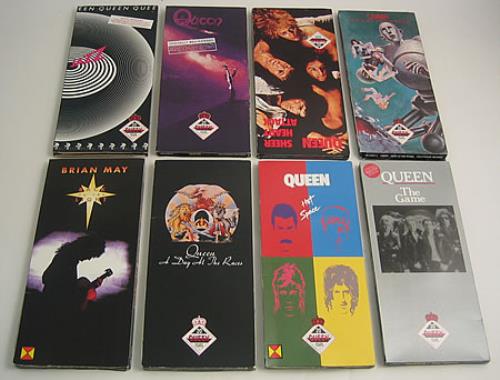
Talk about fragile. A slight scratch and its toast. Durable? Hardly. Not sure how many CD's I had to re-buy because of minor chips or the dreaded "pinhole of death" I can't count. Or what about the green marker urban legend (http://www.snopes.com/music/media/marker.asp). They were also anything but "compact" compared to cassettes. And are you old enough to remember those long CD boxes (https://images.eil.com/large_image/Queen_A+Collection+Of+Emp...) that were a total wasted of cardboard?
Or maybe finally being excited to get your favorite artists old recordings on CD, only to buy the CD, rip it open and read on the back, "WARNING: The music on this Compact Disc was originally recorded on analog equipment, prior to modern noise reduction techniques. This Compact Disc preserves, as closely as possible, the sound of the original recording, but its high resolution also reveals the limitations in the master tape, including noise and other distortions."
I agree that CD's were markedly better, but let's not forgot they still had some serious flaws themselves.
Look at all the 60 year old used vinyl records that have survived and are still just as playable to this day. There's tons of them floating around. On the other hand, it's much harder to find even a 30 year old used CD that still plays fully and without error.
Well, those 60 year old vinyl records that are still playable were no doubt treated pretty reverentially by their owner over that time.
CDs that were handled as carefully as people handle vinyl have lasted at least as well (I don't have any 30 year old CDs but I do have some just getting to 20 years, and those still play fine).
The comparison is between CDs and tapes, not vinyl. Pull a 30 year old tape out of your closet and pray it doesn't leave little bits of itself all over your tape player....
And millennials wonder why people make fun of them. Cassettes were, and still are, terrible.
They made sense since it was possible to copy from another format, such as vinyl/radio/CD even another cassette. It was the only format you were able to copy to (technically you could with 8-tracks, but you could not easily get blanks). Nowadays, if you really wanted a copy, straight to digital.
> They required complicated mecanical trickery to use.
What? I haven't used a cassette in over a decade, but I still remember how they are used, and it didn't involved complicated trickery. Turn on and open the deck, slide in the cassette, close, and press play. Maybe rewind when you're done, and eject.
Streaming music is arguably more complicated, but that's not stopping it.
I enjoyed cassettes. I still have a bunch, and a cassette player in my car. And I never use them over streaming audio from my phone. Why? Because this is 2017 and I'm not a hipster.
do you really think all art should be universally accessible and as convenient as possible? do you really think you can have meaningful experiences with that mindset?


additional, if u really want a kooky old physical medium go with minidiscs! They were amazing!