I first think of React's re-licensing from Apache, where under the new license if you sued Facebook for patent infringement for any reason, you would lose the patent grant to use React.
React was already quite prominent in web technologies, but that license pointed a loaded gun at any business smaller than Facebook who wanted to use React. They opened it up to its current license, MIT, as the backlash built.
First off, in actually using Zola or Hugo, there really is minimal difference in syntax, and I really have to squint to see whether there is stylistic input from their host languages.
Second, people should use the tools they want to to get the job done. If they already know Hugo, and they want to create a blog, it's fine that they use Hugo.
Finally, the bigger decision that the blogger seems to be trying to make is to avoid LLMs in writing, which I admire, and IMO is the far more important technology choice in making their blog.
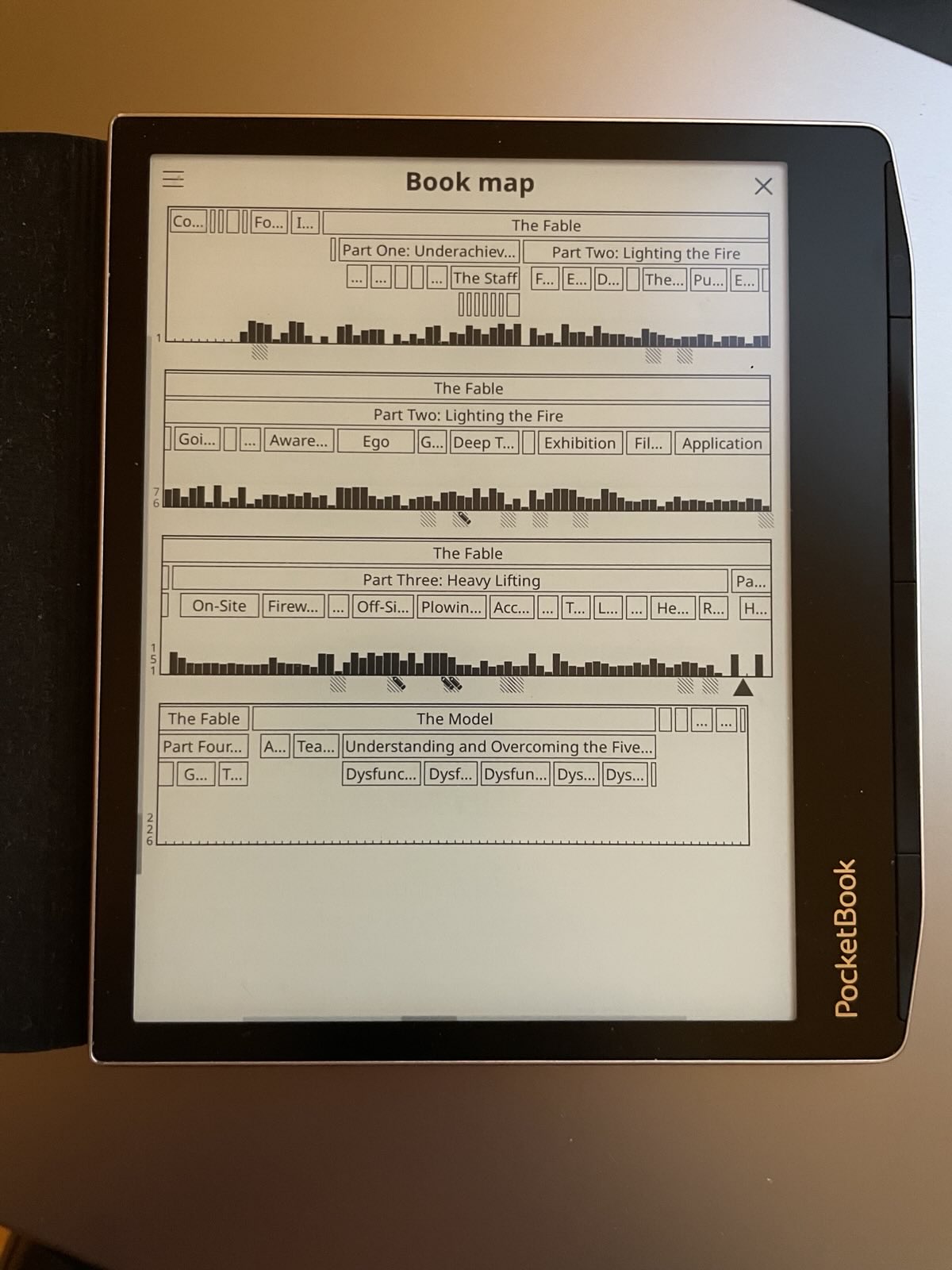
The thing I find the most valuable on KOReader is something I haven't seen mentioned yet: the book map[0]
It shows you chapter and section divisions in a single screen, along with black bars to show you which pages and chapters you've spent a lot of time on. I use this very often to jump back to pages or chapters, or look at which parts confused me. It also visualizes where bookmarks and notes are. When you want to see a segment in more detail, you click there and it brings you to a 6-page zoomed-in view.
Let alone being more useful than the Kindle or Kobo UX, it's more useful than the book UX.
It seems that the students who actually reported the ruins may not have been the ones who graffiti'd it. They supposedly heard from other students who'd discovered it before. Whether or not that's true is harder to say.
I have a suspicion that Twitter laying off so much of the software staff was very influential for people with hiring abilities. The company didn't crash, and they (relatively slowly) began shipping new features again. I think that coincided with the pandemic-era overhiring, and we've been working against that combo ever since.
Every now and then, I actively try to make an LLM replace my tasks, and fully do greenfield projects I would accept- I don't see it. It's very good, no doubt. But I have or have been given the project parameters, and just like with a junior, failures in communication inevitably lead to breakdowns in execution.
It does your job, but not completely autonomously so you don't see it?
It requires a lot of guidance, luckily, I mean thank god otherwise we would be goners. The job itself hasn't become easier, but it did change. If you come across failures you update the spec, the guard rails, whatever you use to guide it. It's not a "it produced bad code and now it's forever useless" type of situation.
I hate to be "that guy" but you're crazy if you don't see AI being able to do greenfield projects you'd accept.
I mean, in your defense, last year I think you would have been right, but right now? Codex rocks, as does Claude. I am literally making money shipping a greenfield project to a customer right now. I'm basically a cheap consultant that is incrementally adding features to make something exactly what they want for way cheaper than it would be to do it the old way.
There are hiccups, outages, things to fix etc. but the customer is happy with the output, and the reduced price means they get bespoke solutions rather than some BS one size fits all SaaS app. Then my job is maintenance and effectively "ITSM." Which kind of sucks in some ways, I miss writing real code for real projects, but this is the future going forward. If you want something for your business, you'll generate it rather than pay for it and for now at least, getting beyond localhost requires someone who knows a bit about computers or is willing to learn. Most small businesses aren't willing to learn.
Now, to your point. Is the code all that clean? Nope (and in your defense sometimes I read through the codebase and shudder)... but who cares? Like, for awhile I would go through and frantically edit it, but why? It worked. Not only that, but there's going to be a new model in 3 months or whatever that can clean it up and make it less shitty. I've literally done that a couple times since I started doing this in January.
The customer ain't reading the code. They don't care as long as the the functionality works - that's what counts. The gazillion tests I have keep it stable as I push code, and the CI/CD pipeline removes a ton of the ass pain I'd have without it.
The biggest thing I'm worried about when it comes to clean code and good design is trying to make sure I keep the token count down on these projects so I can actually do meaningful work without burning through a week's worth of tokens in a single day. That, and I like to try to keep a sort of architectural bird's eye view on what's happening...
Like, I'm not sure what niche of the industry you're in, but for the stuff I'm using it for, stuff is working really well with LLMs.
I assume they are working on low stakes software. Does it really matter if you use an LLM to code a scheduling app for a hair salon or veterinary clinic?
Think about all the geneticists that complain about excel re-writing DNA sequences.
It doesn't matter if its high stakes or low stakes. People use the software that generates the results they like. Not the software that is "correct to use".
So to try and understand your position - you are hired by a small? Company in which sector? And you built an app that does what? And I think most importantly - how did you find the gig? Were they explicitly hiring a AI capable person to do X?
I run my own thing since the start of the year. I’m building little tools for an industry I’m highly familiar that needs very specific scheduling software, data tools, tracking tools etc. My old job was a boring as a government bureaucrat.
I started this by doing some work for an old employer that asked me to start by modernizing an excel spreadsheet into an app I made for them like 10 years ago? They kept asking for more though since, and they’re my biggest customer right now. Which is good because I only have the bandwidth for like one more place right now.
I’ve had a few sort of one off things with other places? But I’m working on getting another company in the same industry right now and I’ll be able to adapt most of the code I’ve built here for another company if they end up deciding to use me.
But my biggest value to companies is “I already know this industry extremely well.”
Hmm, Claude Shannon was an American (the model is ostensibly named after him), so maybe how he pronounced it would be the correct pronunciation.
That said, every language on earth will adapt foreign words into its phonology. The alternative would be to adopt the phonology of every language that loaned a word into your language.
Goodhart's Law isn't a problem immediately. If you want more code to be written, and the only feasible way to write it to goals is to heavily use AI, then you might run into the problems of AI-generated code, and an infrastructure that's poorly architected and much less understood than it would've been ten years ago.
These are indicated through context menus throughout specifying what the responses should be. It's a minimal UI though, and where `git rebase` is confusing magit rebase is confusing.


React was already quite prominent in web technologies, but that license pointed a loaded gun at any business smaller than Facebook who wanted to use React. They opened it up to its current license, MIT, as the backlash built.