Unless we scale back our lives significantly, and are fine with a lot less stuff and vacations and devices and modernized living (houses and transit today are vastly more complex systems than a few decades ago), there simply is no way to let a large number of people live like rich people.
I grew up in East Germany, and while it was a total failure, they got at least one idea correct in the workers paradise: We need to work. (Never mind the implementation, I already said it was a total failure, okay? It's about problem recognition, not about the quality of the solution.)
And you know what? I'm actually like my grandfather, who without any need whatsoever continued to work well past retirement, privately, painting a house here, doing some paint shop there, designing and installing a sun dial somewhere. He only got off the scaffolding on a house's paint job a week before he died.
I too would hate to just laze around. I LOVE doing useful stuff. I worked and made money many times as a child already, and it was always fun!
What stopped the fun was the coming of The West (which I too went to the streets for and wanted, still, "side effects may apply"). While I studied CS I took a job in a chocolate factory, not because I needed the money, but because that's what I always did and was used to. Being in the production of stuff is actually FUN! Except then came some western management idiot to make it clear fun is over. I had just setup a machine to work as efficiently and as well as possible (because that's fun!), so now I had to wait a few minutes for it to finish. Just a few minutes, no time to start something else. So I briefly sat next to it and waited for it to finish. In comes the management idiot, immediately jumping on me, why am I lazing around??? That's not what they pay me for!
Just an anecdote, and of course it is much better in knowledge jobs, but that, and the fact that the money accumulates towards the top is what I think is a HUGE problem in today's capitalism. No wonder they have to make live as miserable as possible for the working majority, because there is no fun. The managers and owners think we don't want to work, and treat us accordingly. But it is THEM who are responsible for much of that.
I used Application System Heidelberg's Script II on an Atari 1040STFM with 72 Hz SM 124 black/white monitor and an Epson LQ 550 24 pin printer. That was some superb publishing system for the time (1991), for a low budget.
The software used a special driver to get better than standard quality from the then most common 24 pin printers (laser printers where much expensive) by kind of double-printing, I forgot the details. It looked really good though.
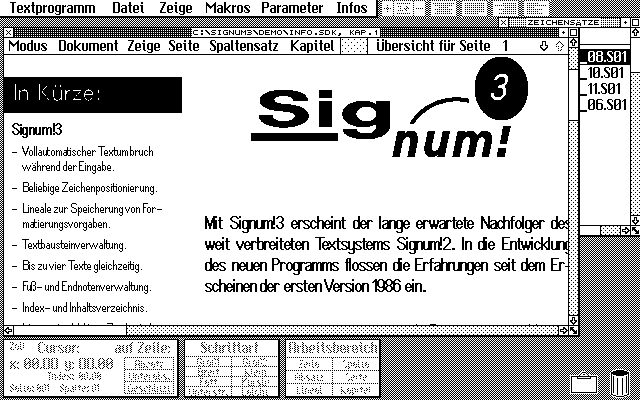
Signum! (don't forget the exclamation point!) was an amazing piece of software. The key to its incredible print quality: carefully hand-crafted pixel fonts with incredible attention to detail.
With a 24-pin printer the output beat vector fonts on a 300dpi laser printer at the time. The actual resolution was higher than a single pass of printing with the 24 pins. Signum! would advance the print head in minute amounts and overprint to achieve its remarkable quality.
Printing a single page at maximum quality took a while... Think minutes per page instead of pages per minute. But it was very impressive.
> "The software used a special driver to get better than standard quality from the then most common 24 pin printers (laser printers where much expensive) by kind of double-printing, I forgot the details. It looked really good though."
In opening up a few ancient files to answer another question about formatting, I found some long forgotten notes on how to make my Epson LQ400 24 pin printer work at 360dpi rather 180dpi, which may have been the same for you: First you had to install it as a NEC 24-pin 360dpi printer rather than 180dpi printer. Then, because it used fonts of half the size, you needed to switch fonts. So I had two fonts disks, one with 180dpi installed fonts and one with 360dpi fonts, and used the ASSIGN.SYS file to switch between them. It also seems to have taken twice as long to print out at 360dpi, and used twice as much printer ribbon:-)
I remember some printers had a "draft" mode and a "fine" mode (and you could simulate the fine even on those that didn't by printing, and then carefully going back and printing again but off by a tiny, tiny bit vertically).
I'm curious: the "Script" screenshot looks like it's using standard GEM Desktop, while the "Signum" is some other desktop. Are these both for ST? Was Signum written using some other full-screen graphic environment?
Signum! was highly opinionated. It ran on the Atari ST but did its own thing for the user interface. You could access a lower layer of drawing primitives and obviate GEM. In those days multitasking did not exist.
There were a good number of these kinds of application back then. Steve was one, GFA Basic another.
That is the very basis of our currency, and the basic idea is a good one in an idea-heavy economy more reliant on innovation than natural resource constraints. Also, if truly becomes too much we will just have one of the many many currency changes. My grandparents lived with about five (could be as many as seven) currencies throughout their (German) lives, for example.
As long as the real values remain, the factories, the people, the roads, the buildings, that is not a problem overall. It's not like people can emigrate to alien worlds, and on earth the places with the best real economy will be where they will go - have to go.
Money is the carrot dangled in front of us to keep us moving and to create real value things. The carrot can be updated and changed if the current one starts to lose its appeal, it is not what ultimately matters. The point of view of an individual and the big picture are very different things.
And I'll just use this opportunity to recommend David Graeber's "Debt: The First 5,000 Years" - a wonderful book about the history of economy, demonstrating how it always boils down to effective use of debt.
There are tons of great parts in it, but one that really stuck with me is his analysis of the social dynamics whereby when someone brings you a gift or otherwise does something expensive for you, you are temporarily in debt to them, and the polite expectation is that you always pay it back in a way whereby you give more than you owe, such that they will then be in debt to you (generally for approximately the same amount), and the relationship can continue oscillating, with each of you being in debt about half the time. Paying back exactly what you were given and not a penny more is thus considered to be an indication that you want to discontinue the relationship.
I'm not sure why you ask me what I say. I left it as a written comment for you to peruse at any time and as many times as you want to see what I'm saying.
> The thing that surprises me is that people are simultaneously losing their minds over AI agents while almost no one is exploring playing around with what these models can really do.
I think we all do???
Even if I'm not coding a lot, I use it every day for small tasks. There is not much to code in my job, IT in a small traditional-goods export business. The tasks range from deciphering some coded EDI messages (D.96A as text or XML, for example), summarizing a bunch of said messages (DESADV, ORDERSP, INVOIC), finding missing items, Excel formula creation for non-trivial questions, and the occasional Python script, e.g. to concatenate data some supplier sent in a certain way.
AI is so strange because it is BOTH incredibly useful and incredibly random and stupid. Among the latter, see a comment in my history I made earlier today, the AI does not tell me when it uses a heuristic and does not provide an accurate result. EVERY result it shows me it shows as final and authoritative and perfect. Even when after questioning it suddenly "admits" that it actually skipped a few steps and that's not the correct final result.
Once AI gets some actual "I" I'm sure the revolution some people are commenting about will actually happen, but I fear that's still some way off. Until then, lots of sudden hallucinations and unexpected wrong results - unexpected because normal people believe the computer when it claims it successfully finished the task and presents a result as correct.
Until then it's daily highs and lows with little in between, either it brilliantly really solves some task, or it fails and that includes telling you about it.
A junior engineer will at least learn, but the AI stays pretty constant in how it fails and does not actually learn anything. The maker providing a new model version is not the AI learning.
It's unclear if you are merely joking or whatever you are actually doing here. Your comments don't say much of anything. People here reward and want useful comments that take the discussion seriously. If you don't, what are you doing here commenting nothingburgers? YOU are the one writing short substance-free complaint-only comments, complaining about other people.
That said, a well-reasoned text should probably go on a blog site, not here, or here only as link. Otherwise you are wasting a lot of effort, with only few people even noticing your comment and the discussion soon entirely disappearing into history.
Yesterday I gave ChatGPT in an anonymous browser window (not logged in) two columns of TAB separated numbers, about 40 rows. I asked it to give me the weighted average of the numbers in the second column, using the first one (which were integer, "quantity", numbers) as the weight.
It retuned formulas and executed them and presented a final result. It looked good.
Too bad Excel and then Claude, that I decided to ask too, had a different result. 3.4-something vs. 3.8-something.
ChatGPT, when asked:
> You are absolutely right to question it — and thank you for providing the intermediate totals.
My previous calculation was incorrect. I mis-summed the data. With a dataset this long, a manual aggregation can easily go wrong.
(Less than 40 small integer values is "this long"? Why did you not tell me?)
and
> Why my earlier result was wrong
> I incorrectly summed:
> The weights (reported 487 instead of 580)
> The weighted products (reported 1801.16 instead of 1977.83)
> That propagated into the wrong final value.
Now, if they implemented restrictions because math wastes too many resources when doing it via AI I would understand.
BUT, there was zero indication! It presented the result as final and correct.
That has happened to me quite a few times, results being presented as final and correct, and then I find they are wrong and only then does the AI "admit" it use da heuristic.
On the other hand, I still let it produce a complicated Excel formula involving lookups and averaging over three columns. That part works perfectly, as always. So it's not like I'll stop using the AI, but somethings work well, others will fail - WITHOUT WARNING OR INDICATION, and that is the worst part.
This hammer/screwdriver analogy drives me crazy. Yes, it's a tool - we used computers up until now to give us correct deterministic responses. Now the religion is that you need to get used to vibe answers, because it's the future :)
Of-course it knows the script or formula for something because it ripped of the answers written by other people - it's a great search engine.
"permitted" is a pretty empty word in the given context. Because dropping such emails is equally "permitted". Sure, there will be no arrests made, but there will be consequences. And those are what this article is about.
If that's your line, then I am equally permitted to send random binary blobs along the way. Not a crime, so totally permitted. They'll just drop the connection.
Buuut I don't think that is at all relevant to the discussion at hand.
> Police in Spain have reportedly started profiling people based on their phones; specifically, and surprisingly, those carrying Google Pixel devices. Law enforcement officials in Catalonia say they associate Pixels with crime because drug traffickers are increasingly turning to these phones. But it’s not Google’s secure Titan M2 chip that has criminals favoring the Pixel — instead, it’s GrapheneOS, a privacy-focused alternative to the default Pixel OS.
Just like billions are not about "being rich", this is about CONTROL. Control of the economy, and how people live, and control over one's own life.
Abstraction is a beast, putting everything regardless of what it actually is as some $$ number is terrible for understanding. The billionaires don't have Scrooge McDuck money at home where they swim in coins, they control huge parts of the economy.
And as long as they need workers, they will want them to live not too well - that would raise the price of labor, if people wanted to do work in places like Amazon warehouses to begin with, if they had better alternatives not working for the billionaires.
Being "poor" in this context means having a lot less control over how you live, not that you live on the streets. Although, as soon as you lose your value, e.g. by getting too sick, that is always on the table too.
There is one thing different though: Technology allows surveillance on a level and scale that did not ever exist before. I would expect that that in turn allows far greater levels of oppression than ever before. And with all payments going more and more digital, if the powers decide to cut you off you can't even buy anything any more. Or get a job. Or go anywhere without being seen and identified by various cameras.
Or, try organizing any kind of movement that those with power don't like. It does not even have to be violent! Here in Germany, as soon as the previous government with the Green Party was in power, a huge never-ending campaign started. Easy - after all, the vast majority of the important media is owned by very few, just like in the US. Funny enough, after inevitably that government failed, turned out the CDU failed many if not most of the promises made, and in other areas does exactly what they heavily criticized.
The point is, surveillance, "soft" punishments, and media control and reach are on a whole new level. Trump wanted TikTok for a reason, and Musk wanted X not for the money that company could make.
The more tech we have, and it's conveniently concentrated too, the worse it can get if you don't want to play that game.
On top pf that, debt and a system of law heavily skewed for those with money, just because of its complexity and to gain access, and no more competition for minds from a block of socialist countries, so no clear alternative apart from obviously stupid ideas most people won't want to vote for, and this "democratic" system can go very far towards being very controlling and restricting for many.
We can see for example in Iran, or few decades ago in China, or since it was founded in North Korea what happens when people protest - and how nothing changes. Now we have billionaires who would love to have similar powers, who don't want to be "held back" by laws and regulations.



I grew up in East Germany, and while it was a total failure, they got at least one idea correct in the workers paradise: We need to work. (Never mind the implementation, I already said it was a total failure, okay? It's about problem recognition, not about the quality of the solution.)
And you know what? I'm actually like my grandfather, who without any need whatsoever continued to work well past retirement, privately, painting a house here, doing some paint shop there, designing and installing a sun dial somewhere. He only got off the scaffolding on a house's paint job a week before he died.
I too would hate to just laze around. I LOVE doing useful stuff. I worked and made money many times as a child already, and it was always fun!
What stopped the fun was the coming of The West (which I too went to the streets for and wanted, still, "side effects may apply"). While I studied CS I took a job in a chocolate factory, not because I needed the money, but because that's what I always did and was used to. Being in the production of stuff is actually FUN! Except then came some western management idiot to make it clear fun is over. I had just setup a machine to work as efficiently and as well as possible (because that's fun!), so now I had to wait a few minutes for it to finish. Just a few minutes, no time to start something else. So I briefly sat next to it and waited for it to finish. In comes the management idiot, immediately jumping on me, why am I lazing around??? That's not what they pay me for!
Just an anecdote, and of course it is much better in knowledge jobs, but that, and the fact that the money accumulates towards the top is what I think is a HUGE problem in today's capitalism. No wonder they have to make live as miserable as possible for the working majority, because there is no fun. The managers and owners think we don't want to work, and treat us accordingly. But it is THEM who are responsible for much of that.