It's a really interesting world. You can spam GPT to get novel math results but here I am trying to scroll up to the beginning of the conversation and 5 minutes in I still don't know if I'm near the top yet.
Scroll... wait for render... scroll... wait for render... repeat...
We live in a world where there's so much crazy technology but few people use it to make products better or to improve people's lives. Most people use it to just make more money. It's funny too, because there's a million things we could use that tech for that actually reduce costs. Hell, what would be the economic impact of putting ML systems into streetlights so they properly coordinate. Don't even need LLMs for that, and I'm sure it'd save billions of dollars a year. Just a lack of will. I wonder if this will ever change. Is this how we create the high tech low life future?
(FWIW, no problems if I jump into the app. It's purely a web thing, but my point more illustrative than specific)
On my mac if you scroll slightly a blob appears on a slider on the right and you slide it to the top to go to the top. I'm not sure about these hidden user interface features that you only find through trial and error.
In an ideal world, that would be true, but the actual world is very far from that. As an extreme example, AI is very useful to automate scamming people.
Like it was so correlated back in 1600? Under the Romans? But perhaps you just mean that the increased financialization of the US economy means that the percentage of economic wealth devoted to actions without value is increasing? Sort of a modern trajectory to 1789 with the foppish nobles not realizing how much everyone else can get along without them?
The architecture of our modern technological society lies on top of pure maths. One cannot say “resolving the physicality of the Navier-Stokes equation” will lead to x, y or Zed human improvements, but for hundreds of years it has. It is like Bach making his fugues for beauty and pleasure but occasionally you get chip technology or mathematical ecology or GPS falling out of it.
It always is about money. As long as there's money it will always be about it. LLMs are big techs attempt of shifting money from the people further up, by getting rid of jobs. We're all not angry enough because some of yall are so delusional about the whole thing, by thinking we will get some kind of Utopia.
I’m a bit surprised OpenAI isn’t finding these big results far faster than the product’s user base. With no limits on runtime, access to dev models, custom tuning, and top talent, you’d think there’d be a constantly running internal project with the goal of solving famous math problems. And who knows, perhaps there is, but it would be interesting to compare the rate of success per unit “effort” of the internal mathematics work with that of the user base.
"OpenAI's internal team solves famous maths problem" is technically impressive but dispiriting. Non-experts solving a problem by just throwing resources at it is kind of the worst possible optics for knowledge workers. It's just disempowering.
"Famous mathematician uses ChatGPT to solve famous math problem" is equally technically impressive, but now you're telling those very same knowledge workers "that famous mathematician could've been you". It puts you in the driver's seat, and provides a clear path forward — subscribe, use our product, and reap the rewards.
I don't think they care if it's disempowering. They'd gain more in market share by indicating that this is God than missing out on a few subscriptions from math theory people.
My guess is they don't do this because they don't have time. They're all trying to build a company that makes them generationally wealthy before the music stops.
Note, in posts like the following, the author indicates they are able to get free subscriptions from OpenAI
As an aside, there's this idea in math that when you create a new field you shouldn't solve all the easy problems - you need to entice other people to learn about the field!
I expect there's some element of that here. It's much better for OpenAI and Anthropic if their users are the ones discovering and writing up the results of the AI solving hard math. Look at the high school and college age students who have become ai power users and potentially learned how to use git to contribute ai generated solutions
(Related: I believe Terry has also gotten all of the subscriptions gifted to him)
You're surprised they didn't eat the tokens to churn on lots of open problems instead of asking others to pay for those tokens? They're in the token business. If they're eating the tokens, it's in support of a marketing effort, not in support of innovation across the frontier of all the other academic disciplines. The collective frontier is way too big for them to just "solve it" without asking society to at least help them break even on such an enormous public good.
It's also much better to distribute the challenge of identifying problems amenable to which prompts
Could they do it? Sure, but to what end? It would make more people hate them and feel even more "take our interesting work." Pitching it as a useful tool just makes more sense on all levels
Confirmation bias. There's likely a wide portion of chats in which "keep going" derails to madness. We then stop saying "keep going" because we notice there is something wrong, and we start another chat. In the end, we largely remember much better the interactions in which "keep going" resulted in something good, and forget about our role in stopping the train when it derails, which is something much harder to do unattended by a human.
Had you heard of these “famous unsolved problems” before now? If you aren’t a trained mathematician, you won’t know where to point the LLM towards achievable goals. Having it solve some Erdos problems is pretty different than a Millenium prize, and even some of those might be unknown to the general non-mathematical public. Finding counter examples, unattended, to various algebraic geometry conjectures is amazing but still a ways off from the a definitive disposition of the Riemann hypothesis, P vs NP, the Navier-Stokes problem (although I wouldn’t be shocked if Professor Tao put an LLM towards a counter example for that based on his technique of encoding machines into initial conditions of PDEs).
Although if I were a mathematical quantum physicist I might be trying to prompt one into a % mathematical field formalized quantum field theory. Weirdly this sort of obvious step has not been accomplished in the last 100 years.
As a small wrinkle: the actual observed number of producers can be small, but the market still be competitive. See https://en.wikipedia.org/wiki/Contestable_market for one case: when potential suppliers are waiting on the sidelines.
I have a pi extension that just runs the same prompt in a loop 25 times. I tried giving it a loop breaker but I found that it'd give up too readily. When the task is actually complete each iteration didn't do a lot of work so it was efficient enough. I suppose another way is to call out to a separate context to check if the task is complete?
Commands like /goal and similar are the more complex version of this; you write a prompt like it was a singular iteration, it runs one iteration, then runs an "evaluator" to determine if the goal has been reached, then runs the prompt again with a little extra to make it go again - and so on. The evaluator is just an LLM with most of the result or context looking at the original goal and the state and answering the question "has the goal been met".
The interesting part of this: while some leading implementations use the same LLM and context for the evaluator, some call out to a different context, some to a tuned LLM and different context; so which is better? many blog-scale benchmarks are calling it a toss-up that is highly dependent on the primary model.
Agreed. But also formalising the statement of a theorem, or rather understanding the formalisation that the LLM suggested to you, is often a lot easier than understand the whole proof, especially if it's a formal proof.
I was surprised at how little improvement they could eek out of tuning it; but it is a non-trivial improvement which is much less likely to wastefully spin if your validation is more expensive than you realise.
Makes sense that its in the major harnesses and not the self-built ones.
What I am thinking is the way you make it 'keep going' and when you have people of the calibre of Tao doing it I kept thinking how many breakthroughs is he going to cause the LLM to find with his targetted questions :D Amazing that we have the privilege of witnessing a true expert in such a way question the LLM.
Just relax and welcome the nondeterministic world as a non-programmer. Also, forget what you were taught in Theory of Computation, no one needs it anymore. AI will do everything for you. /s
Marketing for huge bucks sounds like this.
You will own nothing and will be happy (that you are still alive). Probably.
I’ll have to try this exact phrasing. I had a lot of trouble with GPT 5.5 more or less completely ignoring similar prompts and instructions and entering a sort of “doom loop” or just consistently trying to prematurely end the chat.
I would love any tips for other folks who have successfully used similar approaches.
"The model family was reconstructed programmatically (parameterized cuboid stack) and swept over 2,304 configurations — extrusion directions, workplane-normal orientations, sketch windings, D's plane/height/depth/extent, including all the exact-coincidence heights. Zero failures with the fix; 576 failing configurations without it. The generator is available on request."
It looks like it wrote a python script to generate test cases in our file format for testing. Just... you know, as a side quest.
> It looks like it wrote a python script to generate test cases in our file format for testing. Just... you know, as a side quest.
On the one hand, agents have done this sort of thing for a year+, if you pushed them to check their work. On the other, I absolutely can feel Fable and Sol have crossed a threshold where they can be trusted far more than before. Huge difference between plans written by Opus or Fable.
Accumulated AI slop can simply be cleaned up by better models. Real cost of technical debt is shrinking due to the the inflationary devaluation of code!
Without any more context, "keep going" seems to be doing a lot of work. The user is placing a lot of faith in the LLM to not make subtle logic mistakes and to take good approaches to each problem. In my experience, even frontier models (such as Fable) are quite capable of getting confused during even simple technical work I've done in the dev ops world. For example:
LLM: This package hasn't made it to production.
ME: are you sure? i see it right here!
LLM: You're right to push back. I inferred that based on weak data. I see now that the package has been deployed!
If the above conversation is typical for me, how could one expect to achieve a sound result by repeatedly prompting an LLM to simply "keep going" in dense mathematical proofs? Perhaps the user in this case had actually checked the LLM's work before issuing the prompt, but I think you see my point anyway.
There may be something(s) about mathematics (proofs) that makes it particularly amenable to LLM reasoning - highly inductive from facts that are explicitly within-context/associative space? Being an unusually well documented discipline in general, with less influence from tacit knowledge or idiosyncratic “it works however the opinionated human made it work +- bugs” processes? Something about simulating even the smallest non-pure-inductive leaps necessarily risking simulating mistakes due to the nature of context “perception”?
There’s also probably a lot less noise from casual internet conversations. I imagine a nontrivial amount of what LLMs know about certain technologies comes directly from forums like reddit where quality of response isn’t guaranteed.
I mean, just the way Tao phrases these inqueries seems to imply a weighting towards an extremely abstract and high level rigorous corpus. In a way, prompt engineering really is the big unlock here.
Maybe! But I suspect you can write a little LLM assisted helper to at least make your prompts sound more like Tao's. (Your ideas won't necessarily be better, but you can probably 'imply a weighting towards an extremely abstract and high level rigorous corpus'.)
Not likely. You run the risk of bleeding into the crank mathematics language pool which is well represented in the training. I mean the prompts may sound good to you and me, but they will have low probability words in respect to the Tao level maths.
I disagree. In fact, I think the field of dev ops gives a clean analogy with mathematical proofs. My point was that my work often requires that I figure out a consistent way to prove to myself what the condition of a system is by asking the right probing questions about it. What I've seen is that even the best LLMs lack a good intuition about what questions they should be asking and instead reach for the quickest and most obvious checks that leave edge cases uncovered. Maybe it is something about the domain of the problem; I don't know. But it makes it hard for me to imagine that an LLM wouldn't make similar errors in other cases, especially when generating mathematical proofs that will soon be too dense for humans to review.
Agreed, often you have to step in and stop it from reasoning itself into dumb directions, but occasionally it goes just like the transcript in question.
Maybe, but I want to point out that even the lesser models are capable of hunting this stuff down. The most important thing is that you provide a decent path for them to follow.
That’s probably not interesting anymore, but 5.6 wasn’t able to name the conjecture when presented the notation only, but confirmed the proof and when told what it was, agreed it works. Much less psychosis than when given the Jacobian counterexample, at least.
If I understand correctly the conversation, ChatGPT had to compute for quite some time, meaning a large amount of computations. What kind of resources would be we needed to achieve the same results with a local LLM? Is it even feasible with current open models?
For instance, would it be affordable for a research lab to not rely on OpenAI?
Is this the same as Dinitz Theorem[1] which seems to have been proved in 1994? This is the only result I keep stumbling upon when trying to understand the problem formulation
I disagree. The various questioners in The Last Question all hope for/expect an answer; what they don't expect is the "insufficient" response.
I am talking about someone jokingly asking AI `HOW TO ACHIEVE COLD FUSION` (or `A UNIVERSAL CANCER VACCINE`, or `AN AI FRAMEWORK SUPERIOR TO THE TRANSFORMER`), and getting a usable answer.
Even the standard RSI prompt will be like (or probably already is): "Improve yourself, make some breakthroughs, think really hard and don't give up until you are improved and make no mistakes."
Eventually there will be an AI that will be able solve those sorts of questions as simply stated, like "cure all human diseases. also, make no mistakes!".
That would only be physically possible if all the data about biology was accessible. Given we routinely find new biological facts that contradict prior beliefs about how cells work, it seems likely that this day of total biological information access by humans and our creations is some time off. Reasoning ability is a limit sometimes, but we have had reason for a long long time - a solid persistent corpus of good data about the mechanical details of cells and planets and chemistry is also needed, along with a good method for validating existing ideas. LLMs will absolutely speed this up, but I can’t quite see how they will replace it.
That bothered me decades ago, when I heard people suggesting we no longer needed animal trials, we could just simulate human biology for testing.
Don't get me wrong, the way we collectively treat animals is evil, but the idea that somehow we know enough about biology even today to reliably simulate drug behaviors seems unlikely.
I've noticed GPT specifically has more of a tendency to stop partway through things than many other models do. Although my most recent experience with it was 4.X I believe.
Hearing "here's what I've done, here's the completely unambiguous next steps, I'll wait for you to send a pointless message before I continue" over and over again is a real pain.
That was a tendency of 5.4 and earlier, OpenAI specifically worked to avoid it in 5.5 and I find it happens rarely know. It really felt like 5.4 had been intentionally trained to stop and check, I believe it wasn't the system prompt.
At Mozilla, we had a set of whiteboard tags we could set on bugs, like "[crash]" or "[compat]" or "[leave-open]". That last was used when there were multiple patches attached to the bug, and we wanted to land only some of them without automation closing the bug once they landed. (It's common to have alternate approaches or test cases also attached to the bug, so you normally don't want to wait for all of them to land before closing the bug.)
I started using "[leave-open" for those.
It lasted for a couple of years, until someone went through and "fixed" them all.
There are significant trade-offs with this technology.
It's storing heat, so if you need electricity then you eat a lot of efficiency. I think Vernon said ~45% round trip efficiency. Batteries are 90%+.
The storage is at a high temperature (500-600C) which means that you can't use heat-pumps to produce the heat to be stored. This means that you miss out on ~400% energy gains possible from converting electricity to heat.
So the efficiency is pretty low.
That said, solar PV is really cheap and moving large amounts of earth into a pile is also a very much solved problem so in some cases, notably higher latitudes which have very long days and low heat/electricity demand in the summer and the opposite in the winter, it could still be a very good solution.
The whole point is that the thermal energy is used directly, via district heating. These are not meant to store energy for electricity production (though they could do that if really needed – emergency power for various facilities? Maybe not worth it compared to diesel.)
Heat from existing thermal power plants can be stored directly and later distributed with no conversion loss; excess electricity from renewables can be turned to heat at 100% efficiency, but the problem is that peak heat demand and peak electricity supply do not typically coincide. Heat batteries are meant to solve that problem.
"In response, Lord Watts added that young people “are not stupid”, explaining that if they assume they will “earn low incomes and there’s no future”, then youths will likely lower their aspirations as a result."
There's probably a lot more interesting info hiding behind that statement. If housing is massively unaffordable (as it in the UK), social mobility is rather low, why go out there and destroy yourself in low wage jobs?
Not saying there's no spoiled youth waiting for their lottery ticket that will never come, but there's a rational aspect to it as well.
You're on the right track in channeling this negative energy into productive work on the company.
There are a few things to keep in mind, some of them you've already argued yourself. One, Engage is a common word, so that's on you, and two, more importantly, in today's SEO/ASO/other algorithmic wars, if you truly are the leader in this space, people will copy as much of your name/branding as possible to steal your customers' attention.
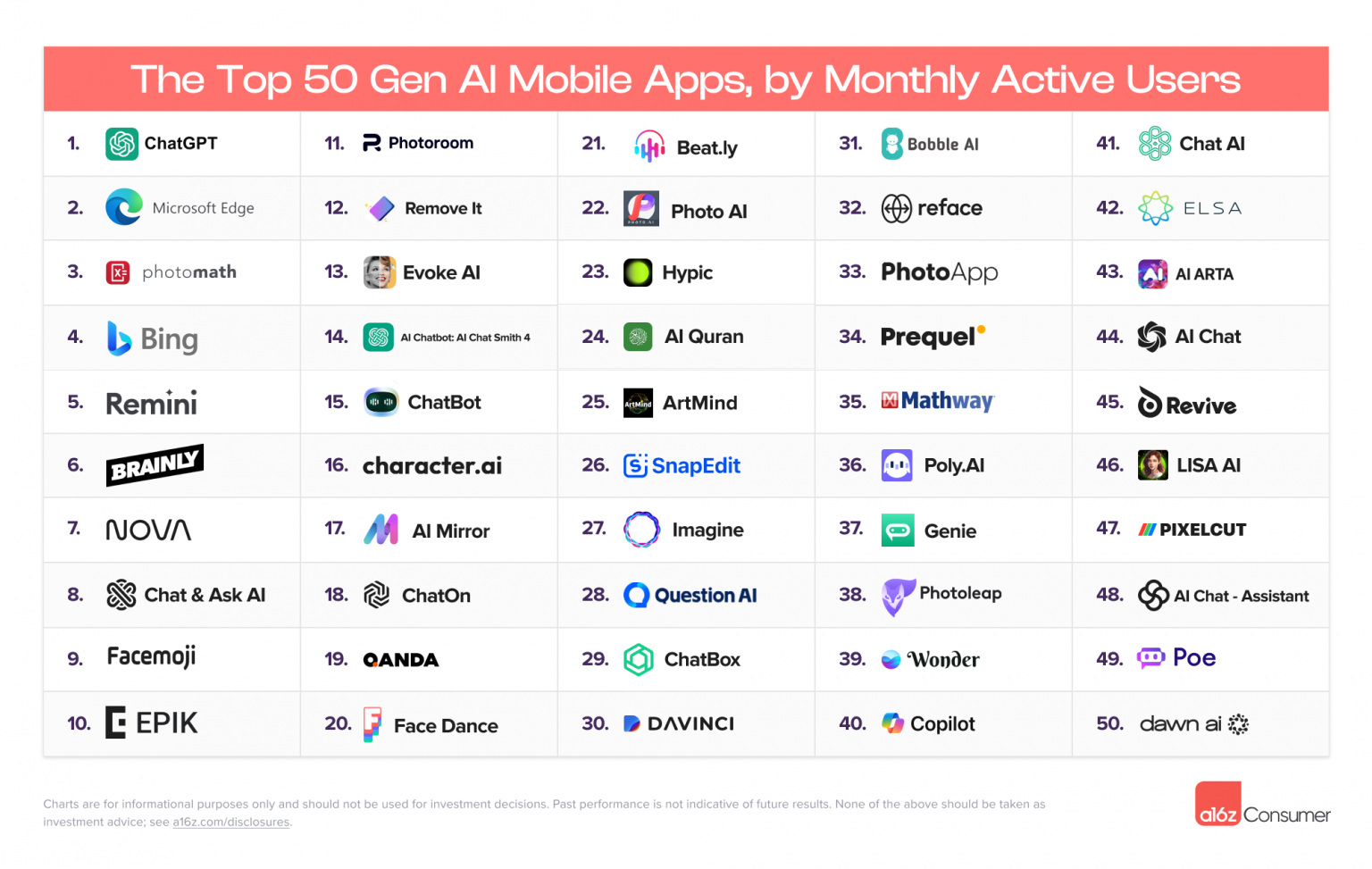
You are absolutely not in a unique position in this regard, if you want evidence, look at this top 50 generative AI mobile apps ranking: https://isarta.com/news/wp-content/uploads/2024/05/image-6-1.... Count the amount of Chat + "something" names, and the amount of practically identical logos as ChatGPT in addition. That's the game these days, if you are successful, you will be copied relentlessly.
And the copycats might not even be copycats in the sense you're thinking. Automated customer engagement, LinkedIn or otherwise, is probably among the top 3 ideas that came to mind to anyone working in the sales/CRM space as soon as LLMs became convincingly human in conversation. So it's just thousands of people realizing the same opportunity at roughly the same time, going out to build it, maybe checking if there's a significant player in the space already, learning from their mistakes, copying the parts that made sense, and firing on all cylinders to become the leader in the space.
Yes, someone with more money might even beat you to the #1 spot, and the people who you think are your competitors right now might not even be relevant in a year, when various CRM companies build this functionality into their systems as a feature. In an even worse scenario, companies like Persana might be acquired with way worse numbers than you have, because of the network, the budget, the lower risk due to being ex-LinkedIn, etc.
None of this is particularly "fair" in the school playground sense of the word, but rarely anything is in business. If you have a true competitive advantage in terms of product, you have better odds than most, but maybe someone is going to beat you on distribution, pricing, marketing, targeting, to the point that product will barely matter.
It's on you to figure out what you want to focus on, and what outcome you will be happy with. If you have the metrics, you can probably fundraise easily. You might not want to, because you want to bootstrap, but then stop wasting energy on thinking about competitors who are doing it differently. Whatever choices you make, make them, and focus on your own path.
There is a tremendous share of medicine specialties facing shortages, and fear of AI is not a relevant trend causing it. Even the link explaining shortages in the above article is pretty clear on that.
I do agree with the article's author's other premise, radiology was one of those fields that a lot of people (me included) have been expecting to be largely automated, or at least the easy parts, as the author mentions, and that the timelines are moving slower than expected. After all, pigeons perform similarly well to radiologists: https://pmc.ncbi.nlm.nih.gov/articles/PMC4651348/ (not really, but it is basically obligatory to post this article in any radiology themed discussion if you have radiology friends).
Knowing medicine, even when the tech does become "good enough", it will take another decade or two before it becomes the main way of doing things.
The reason AI is hyped is because it's easy to get the first 80% or 90% of what you need to be a viable alternative at some task. Extrapolating in a linear fashion, AI will do the last 10-20% in a few months or maybe a couple years. But the low-hanging fruit is easy and fast. It may never be feasible to complete the last few percent. Then it changes from "AI replacement" to "AI assisted". I don't know much about radiology, but I remember before the pandemic one of the big fears was what we'd do with all the unemployed truck drivers.
> That's a hefty assumption, especially if you're including accuracy.
That's exactly what the comment is saying. People see AI do 80% of a task and assume development speed will follow a linear trend and the last 20% will get done relatively quickly. The reality is the last 20% is hard-to-impossible. Prime example is self-driving vehicles, which have been 80% done and 5 years away for the past 15 years. (It actually looks further than 5 years away now that we know throwing more training data at the problem doesn't fix it.)
Waymo barely works, with 24/7 monitoring by humans in a "fleet response" center[0], in 4 cities in the world. That's only 95% done if you're counting good enough for government work.
The monitoring might be 24/7 but its reaction time is nothing usable in a life-and-death situation. Or I just cannot imagine a human being notified "I think I'm crashing into something" and able to take over and do anything of significance within that second to avoid the crash (except hitting on the brakes which the car could do just as well). So don't read too much into the response team, it has definitely its use but won't save you from plunging into that sinkhole who just appeared.
That's their point, I think; since the 50s or so, people have been making this mistake about AI and AI-adjacent things, and it never really plays out. That last '10%' often proves to be _impossible_, or at best very difficult; you could argue that OCR has managed it, finally, at least for simple cases, but it took about 40 years, say.
> The reason AI is hyped is because it's easy to get the first 80% or 90% of what you need to be a viable alternative at some task.
No, it's because if the promise of certain technologies is reached, it'd be a huge deal. And of course, that promise has been reached for many technologies, and it's indeed been a huge deal. Sometimes less than people imagine, but often more than the naysayers who think it won't have any impact at all.
> There is a tremendous share of medicine specialties facing shortages
The supply of doctors is artificially strapped by the doctor cartel/mafia. There are plenty who want to enter but are prevented by artificial limits in the training.
Medical professionals are highly paid, thus an education in medicine is proportionally expensive. An education in medicine is expensive, thus younger medical professionals need to be highly paid in order to afford their debt. Until the vicious cycle is here is broken (e.g. less accessible student loans? and more easily defaultable is one way to spell less accessible), things are not going to improve. And there’s also the problem that you want your doctors to be highly paid, because it’s a stressful, high-responsibility job with stupidly difficult education.
US doctors are ridiculously overpaid compared to the rest of the developed world, such as the UK or western EU. There's no evidence that this translates to better care at all. It's all due to their regulatory capture. One possible outcome is that healthcare costs continue to balloon and eventually it pops and the mafia gets disbanded and more immigrant doctors will be allowed to practice, driving prices to saner levels.
How doctors are licensed in the US compared to western Europe might explain why health care costs are higher in the US, but it does not explain why health care costs are rising so much. That's because health care costs are rising at similar rates in western Europe (and most of the rest of the first world).
For example from 2000 to 2018 here's the ratio of per capita health care costs in 2018 to the costs in 2000 for several countries:
2.1 Germany
1.8 France
2.0 Canada
1.7 Italy
2.6 Japan
2.6 UK
2.3 US
Here's cost ratios over several decades compared to 1970 costs for the US, the UK, and France:
Doctor salary is not the only or perhaps even the main factor in healthcare expensiveness, but taking on the overall cost disease in healthcare would broaden the scope too wide for this thread, I think.
Also, I admit that the balloon may in fact never pop, since one theory says that healthcare costs so much simply because it can. It just expands until it costs as much as possible but not more. I'm leaning towards accepting Robin Hanson's signaling-based logic to explain it.
Yep, this is precisely what they argue. They don't simply say they want to keep their high salary and status due to undersupply. They argue that it's all about standards, patient safety etc. In the US, even doctors trained in Western Europe are kept out or strangled with extreme bureaucratic requirements. Of course, again the purported argument is patient safety. As if doctors in Europe were less competent. Health outcome data for sure doesn't indicate that, but smoke and mirrors remain effective.
I wouldn’t dismiss the premise so quickly. Other factors certainly play a role, but I imagine that after 2016, anyone considering a career in radiology would have automation as a prominent concern.
Automation may be a concern. Not because of Hinton, though. There is only so much time in the day. You don't become a leading expert in AI like Hinton has without tuning out the rest of the world, which means a random Average Joe is apt to be in a better position to predict when automation is capable of radiology tasks than Hinton. If an expert in radiology was/is saying it, then perhaps it is worth a listen. But Hinton is just about the last person you are going to listen to on this matter.
> even when the tech does become "good enough", it will take another decade or two before it becomes the main way of doing things.
What you're advocating for would be a crime against humanity.
Every four years, the medical industry kills a million Americans via preventable medical errors, roughly one third of which are misdiagnoses that were obvious in hindsight.
If we get to a point at which models are better diagnosticians than humans, even by a small margin, then delaying implementation by even one day will constitute wilful homicide. EVERY SINGLE PERSON standing in the way of implementation will have blood on their hands. From the FDA, to HHS, to the hospital administrators, to the physicians (however such a delay would play out) - every single one of them will be complicit in first-degree murder.
Waymo was providing 10,000 weekly autonomous rides in August 2023, 50,000 in June 2024, and 100,000 in August 2024.
Not everything has this trajectory, and it took 10 years more than expected. But it's coming.
Not saying AI will be the same, but underestimating the impact of having certain outputs 100x cheaper, even if many times crappier seems like a losing bet, considering how the world has gone so far.
Waymo is a great example, actually. They serve Phoenix, SF and LA. Those locations aren’t chosen at random, they present a small subset of all the weather and road conditions that humans can handle easily.
So yes: handling 100,000 passengers is a milestone. The growth from 10,000 to 100,000 implies it’s going to keep growing exponentially. But eventually they’re going to encounter stuff like Midwest winters that can easily stop progress in its tracks.
About driverless cars, new tech adoptions often start slow, until the iceberg tips and then it's very quick change. Like mobile phones today.
I remember thinking before smartphones that had entire-day battery and good touchscreens: These people really think population will use phones more than desktop computers? Here we are.
I wouldn't say so, because the cars are not at all autonomous in our understanding of autonomous.
The cars aren't making all their decisions in real-time like a human driver. They, Waymo, meticulously mapped and continue to map every inch of the traversable city. They don't know how to drive, they know how to drive THERE.
It would be like if I went to the DMV to take a driving test. I would fail immediately, because the parking lot is not one I've seen and analyzed before.
"true" self driving is not possible with our current implementation of automobiles. You cannot safely mix automobiles that self-drive with human drivers. And the best solution is to converge towards known routes. We don't even necessarily how to program the routes - we can instead encode them in the road itself.
It might occur to you that I'm speaking about rail. The reality is it's trivial to automate rail systems, but the variables of free-form driving can't be automated.
Maybe this will be helpful to the author (partially already mentioned):
- Nonprofit business model does not equal "everything is free for the user forever", I'm guessing you already know that, but the wording on why you don't believe in nonprofit business models explicitly mentioned keeping everything free as the reason. You can earn revenue from users in a nonprofit business.
- You have a big audience with good engagement for the segment, there are multiple ways to make money without abandoning the core mission (job boards, screencast upsells for advanced courses, premium content, whatever else, look at how Remoteok.com makes money, copy-paste as the founder is super open on his process)
- Being a for-profit business and fundraising, will temporarily solve your issue of having funds to run a business. It will not solve the issue of not knowing how to/being afraid to charge users or other parties for the value they get out of your product. You could already be solving this problem today, and you have a 2million audience pipeline built in to solve that issue.
I'm not dismissing the challenge of some business segments being extremely difficult to make money in despite the value being meaningful, I work in healthcare, so I know, but since your new business will effectively be in the same segment, do focus on the revenue aspect much sooner and much than you think you'll need to, because you already know what happens if you don't.
And big respect for what you've built in a super crowded space, you obviously have the product and user empathy chops needed, wishing you the best of luck on nailing the business chops!
Do you get your money back if you go to the store and buy some new food/fruit/snack you don't like the taste of?
No, you throw it away, and probably won't buy it again. If you don't like NYT, don't buy from them.
If NYT is like an avocado for you, sometimes ripe and delicious, sometimes unripe, sometimes rotten, you get to decide how often you're gonna buy avocados, or if you'll develop your own methods of avocado testing before buying to increase your odds. In no case do you get to take the avocado skin back to the store asking for a refund.
Perhaps a simpler analogy, you see a new bag/flavour of chips in the store, "super crunchy" "delicious", you buy it, go home, tastes horrible, barely crunchy, do you get to take it back and get your money back?
Very much agreed on a lot of the points there, and on that note, how new frameworks market to developers is probably a great lesson in that. Pieter Levels (of nomadlist.com and similar fame) recently talked about it on a podcast, how he basically sticks to PHP and jQuery, and how often he sees developers jumping on a new framework, not realizing it's likely a marketing tactic that's pulling them in.
The part that feels most like the advice above: "And same thing what happens with nutrition and fitness or something, same thing happens in developing. They pay this influencer to promote this stuff, use it, make stuff with it, make demo products with it, and then a lot of people are like, “Wow, use this.” And I started noticing this, because when I would ship my stuff, people would ask me, “What are you using?” I would say, “Just PHP, jQuery. Why does it matter?”
And people would start attacking me like, “Why are you not using this new technology, this new framework, this new thing?”
Worse yet is when the influencer is being paid to peddle the bundling of a handful of technologies that have existed for years and that you're already using, and everyone who doesn't understand that you're already doing that won't listen when you tell them.


The first one was someone proving another conjecture false by just repeatedly saying "keep going" to ChatGPT: https://x.com/DmitryRybin1/status/2079904005652893709
What a world we live in.