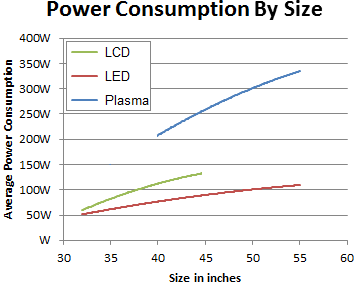
I connected a simple energy meter to my old (inherited with a house purchase so don't know exact age) 720p non-smart plasma TV to an energy meter just to get an idea of its power consumption. It was pulling between 350-400W! For comparison my 10 year old 1080p LED smart TV pulls about ~90W.
Maybe give it up, the energy savings associated with replacing it with a LCD/LED TV will quickly add up, environmentally and economically. Depends on how much TV you're watching though.
I don't understand why people think electronics are supposed to die. Even if they do, it's often just some capacitors that died in the power supply. An easy fix!
this is about justification. The current thing works fine but I would like the new expensive thing. I cannot justify expense of replacing working thing, but if it would die, then it's justified expense.
it isn't about that it's more economical purchase when it dies, but I even saw people breaking stuff just so they "had to" buy new thing that they want.
Perhaps you’ve noticed this already but having bought my last TV in 2008 I had no idea how cheap they’ve gotten! Checking Amazon right now I see a 50” 4k Samsung for $450.
Expense doesn’t always mean purely financial. There is an environmental cost to buying something new as well, and a social cost in supporting the manufacture of electronics that may have less than perfect supply chain ethical standards.
I’m not saying this to be snarky or judgemental - your comment genuinely made me think about the issue and this was my response.
Back in the day, there was a strong public perception/rumor that plasma screens would fail much sooner than other kinds. Maybe it was just a FUD campaign, after all.
Plasma did have an issue with 'burn in' on static images. If you did a lot of gaming on them, you could see it. Same with banners on news programming.
If you watch a lot of movies, it isn't an issue. Plus, the TVs came with a 'burn in' reduction program that you could run a couple times a year, but that operated by sweeping an intense white bar across the screen, so you were effectively 'wearing' the pixels down to a similar level to reduce the obvious burn in. If you ran that cycle to often, it would kill the maximum brightness.
wouldn't LCD be downgrade? i never owned plasma tv, but AFAIK biggest advantage are perfect blacks, so I guess OLED should be more natural upgrade path?
OLEDs have very good blacks, but as soon as a pixel needs to emit any light at all, it will be significantly brighter than what a regular IPS pixel can emit at it's lowest brightness.
Also depends on the TV you upgrade to: replacing a 50" plasma with an 84" LCD will do nothing to decrease your energy usage.
While plasma uses a bit more energy than LCD it's not that big of a deal (especially if you've got one of the last gen plasma panels) if you don't use it as some sort of moving wallpaper but just turn it off when not in use.
Depends on the generation. I've got one of the last plasma's made (2013 model), it's a 42 inch panel and has a max consumption of 180W (only when at full brightness viewing a white screen).
I highly doubt AI is being used here to match up the Open Camera footage with the instagram pic. Identifing humans as an object within a frame is trivial. Identifying individuals requires a considerable amount of custom training which is more than what is available from an instagram pic and a few video frames. I'm not saying it can't be done, it's just not that easy. I'd bet $100 bucks that most, if not all, of these matches were accomplished using good old stalking (matching post times to manually reviewing video data). Would be happily proven wrong but without any source code provided I stand firm with my opinion.
Have a look at pimeyes.com. A single picture is enough, often even with sunglasses. Though that site requires input photos of slightly better quality than what you would be able to get from surveillance webcams. Then again, try it often enough, and use AI enhancement/upscale, and perhaps you can just use the site to replicate the project.
I suspect it's likely that there's a fair amount of effort involved, but I don't think you'd have to work too hard to substantially narrow your search with machine learning. Even just a small classifier that outputs clothing color and timestamps would make a remarkable difference. Identifying humans (which you can see in the videos) and checking how long they linger for could inform potential candidates for folks getting their photo taken.
You can fully modify styles in mermaid using CSS and style attributes. You can also load it as a JS library, attach events to chart components, programmatically render charts plus way more.
Bitcoin / Blockchain doesn't have any intrinsic value other than to those who believe in it. Self driving cars (Level 4-5) are not available to the public and is still in development. This stuff is real, produces some incredible results, available to the public and advancing at a rapid rate.
The output of these models seems really impressive, but for my money the notion that it has value is undermined by the way its trainers keep "proprietary" data that is likely to be in violation of image usage rights at a large scale. What is the true value of something that can only be had at the other end of misbegotten extraction/exploitation? It seems like a similar trade-off to the one that web3 proponents are asking us to make. The apparent end-game is that we'll kill off all the true value creators - the working artists responsible for the source data - and all we'll be left with is an artifact of their works.
I think it also depends on the accent you read this in. The Australian accent makes this very difficult to decipher. The audio sounds much closer to the original.
I've been hosting one of my larger sites (multiple frontend, backend and load balancers) on DO for years. This is the first major outage I can recall, and it only lasted 10 minutes. I've had more downtime on AWS.
Well I guess it would vary depending on the criticality of your services but I've always been skeptical of running production workloads based on a number of reviews I have read in the past. For testing and development they have been great for the price.