I reported a similar case of mine several days ago [0]. I was able to achieve better quality than Claude Code's 624 lines of spaghetti code in 334 lines of well-designed code. In a previous case, I rewrote ~400-line LLM generated code in 130 lines.
This better reflects what I thought about the other day. You either, let clankers do its thing and then bake in your implementation on top, you think it through and make them do it, but at the end of the day you've still gotta THINK of the optimal solution and state of the code at which point, do clankers do anything asides from saving you a bunch of keypresses, and maybe catching a couple of bugs?
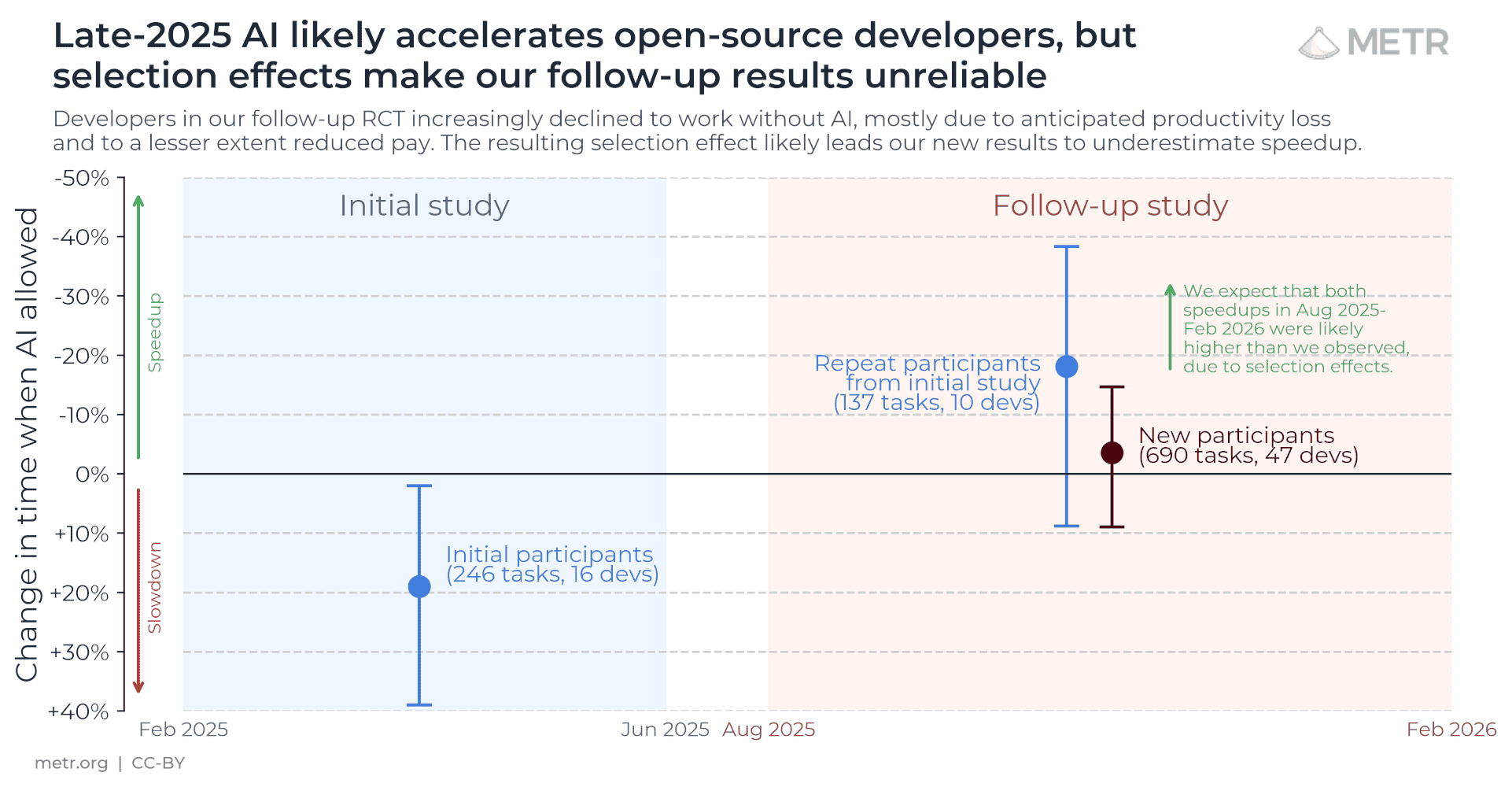
That update blog is funny. The only data they can get at reports slowdowns, but they struggle to believe it because developers self-report amazing speedups.
You'd get the same sort of results if you were studying the benefits of substance abuse.
"It is difficult to study the downsides of opiates because none of our participants were willing to go a day without opiates. For this reason, opiates must be really good and we're just missing something."
My bad, I messed up by being lazy while switching from decreases in time taken (that they report) to increased in throughput. (Yes, it's not just flipping the sign, but as I said, I was being lazy!) The broad point still holds, their initial findings have been reversed, and they expect selection effects masked a higher speedup.
I did my own experiment with Claude Code vs Cursor tab completion. The task was to convert an Excel file to a structured format. Nothing fancy at all.
Claude Code took 4 hours, with multiple prompts. At the end, it started to break the previous fixes in favor of new features. The code was spaghetti. There was no way I could fix it myself or steer Claude Code into fixing it the right way. Either it was a dead-end or a dice roll with every prompt.
Then I implemented my own version with Cursor tab completion. It took the same amount of time, 4 hours. The code had a clear object-oriented architecture, with a structure for evolution. Adding a new feature didn't require any prompts at all.
As a result, Claude Code was worse in terms of productivity: the same amount of time, worse quality output, no possibility of (or at best very high cost of) code evolution.
Are you able to share your prompts to Claude Code? I assume not, they are probably not saved - but this genuinely surprised me, it seems like exactly the type of task an LLM would excel at (no pun intended!). What model were you using OOI?
The exact same prompt ? Everything depends on the prompt and it’s different tools. These days the quality and what’s build around the prompt matters as much as the code. We can’t feed generic query.
Imagine you are stranded in your home with all your loved ones, and you get a call from your "warmonger" president and the matter is urgent; he says "We have received intel regarding a enemy plan to bomb your house in 30 mins. This report is only x% reliable, but we have the exact location of the enemy and we have birds in air that can hit them in 5 mins. This might escalate into a larger conflict, Do you want us to proceed? "
What would your response be? What is the value of `x` at which you will approve of the pre-emptive attack?
What is your percentage to say no lets do not take actions. Because again; with this perspective every single action is legitimate. There is a chance for everything. If there is a weapon that can kill every human on the planet, every country will race to invent it because every country will try to invent it. Every action is valid. Every weapon development is okey, because if you dont, others will. You can kill everyone, because everyone might eventually try to kill you, there is always a chance.
We both know that it is not true. Because by this logic, you wouldn't fire a weapon at someone who is about to stab your wife or child. Because there is a small chance that they will die of a heart attack before they can do it. So it is some value that is < 100%, but apparently that is not good enough for you.
You did not accept my answer and did not answer to mine as well.
On top of that, while you are pulling some hypothetical scenarios, the reality is exactly as I described. Governments, especially us gov, kept invading, bombing and killing people based on some subjective percentages and this is still ongoing.
Although you did not like my ‘prefer to die instead of kill’ idea, you still did not solve ‘you can kill everyone since there is a chance anyone can kill you’ problem. And reality is closer to latter, unfortunately.
>What does objectivity have to do with the value of x?
It does not have anything to do with objectivity. I thought it to be futile to discuss that since, as you implied, predicting future can't be 100% objective, and thus decisions to avert a bad future outcome always need to be based on subjective decisions.
So this is another question where I want to ask you how you would make a subjective call.
I wouldn't expect customers to say what they really want. They are looking for faster horses after all. But law professors? Among all professors, law professors should be the ones saying what they really want.
I've lowered my expectations over the years, but there's this single stupidity that drives me crazy: When you search for a keyword and play a song from the results, playback continues with the rest of the search results. Why the hell would I want to play all of the songs with similar names? iOS Music, on the other hand, does the expected and creates a station from the first played search result.
GP commenter got my attention during the last few days. Judging by their claims of productivity, they should have been a billionaire already. I'm curious to know their motivation behind making such outrageous claims.
I’ve seen their outrageous comments so often I wonder if it’s Sam Altman’s alt account. Probably the biggest AI snake oil merchant on the forum these days, with a sadistic pleasure at seeing people losing their job to AI.
Providing a negative reference is totally different than gathering negative references and selling them. The former could be legal while the latter could be illegal.
in my comment, i was speaking more generally than i should have, and that (obviously, in hindsight) caused some confusion between the specific case of the hypothetical company, and the general case of an employer providing a negative reference. my bad -- and it is too late to edit to provide clarification.
No problem, I wasn't very clear either! I remember someone I know looking into this in the early 2000s as part of a wider collective thing. It's long enough ago that I can't remember the details but it was definitely less about a poor reference and more about the individuals' being on a list somewhere without having even applied for a job. And come to think of it, it's probably even more illegal now because of GDPR.


[0] https://news.ycombinator.com/item?id=47272913
reply