Which means that they don't need to do broad sweeps of people to find the terrorists, they can use their algorithms on people who are already suspected, via some other means, of being a terrorist, and crucially, they can get a warrant to do so.
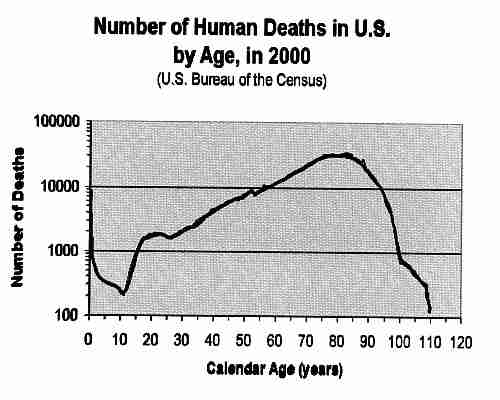
There's one thing missing from your analysis: the life expectancies calculated this way include all deaths; someone who is 58 has managed to avoid some pretty dangerous parts of life, for example:
1. They did not die during their first year of birth. About 6 babies in 1000 die during the first year of birth in the US.
2. They did not die as a youth from depression or driving their car into a tree.
If we attempt to look into the future, I think we see that computers are likely to permeate every aspect of our culture. If they continue to decrease in size as they have been doing, they may actually end up being embedded in much of the stuff we use.
We should also notice that programming itself has a huge gradient in terms of difficulty. Things like Scratch, and other block programming languages make the act of programming easier, where amateur developers can focus more time on trying to solve the problems they are working on, and less time figuring out which parenthesis they missed.
So we have two trends - that programming is becoming easier to do, and that computers are becoming more common. Both of these lead me to the conclusion that not being able to program will eventually be akin to being illiterate. You won't be able to use and modify many of the tools of the future without some programming skill.
Further, many people are developing some of the core programming skills in pieces. Look at http://ifttt.com/ for example. This is an example of using apps as procedure calls, and writing very short subroutines to handle tasks for you. It is a perfect example of how programming is beginning to permeate popular culture.
Soon, telling people not to learn how to program will be much like telling people not to write or not to do math - it will be a bit ridiculous. We will just need to be able to use better systems for keeping track of who is an amateur, and who is a professional, much like we do with writing and mathematics.
I wrote an online attendance system for my school, which often come with way more features than we need and cost in the range of $50k. It's not $2 million, but $50k is a teacher's salary. In education, that's huge. It took me 2 weeks to set up, and another 4 weeks of testing with teachers to iron out all of the bugs, but now it is used every day by all of our teachers.
I've also used my ability to code to develop learning apps for my students. It's been incredibly valuable in my career.
Mathematical notation has been chosen, or developed over time, because it is highly efficient at communicating a huge amount of information in a short amount of space. It is almost as if the natural tendency of mathematical notation is to act a as a space-saving algorithm; the information content to notation ratio in mathematics is extremely high.
Most attempts to communicate this notation to computers has been difficult at best, with MathML being much too complex for humans to actually write, and LaTeX often requiring much looking up of the various short cuts that been developed, particularly for beginners.
Here's an example of some LaTeX to produce a mathematical diagram.
It would be nice if when teachers gave them feedback, they'd act on it. Unfortunately, it seems that any criticism of the Khan Academy is seen as an attack on the whole of the Silicon Valley, and every geek comes out to lead the charge against the educators suggesting that they have entirely the wrong approach.
Instead of viewing mathematics as a series of problems to be solved, each of which has a solution, maybe it would be neat of the Khan Academy actually spoke to some educators (and then publicly announced the results of this consultation)?
What would you suggest calling running pilot studies at schools (both affluent and lower-income), like Khan Academy has done with schools in Los Altos and Oakland (http://educationnext.org/can-khan-move-the-bell-curve-to-the...), and getting feedback and suggestions from the teachers who are implementing the pilot programs? Of course they could they do even more (although who of us really knows who they've spoken to and how much/what about), but it's a bit unfair to suggest that they haven't been working with educators.
The lessons they're learning from the massive amounts data they've been collecting from real students (ones outside the pilot programs, who are using their material in an uncontrolled, natural manner) also shouldn't be discounted, and I would argue that it might be as useful as talking to educators can be. It's definitely a Silicon Valley thing to put data up on a pedestal, but should it be valued any less than education research that can be hard to generalize from due to problems with experimental design (like giving extensive training to teachers in the experimental conditions when it's unlikely that most teachers who'll have to implement the same experimental curriculum will have the same sort of training/enthusiasm) or anecdotal evidence from teachers working with one or two classes?
Are you talking about the feedback in this article? Its sort of hard to act on "Using computers to teach math is just stupid".
As to why many people might want to defend Khan Academy, well, its because I think I would have been much happier with Khan Academy than the math education I actually had, and I would very much like it to be available to children like myself. I was bored stiff in math class in middle and high school, and being able to work at my own base, not bound by the slowest person in the class, would have been amazing.