Everyone talks about Websockets for pushing real time data to the browser. This article highlights some of its drawbacks. I use Server Sent Events (SSE) instead. A lot of the problems the author of the article faced are solved with SSE. Also, SSE scales way better than polling all the time.
I wish anycast was easier to use without owning your own set of ips. I've done something similar to the author, and ended up also relying on another provider for geo dns.
If I could have my own anycast ip to share on all my servers, that'd be really cool.
I didn't see anything in the article about battery capacity or the density. This (with the other info in the article) would tell us if this is groundbreaking or not.
It is not true that Ollama doesn't use llama.cpp anymore. They built their own library, which is the default, but also really far from being feature complete. If a model is not supported by their library, they fall back to llama.cpp. For example, there is a group of people trying to get the new IBM models working with Ollama [1]. Their quick/short term solution is to bump the version of llama.cpp included with Ollama to a newer version that has support. And then at a later time, add support in Ollama's library.
Not always true! Your statement is only true when the running clock's speed is the same as time. Thus, regular time and the clock's time will never meet.
If the clock is running faster than regular time, it will at point catch up to regular time and thus be correct for a split second. If the clock is slower than regular time, regular time will catch up to the clock and the clock will be right for a split second.
If we are being pedantic, running clocks never run exactly the same as time. So they'll be right (very) much more seldom than the stopped clock, which is right twice a day.
If the clock is running backwards at very high speed, it would be right infinitely many times but the proportion of the time that it is right would approach some finite constant.
Please share this information in a non Google, non Microsoft format. Perhaps make it a plain HTML page or PDF and link it directly from your primary website.
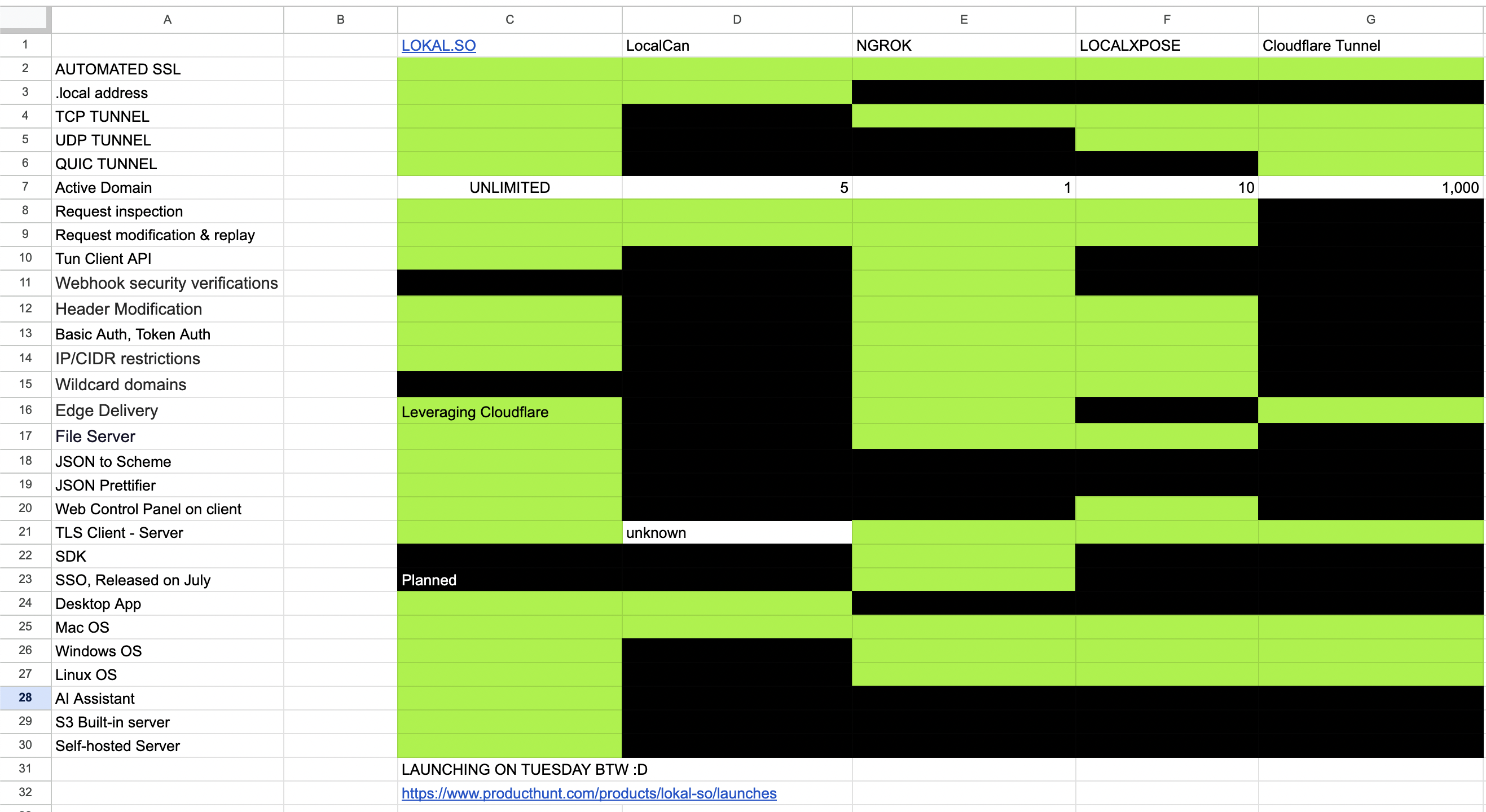
Having a .local suffix doesn't really seem like a feature.
Also, I still don't see why this is better than ngrok. If anything, I'd turn it down because there's functionality (an AI assistant) that I don't want.