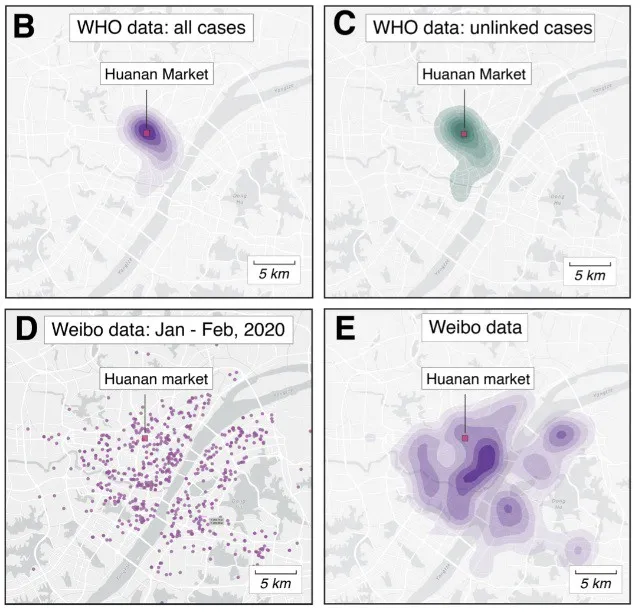
I sort of lost faith in the article's willingness to take lab leak seriously when they threw this map up[0] and inexplicably did not label where the Wuhan Institute of Virology is on it. For reference[1].
It's not at all far-fetched to think the virus piggybacked 10 miles before finding a nice home for itself at a wet market, after which it went gangbusters and infected lots of people. Obviously the virus proliferated in the market, but that doesn't necessarily make the market the origin. The two bottom 'Weibo data' maps from the first link show clusters on both sides of the rivers and also very close to the lab.
That's just the most obvious bit of bias, but I'm confident that article isn't being as fair-handed as it's pretending to be.
You do realize that your two points are in direct contradiction?
You're mad at the author for not pointing out the WIV (Which had 0 confirmed cases anywhere near it until much later in the pandemic which is what the two bottom charts are referring to) but then you also grant that it looks like the market was the center of spread?
In any case, they directly address this;
> Importantly, even pneumonia cases that had no association whatsoever with the market (no work, travel, visits, or contacts there) still centered around the Huanan market and could not have been subject to ascertainment bias. The market was the only place in Wuhan where early cases had a clear association. There are no other epidemiological links to any other place in the city, other clusters only started forming later in Jan-Feb (Weibo data, shown above) and became more representative of the city’s population density.
> It is worth mentioning here that the Wuhan Institute of Virology (the alleged ‘escape’ laboratory working on CoVs, not shown in map) is located on the other side of the Yangtze River, South West of the Dong Hu lake, more than 16km away from the Huanan market, and no sickness clusters of cases were shown anywhere close in December 2019.
As for:
> It's not at all far-fetched to think the virus piggybacked 10 miles before finding a nice home for itself at a wet market, after which it went gangbusters and infected lots of people.
You still need to explain how there are two distinct lineages at the market among the first cases!
Picking and choosing one data point to be skeptical of is useless, the totality of the evidence needs to be weighed.
> You're mad at the author for not pointing out the WIV
Yes, an article comparing two possible originating locations should obviously show both on that graphic (especially when both places are well-within the frame of the image); I can't see any good reason for the author to have omitted that.
> but then you also grant that it looks like the market was the center of spread
Yes. And that's not contradictory to the lab leak idea, because people aren't trees and they go places after work. I think it's entirely reasonable to hypothesize that the virus escaped from the lab on a person and ended up successfully taking root in a less-than-sanitary wet market just across the river. If two-headed turtles started showing up at a Popeye's 20 minutes away from the Turtle Experiment Laboratory, would you say that Popeye's was the source of the two-headed turtles?
> You still need to explain how there are two distinct lineages at the market among the first cases!
Again, there's no reason both theories can't be true here. The caged, dirty animals definitely seemed to be the virus' first stronghold, but that doesn't mean that the new bat virus couldn't have come from the New Bat Virus Laboratory 20 minutes away from the wet market.
> Picking and choosing one data point to be skeptical of is useless, the totality of the evidence needs to be weighed.
My point is that it made the bias of the author nakedly apparent. It's an pro-wet-market argument piece, not an objective look.
There are two key problems with this analysis. The first is that the data to which we have access has been subject to gatekeeping by the Chinese authorities. (Is this a conspiracy theory? Yes, very much so, and rationally so given the way the PRC operates.) The second is that workers at the WIV aren't going to leave work and then hang around on the street outside, infecting passers-by in the immediate vicinity, causing a cluster that radiates around the WIV itself. They're going to get on transit and head home, mainly westwards.
> You still need to explain how there are two distinct lineages at the market among the first cases!
Actually, YOU do. You need to explain how a virus made two separate rare hops to humans in the same place, at the same time, in two different forms. This is possible, but statistically unlikely. The (vastly) more likely hypothesis is that it made only a single cross-species hop, which then spread and mutated later.
That's the Wuhan CDC. It's across the street from the market and has a virus lab. Google Maps will not show you the correct location but you can put the address (湖北省武汉市江汉区马场路288号) and it's close enough. Or use Baidu Ditu and find it's right in the middle of the clusters in your first link, ~300m south of the market.
No, there's a lab in there. This was the lab originally called out by Chinese whistleblowers.
Also you have the wrong address, put in the Chinese name on Baidu and you'll find it's in walking distance to the market. Like literally just across the street.
Yeah. Also their real names and them being immature and getting angry also went out to 400k people and is now effectively part of history. That's probably even worse than being the kid who did this, what if a future employer comes across this?
It won't be consistent though. No one would ever call investing in broad market indexes "StableGains" or something like that. I probably should have left EM debt off the list.
You're forgetting the 6 trillion-dollar "IOU, I'm good for it, pinky swear" from Deadbeat Dave. I'm assuming that's what their commercial paper holdings resemble.
> TerraUSD (UST) is pegged to the price of a dollar and is secured by Terra (LUNA). LUNA is an asset reserve that ensures the stability and security of the UST through the seigniorage process (income received from an emission of money).
Sounds like the peg was more-or-less a perpetual motion device that relied on a strong wind
The mechanism by which they turned garbage mortgages into AAA was 1) tranching, ie having junior and senior tranches, and 2) the assumption of low correlation (not all borrowers will run into trouble simultaneously).
Arguably, here we have something equivalent to the assumption of low correlation: if a few people here or there dump UST, you can indeed maintain the peg by issuing LUNA against it. But if many people simultaneously do it, then the whole edifice collapses.
> they turned garbage mortgages into AAA was 1) tranching, ie having junior and senior tranches, and 2) the assumption of low correlation (not all borrowers will run into trouble simultaneously)
Even the junior tranches eventually paid. They just weren’t liquid like other AAA assets (namely, Treasuries) in a crisis. The ratings described the tranches mostly accurately in terms of payout probabilities. Not in terms of liquidity.
The correlation assumption is common to these two. But…
> we have something equivalent to the assumption of low correlation: if a few people here or there dump UST, you can indeed maintain the peg by issuing LUNA against it
LUNA and UST were simultaneously issued by the same system. They are fundamentally correlated in a way even American mortgages are not. If the bandwidth of arbitrageurs is broken, the peg fundamentally fails. While one mortgage not paying increases the risk of another not paying, it doesn’t directly cause it in the way we see here.
Also, holders of junk mortgages still got a deed of real property against their loan. What will most Terra/Luna holders get?
> They just weren’t liquid like other AAA assets (namely, Treasuries) in a crisis.
Yes. I think that a big contributor to the crisis was that everyone knew that there was some loss on under-water-real-estate, but due to the complicated nature of the traded products nobody knew where those losses would manifest, and thus trust collapsed across the board.
What caused the 2008 crash was nothing to do with loose monetary policy. If you recall, that began in earnest after, and in response to, the crash.
It was loose regulatory policy. In no small part that Clinton rolled back Glass-Steagall in 1999. [1] Toxic mortgage-backed CDOs didn't have to become a systemic risk in the first place. There were a lot of contributing factors, but low interest rates weren't really top 10.
> Toxic mortgage-backed CDOs didn't have to become a systemic risk in the first place.
The problem had nothing to do with CDOs. No matter how you slice and dice risk, you never increase/decrease it. Someone would have owned the underlying MBS.
The issue was that the Blue Dog Democrats in the 90s decided with Alan Greenspan that homeownership should be incentivized. This created a housing bubble which ultimately is what caused the GFC.
Loose banking policy, and not just in the US - Anglo-Irish and Kaupthing were major contributors, and RBS destroyed themselves and had to be rescued by the government. If I remember rightly it was an old fashioned physical bank run on Northern Bank which triggered the UK side of the collapse.
> The right of the people to keep and bear arms shall not be infringed; a well armed and well regulated militia being the best security of a free country: but no person religiously scrupulous of bearing arms shall be compelled to render military service in person.
Then, the next time it appeared, it was reworded as
> A well regulated militia, composed of the body of the people, being the best security of a free State, the right of the people to keep and bear arms shall not be infringed; but no person religiously scrupulous shall be compelled to bear arms.
Before being whittled down to nix religious exemption and leave ambiguous who runs the militia
> A well regulated militia, being necessary to the security of a free State, the right of the People to keep and bear arms, shall not be infringed.
Judging from the Congressional record nobody focused on the fact that the militia clause got flipped between meetings, so take from that what you will.
> It also seems clear to me that "well-regulated" is not there to be any part of the point of the Second Amendment.
That's how I read it as well. In fact, I consider the whole first part of 2A ("A well regulated Militia, being necessary to the security of a free State,") as more of a quick justification that has no legal bearing on the actual right that follows ("the right of the people to keep and bear Arms, shall not be infringed.")
So, essentially, "A well regulated Militia being necessary to the security of a free State [begets that] the right of the people to keep and bear Arms shall not be infringed."