> Imagine a taxi driver facing his family knowing he will be replaced by a machine fully; imagine that taxi driver thinking that there are slick graduates from top schools who wake up everyday (waymo, tesla, zoox) with one goal in mind - let's automate this taxi driver.
Back when self-driving cars still seemed imminent and Musk hadn't started losing his teflon coating, I asked an actual taxi driver his thoughts about self-driving.
He was looking forward to it.
This surprised me, until I found LLMs were automating coding and found I felt not too different about my own career.
Presumably your POV depends on whether you believe the capability of AI will somehow stop at coding, so you'll still have your job with a cool new tool, or whether AI will replace your job altogether, in which case perhaps you are planning a career pivot to taxi driver?
Weird thing I've encountered. I've seen all the stuff you say, but not all at the same time.
The stuff I'm getting from ChatGPT this week has been absolutely garbage. Back in the very early days you might prompt 5 times and see if it was consistent with itself in the conclusion, even if not how it got there; this week it's not even been that. But back in those days the UI was also fast, today it lags massively on relatively short chat sessions.
Ugly, dubious, incorrect, it definitely feels like a regression. And its love of emoji hasn't gone away.
Claude no longer works for me on Safari, only Chrome. No lag at least, but the free message allowance has shrunk a lot.
I'm not too fussed about messy code, given the humans I've worked with, but that's about it.
Even the ChatGPT image model is… for all the improvements in the model itself, the UX isn't good enough to make up for what the model still can't do. In many cases I actively prefer running Stable Diffusion locally because that's easier to fix the last 5% than having to deal with a completely different 5% wrong each time.
But yeah, correction very possible. Was thinking so just on the basis of the % of US electrical power being called for: that can't possibly be sustainable for the broader economy.
> Can our sci-fi writers come up with something equivalent that is as dizzyingly far from what we know now, as now is from what Aristocreon knew?
Sure they can, but as one of them once opined: any sufficiently advanced technology is indistinguishable from magic.
What we cannot do, is guess which things so different from our world are, and are not, magic. Are the probabilities in quantum mechanics themselves quantised?
Is there an island of stability for fundamental particles, as distantly related to the gap between the electron and tau as silicon wafers are to the gap between titanium dioxide sand and silicon dioxide sand, such that we could use them to create conducting plates fine enough, that they could be placed close enough together, that by the Casimir effect we could construct a macroscopic object with overall negative mass?
Will we ever have a engineering-quality definition of consciousness, or be limited to the kind of pre-paradigmatic thinking that had Diogenes presenting a plucked chicken in response to Plato defining man as a "featherless biped"?
Will we destroy the earth in a way that preserves all the information, and find our minds resurrected a million years hence by strange alien beings?
"X will decimate your privacy" [please accept the following tracking cookies, including for 3rd party ad analytics from a company whose CEO has called its users "dumb fucks" for trusting him with their data]
Don't get me wrong, just because it's a hypocritical headline doesn't mean it's incorrect. Just still rankles to see it, is all.
> The problem is .. what flows don't need determinism? Search results / recommendation engine / ad targeting ?
That's not the relevant question, because the actual answer to what you asked is "all flows where human judgement is used".
The thing we need to not blindly use current generation AI for is "things where we accept the combination of an untrained (or barely trained) human with no QA".
IMO, the drive to use AI is not only fully automating a lot of things that shouldn't be so, but also revealing how some of them never should have been in the first place. If your human customer support agent makes stuff up and that got your business a penalty fine, you might discipline or fire them; not so easy when it's an AI that replaced a whole call centre in one go, even when the incident frequency is the same.
slightly related .. I saw a talk on DCs in space, and it said median Earth orbit had a latency of 500ms .. but back of envelope seems to be : 15,000km above Earth would have around 100ms latency, comparable to internet ping times.
I'm still working on the blog, but as a quickie: it's the lesson of the Datasaurus dozen, that sometimes you need to look at the actual distribution rather than statistics.
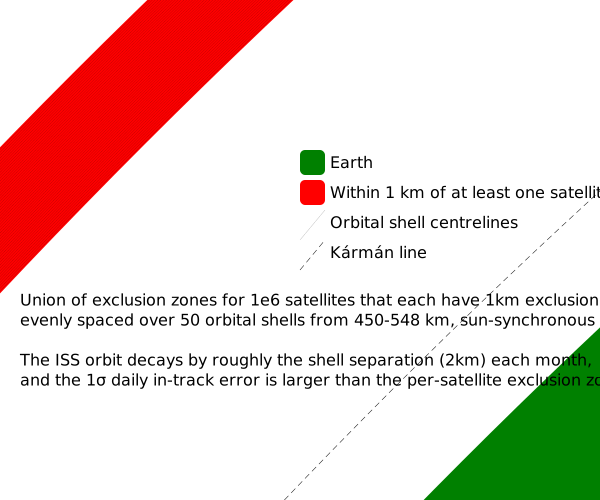
There's no (safe) gaps. Plenty of physical space, but the safety margin eats it all up. Nothing else is allowed to use those orbital shells or anything between them.
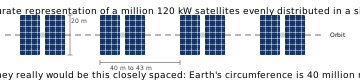
Also, this is what happens if you put them all in a single orbit at the same altitude:
> slightly related .. I saw a talk on DCs in space, and it said median Earth orbit had a latency of 500ms .. but back of envelope seems to be : 15,000km above Earth would have around 100ms latency, comparable to internet ping times.
500ms means ~150,000 km travel distance; for that distance as round-trip time from origin to destination and back again means the one-way distance is 75,000 km, so if it's via a single satellite bounce then the average distance to the satellite would be 37,500 km: [You]-37.5Mm-[Satellite]-37.5Mm-[Them]-37.5Mm-[Satellite]-37.5Mm-[You].
I think they must be assuming all comms are via geostationary satellites. In some talks, this is what the speaker actually meant, though they may not have been clear about it; other times, there's talks from people who copied the former but perhaps didn't understand.
For DCs in space, even in GEO, it would be half the distance because you're communicating with the satellite itself not with someone else somewhere else on the ground.
People already talk about that, so I wouldn't be adding much new. That said, had already put in a bit about cost of launching.
TL;DR: Alphabet researchers (and Alphabet owns more of SpaceX than the entire IPO so if anything they're biased to optimism), recon it will take SpaceX launching about 370,000 tons to orbit before they've even figured out how to get the costs down to the point it makes sense to put these in orbit.
I'm currently writing a blog post about data centres in orbit, and my current conclusion is that even though they can build one, they definitely can't put 1 million up there and would have better things to do if they could.
AGI? Too loosely defined. They lack a lot of competences which humans recognise when we see them but find it hard to put into words; on the other hand what they can do they already do faster than any human (and have greater breadth than any single human, but this usually doesn't matter because "coder" and "economist" and "translator" gets solved in human teams by hiring three people).
I do not think current ML has the tools to solve for quality. But we know it's possible for a really mediocre intelligence to make human level intelligence, because evolution made us, so for me the question of AGI is more a practical one: is it affordable?
(I also think not at the present time, but that's an "I think" not "I am analyzing it carefully").
Maybe you missed the part where starlink / orbiting datacenters don't really have to even make money as long as they partially fund rocket launch tests.
Or maybe you don't take Elon seriously when he talks about Mars.
> Maybe you missed the part where starlink / orbiting datacenters don't really have to even make money as long as they partially fund rocket launch tests.
I am only dismissing the orbital data centres, I do see a future for Starlink. One with competition, but a future nonetheless.
I'm old enough to remember the dot.com bubble and "we lose money on each unit and make up for it in scale":
If they don't make sense, they don't help. Putting a single one in space, or even a handful, is physically possible! But even optimistic Alphabet researchers (and Alphabet owns more of SpaceX than the entire IPO) say this only makes sense at $200/kg, while early Starship launch costs while they sort out reusability be at best $400/kg and the researchers don't expect $200/kg until the mid-2030s even with a high launch rate:
If the learning rate is sustained—which would require∼180 Starship launches/year—launch prices could fall to <$200/kg by∼2035
At $200/kg, and using the payload estimates elsewhere in the paper (the learning rate is based on mass rather than launch count), they'd need to launch 370,000 tons (4.4 ibid); even at the "good enough" cost, $200/kg, they'd need to spend $200/kg * 3.7e8 kg = $7.4e10. That's a hell of an R&D spend for the next 10 years of a company whose lifetime revenue (not profit) is reportedly $4.6e10.
My current draft has a few thousand words of additional problems, plus a bunch of things which I mention only to say why they are not, and some more where I say the research has yet to be done.
> Or maybe you don't take Elon seriously when he talks about Mars.
Used to, not any more. Has been too slow with Starship even before the fact that iteration with hardware is necessarily slowed down by a 2-year gap between launch windows.
There's not even been any news about demonstration models of either Mars-rated or Starship-rated Sabatier processors, which would be an easy win and also win points for both environmentalism and energy independence viz. Iran/Hormuz.
On the contrary: I've paid a lot of attention, causing me to look at it closely and determine it is a terrible idea worthy of an illustrated 5,000 word blog post explaining exactly how terrible.
If you build the DC satellites as currently specified, you're strictly better off not launching them. That's how bad the idea is.
> Serious question: do you think the NSA aren't training their own LLMs?
Given the evergreen discussion of "are these companies making a profit"*, I think any LLMs that the NSA (or any other government agency worldwide) may be making are quite far from the leading edge.
* Person A: "they are making a loss!" Person B: "Only if you count training, they make a profit on inference, look at what it costs to run comparable open models on generic cloud servers" A: "Sure, but if they don't train new models they'll be left behind, so they're still making a loss"
That and the way compute is now measured in GW, I think even random low budget vloggers just getting started would be able to spot if the NSA was doing anything significant just from the extra heat emissions or power plants getting built.
The rate of inference compute to training compute is ~10:1, for popular frontier models. Models are routinely overtrained past the Chinchilla optimum now because it makes an immense amount of economic sense to do so.
Worse the more niche and unused your models get, but when this "making a loss" fuckery pops up, it's usually about the big guys like Anthropic, OpenAI, GDM and maybe xAI and Meta. Of which only the latter can be accused of not selling enough inference to offset the training runs.
The real money sinks are: R&D and infrastructure buildouts.


The one LessWrong-adjacents have been warning about for a decade or two before this was possible:
Instrumental convergence.
reply