Because what matters is _Capital_ requirements, which differ by the _risk_ of the loan. A bank's Capital is what limits their ability to lend. Reserve requirements are irrelevant in the modern banking system.
You can give any amount to your kids tax free ... if this is within 7 years of your death then Inheritance tax applies to amounts given over 3k per year (on a sliding scale). So works fine if you want to give away large amounts of assets long enough before you die.
If you want to give away property, then you have to make sure you don't continue living in the property rent-free for it to count for IHT.
As others have mentioned, serious estates just use trusts etc. instead.
> what concretely happened: a poaching of a key employee
Not quite the reason for the fine according to TFA:
> Instead, it ruled that Luckey, who was working as a contractor for Zenimax before starting the Kickstarter for the Oculus Rift headset, violated his non-disclosure agreement,
In my personal opinion, whether or not Luckey violated the NDA is a little academic. Clearly, the $3 billion acquisition occurred on the reputation of John Carmack, who was poached.
I don't think you should charge $500 million for a poaching. That's the crux of my anticompetitiveness argument.
Nonetheless, you definitely shouldn't charge $500 million for merely violating an NDA, even if that's what the jury found.
Offtopic but, why do people feel it's alright to refer to the article as The Fucking Article and on some other stuff they get all mad because someone used a curse word? The HN crowd is bipolar...
Thank you all for the downvotes for asking a serious question that was really bugging me. I even bet the ones who downvoted didn't even took the time to answer. Cheers!
> fulltime labor for everyone is simply not going to happen. We just don't need it.
and from the article
> there’s not enough work to go around
I disagree.
There's not enough paid employment to go around, but there is an enormous amount of work that needs to be done!
Our entire society needs to be weaned off its carbon dependence if we want humans to survive the next century. This will involve at the very least the wholesale transformation of our transport and energy systems, and probably construction too. We should be putting massive numbers of people to work on solving and fixing this, and there's no point leaving people unemployed while there's still work that needs to be done. Whether we can organise society in time to achieve this is the real question. Once we've fixed the environment and created a truly sustainable civilization, then we can talk about labor that is surplus.
Other work that will be in increasing demand is healthcare and elderly care (especially given the aging populations of most countries). I don't see robots replacing humans for this any time soon, and we are far from the point where we have enough health / personal care for everyone. Plenty more examples of work that's needed but not currently being done can be found with a bit of creative thought...
> there's no point leaving people unemployed while there's still work that needs to be done
Yes, and the government can compensate for unemployment by investing in public works, at least until the automation reaches a level where UBI needs to be implemented.
The constant supply solar of energy (and finite supply of mineral energy sources) also means that we won't be able to grow the economy indefinitely and need to find a way to transition to a system that thrives at equilibrium.
I'll leave that problem to my great-great-grandchildren. For now, I'm more concerned with pulling off the fossil-to-solar transition without breaking down in the process.
The rate of CO2 emission per GDP is already decreasing thanks to technological advances. There's no fundamental reason why the same couldn't happen to the ratio of energy use per GDP. So finite supply of resources is not a problem per se, and certainly won't be within our lifetimes, which is what we need to deal with.
You can't be more than 100% energy efficient, so, while there may be some headroom in that direction, there's a hard limit as well.
Edit: Also, while there seems to be a positive correlation between GDP per capita and energy efficiency, the most efficient nations in the world have a very low GDP per capita... I wonder why it is the case.
Yes, you can, practically speaking. The amount of energy needed to produce a given amount of value to humans is not fixed; it can be decreased, and in principle can be made as small as we like given sufficient advances in technology. That means the amount of value to humans that can be produced with a fixed amount of energy can increase, in principle as much as we like. That's what the parent to your post was saying.
Obviously it will be a while before we have technology advanced to the point where, say, the amount of value currently being produced per year on Earth can be produced with one tenth or one hundredth or less of the energy it currently takes. But we also have a while before we hit any hard limits of the sort you are referring to.
Given that the total of humanity produces all necessary food, consumables and other services today, it seems that humanity generates and requires an amount of work that seems to be in some sort of equilibrium right now. The rest is just a matter of distribution.
Humanity is divided, especially around wealth, and the new technologies will make the rich richer in the short to medium term, which will make the poor poorer especially now that they lose their jobs. How will we handle that situation?
I agree, and an extensive program like this might permit for a clean transition as even the make-work disappears; pay for public good work to doing whatever you want and sharing it with the world sounds like the ideal utopian outcome.
The $1.8 billion in consumer relief is not actually a penalty, since most of it is money that has already been lost, and is only being recognised now under the pretence of it being a penalty.
> "The consumer relief will be in the form of principal forgiveness for underwater homeowners and distressed borrowers; financing for construction, rehabilitation and preservation of affordable housing; and support for debt restructuring, foreclosure prevention and housing quality improvement programs, as well as land banks."
The principal forgiveness had to happen anyway in the normal course of business, one way or another. If underwater homeowners and distressed borrowers owe you a billion dollars, that does not mean that those mortgages and loans are worth a billion dollars in reality. At best you can realistically hope to eventually be repaid 60% of that (to pick an arbitrary number), given that these are distressed borrowers we're talking about. So writing down those assets in your books to e.g. $600 million dollars does NOT constitute a penalty or consumer relief of $400 million, since your assets were not really worth a billion to begin with and probably haven't been for years.
Same for the rest of the "relief", for example foreclosure prevention is almost always a net positive for the lender. Finding a way for the owner to stay in the house, look after it, and keep repaying whatever they can afford, will usually recoup more money for the bank than a distressed sale at auction (how foreclosed properties are usually sold).
Principal relief for homeowners who are above water and up to date with mortgage payments, now that would be an actual penalty
Don't forget that the money that the "big equity market players" invest is mostly held on behalf of members of the public, in their pension and investment funds, so the public is definitely affected.
To the extent that the public is harmed in this way, for this harm all responsibility lies on the administrators of those pension and investment funds for making an unwise purchase.
Sounds like the EU versions of US cars are currently re-engineered to meet EU standards, and that costs manufacturers money. They're trying to save that cost by saying all rules are equivalent. From the article:
> under current rules cars sold globally, such as the Ford Focus or Volkswagen Golf, must still be re-engineered multiple times - at considerable expense to manufacturers - to satisfy crash-test standards around the world
I'm totally fine with homogenizing safety standards across the world. But it has to be done by lifting the lower standards up to the higher level, not the other way around.
This concern about economic growth in 1000+ years is entirely academic. The more relevant question is whether exponential growth (at whatever rate) is feasible for the next few decades and even centuries, and to me the answer to that question is yes, just using the examples from the article. So we can build appropriate policies for the present and near-ish future. Our descendants can decide for themselves at that point whether it's reasonable to continue economic growth, based on knowledge and science and experience they have gained.
I mean, how many physical theories can be argued to work into the infinite future? Does quantum mechanics or GR hold past the end of the universe? It's not even a meaningful question. Why hold economic models to the equivalent standard, when all that is needed is whether they hold in the relevant domain?
I feel that this question and argument is often used to try to draw the conclusion that we must stop trying for economic growth NOW, because infinite growth is impossible. Maybe it is impossible, but I don't think something happening or not happening at infinity or even in a thousand years has any bearing on what we should be doing now.
From what I got out of it, they were talking about smaller timescales, on the order of a couple centuries. The 1400 years was a sort of upper limit (our planet consumes as much energy as the sun, hotter than the sun). 400 years was where the atmosphere reaches the boiling point. Those of course are the steady 2%-3% increase numbers though, and assume there's actually enough energy to reach those states, which there probably isn't.
But it's not the 1000-year timespan that's facing limits.
Looking at total energy and net heat production just hammers home that within an exceptionally short timeframe by historical measure growth of human activity on Earth must come to an end. And if you look at more complex systems models, there's strong argument that sustainable carrying capacity has been exceeded. When and by how much provides a wide range of estimates -- I've seen good arguments for from 50m to 10 billion, though lower-end estimates in the 500m - 2 billion range strike me as most plausible.
The first-order argument is to demonstrate that infite growth is impossible that's what Murphy demonstrates here.
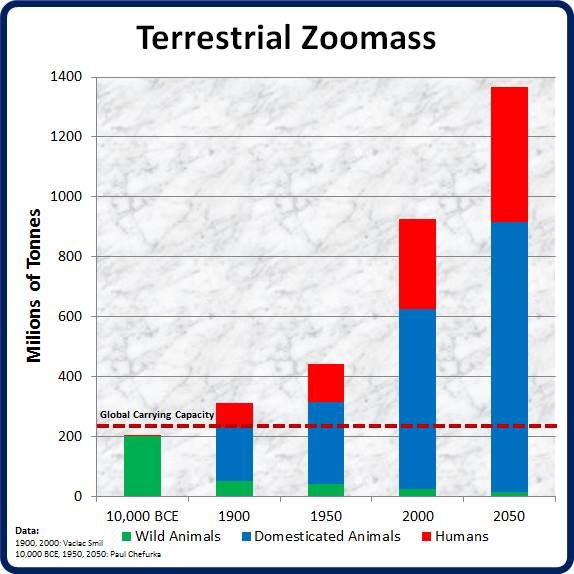
Then there's the question of assessing what actual physical resource needs do exist. Looking at total population, relative biomass of humans vs. other terrestrial vertebrates (http://i1176.photobucket.com/albums/x330/chefurka/Zoomass_zp...), land area per person, human appropriation of net primary production (a fancy term for "how much plant growth to humans consume directly or indirectly), total arable land, available critical and limiting resources (particularly freshwater, topsoil, phosphorus, copper, and of course, fossil fuels, see Leibig's Law: https://en.wikipedia.org/wiki/Leibig%27s_law), incident solar flux per person, the situation for effluent sinks (sewerage, CO₂, industrial pollution, heavy metals, radioactive waste), systemic risks (see David Korowicz, "Financial System Supply-Chain Cross-Contagion": http://www.feasta.org/wp-content/uploads/2012/06/Trade-Off1....).
On land area and solar flux per person, if you assume that the only long-term energy option is solar (meaning: solar, wind, hydroelectric, wave, and biomass, all of which derive from it, but excluding tidal, and geothermal energy, as well as nuclear), then we're looking at, with 8 billion people on the planet, less than 0.5 MW of total available recoverable solar, at present conversion rates, per person via photovoltaics. This is with blanket coverage of the planet in PV panels. Yes, that's in excess of how much energy an American ses on an ongoing basis (about 10 kW continuous), by about 45x, but that excludes conversions to other factors, including liquid, solid, or gas fuels for later or mobile consumption. It's also a total land-area usage: 3.18 million km² without storage and fuels allowances. On a large-scale engineering basis, I'd really like a far larger margin of error. In 1850 it would have been 250x, in 1AD, 20,000x.
At some point, the prospects of 1) Business as Usual, 2) "developing world" advancement to first-world standards (even EU vs. US, at about 50% of per-capita resource consumption), demographic transition, and surviving even a "modest" 8-9 billion total humans on the planet ... looks exceptionally dicey.
An exceptionally common response is wishful thinking, expressed variously as "there's no problem", techno-optimism, "they're" working on it (whoever "they" might be), etc. A significant problem with the techno-optimist viewpoint is that there's a compelling argument that technological level (complexity) is dependent on, not independent of, net energy throughput.
The more I've looked at the situation, the less credible I find any of these options. And "solving" any one issue (e.g., energy, which YC have addressed with several recent startups), still leaves multiple other challenges.
Yes, that's what they meant. Rip tides aren't usually that wide. The best thing to do if you get caught in one is to remain calm and swim perpendicular to the current.